
Online Grocery Market Size, Share, Trends, Industry Analysis Report, 2026 - 2034
REPORT DETAILS
Online Grocery Market Summary
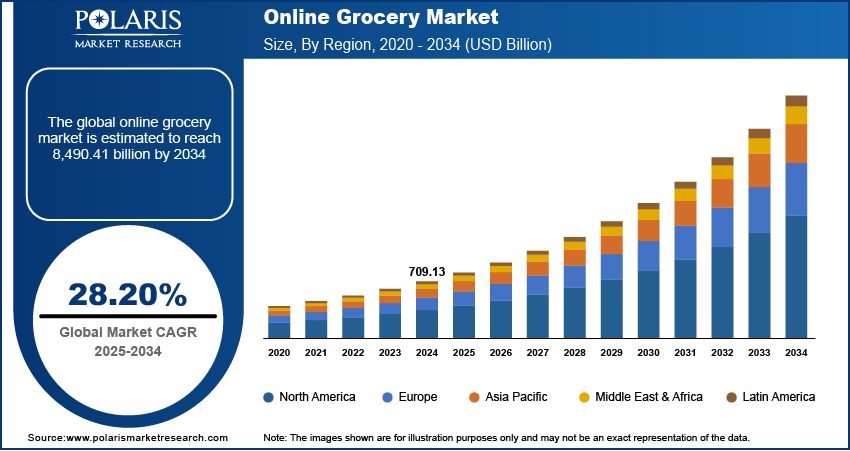
The global online grocery market size was valued at USD 906.01 billion in 2025. The market is projected to grow at a CAGR of 28.20% during 2026 to 2034. Key factors driving demand for online grocery include widespread adoption of smartphones and e-commerce platforms, and technological advancements in logistics.
Market Statistics
Key Takeaways
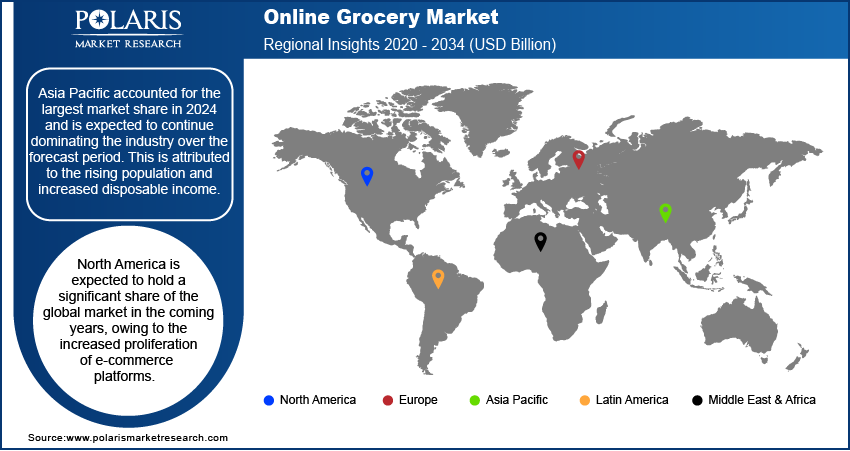
- Asia Pacific accounted for the largest market share of 58.30% in 2025 and is expected to continue dominating the industry over the forecast period. This is attributed to the rising population and increased disposable income.
- North America is expected to hold a significant share of 35.40% by 2034, owing to the increased proliferation of e-commerce platforms.
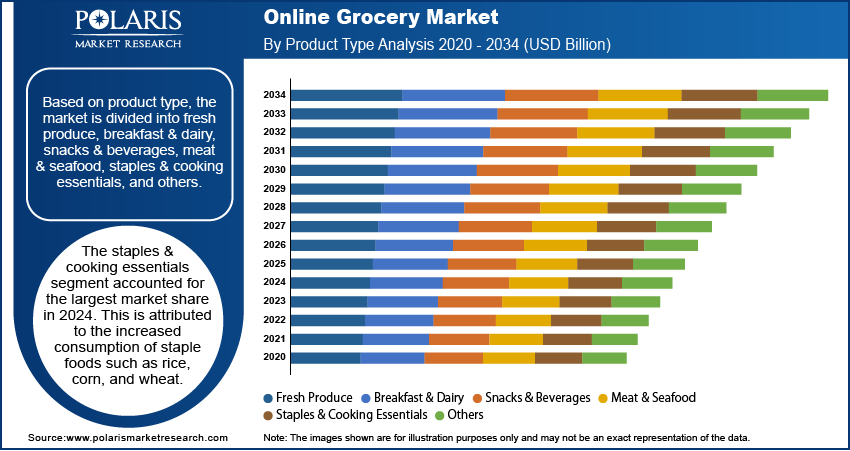
- The staples & cooking essentials segment accounted for the largest market share of 35.62% in 2025. This is attributed to the increased consumption of staple foods such as rice, corn, and wheat.
- The breakfast & dairy segment is expected to witness a 26.9% CAGR over the forecast period, owing to the increased dairy consumption in emerging economies such as India, China, and Japan.
- The fresh produce segment held a 42.78% market share in 2025. This is because fresh produce accounts for a significant part of daily or weekly groceries.
Note: Figures and projections outlined in this report are the result of Polaris Market Research’s proprietary analytical processes, grounded in the latest available datasets and market observations.
Industry Dynamics
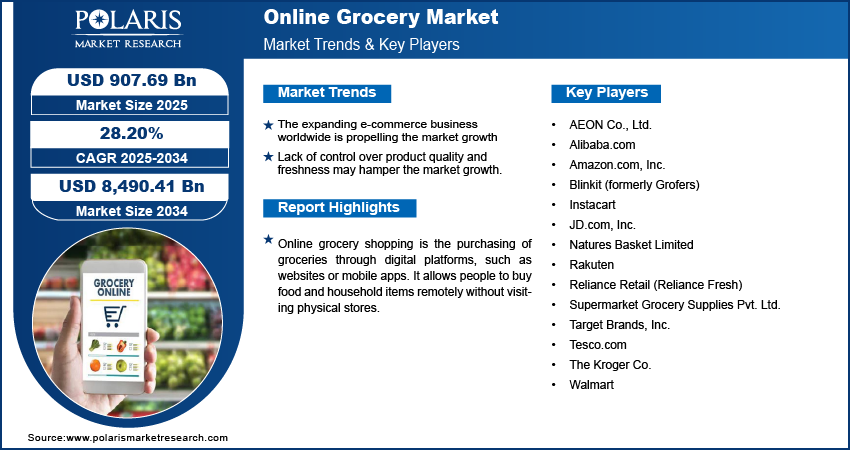
- The expanding e-commerce business worldwide is propelling the market growth
- Growth, urbanization, and increasing usage of smartphones are also increasing the demand for online groceries.
- The economic growth in countries such as China, Japan, and India is creating a lucrative market opportunity.
- Lack of control over product quality and freshness may hamper the market growth.
Source: Polaris Market Research Analysis
To Understand More About this Research: Download Sample Report
AI Impact on the Online Grocery Market
- AI helps in personalized shopping by analyzing purchase histories.
- AI optimizes inventory management through predictive analytics.
- AI helps grocers understand consumer behavior and market trends.
Online grocery shopping is the purchasing of groceries through digital platforms, such as websites or mobile apps. It allows people to buy food and household items remotely without visiting physical stores. People are now using online grocery platforms to save time and avoid travel. It also helps people to compare prices easily and access exclusive deals. It further enhances shopping efficiency, especially for busy individuals. Factors such as increased urbanization, rising working population, hectic schedules, and increasing passive lifestyle adoption are expected to drive the growth of the online grocery market.
The widespread use of internet services, the proliferation of smart devices, and the availability of simple virtual payment methods are making online platforms easier and more convenient for customers, resulting in increased demand for the online grocery. Moreover, the rising trend of sustainable delivery and eco-friendly packaging is also accelerating industry growth as consumers are becoming increasingly conscious about their purchasing decisions. The outbreak of the COVID-19 pandemic has a positive impact on the growth of the industry as many people turned to internet shopping to avoid crowded places and human contact as a result of the pandemic.
Industry Dynamics
Growth Drivers
The growth of the market is attributed to easy doorstep product delivery, better quality products, along with no geographical boundaries. Consumers are choosing online purchasing than physical shopping due to the convenience of door-to-door delivery offered by online grocery platforms. The expanding e-commerce businesses and the adoption of attractive marketing strategies by key players in the market are also leading to the market growth. The growing employment rate and urbanization in many parts of the world, especially in emerging economies such as India, Vietnam, and Brazil are further leading to the market growth.
Benefits vs Challenges of Online Grocery Market
Benefits
- Savings of time and energy through door-step delivery
- Variety of goods in different product categories
- Enabling feature to compare prices and avail discounts
- Availability around the clock with the help of smartphone apps and online portals
- Safe and convenient shopping experience through contactless technology
- Smart purchase options through subscription plans
Challenges
- Quality problems associated with perishable items
- Logistics cost issues
- Timing problems due to heavy traffic periods
Lack of adequate coverage in remote areas
Online Grocery Platform Models
| Model Type | Description | Examples |
| Inventory Model | The platform owns the inventory stored in warehouses/dark stores | Amazon Fresh, BigBasket (in part) |
| Marketplace Model | The platform links customers to multiple grocery retailers | Instacart, Alibaba |
| Quick Commerce Model | Same-day delivery (10-30 minutes) via micro-warehouses | Blinkit, Zepto |
| Hybrid Model | Uses inventory model, marketplace model, and quick delivery | Reliance Retail, Walmart |
| Subscription Model | Subscription-based model where users receive periodic delivery of groceries | Amazon Subscribe & Save |
Source: Polaris Market Research Analysis
Delivery and Logistics Technology
Technology is one of the key factors driving the efficiency of online grocery delivery services. Organizations use AI-driven demand forecasting, route optimization software, and warehouse automation technologies to process large volumes of orders and deliver faster. Technology such as real-time tracking solutions makes it easier to monitor deliveries, while data analytics enables organizations to better understand consumer demand and prevent waste. Additionally, the emergence of dark stores and micro-fulfillment facilities has enabled faster last-mile deliveries in urban settings.
Source: Polaris Market Research Analysis
Report Segmentation
The market is primarily segmented on the basis of product type and region.
| By Product Type | By Region |
|
|
Source: Polaris Market Research Analysis
Know more about this report: Download Sample Report
Source: Polaris Market Research Analysis
Insight by Product Type
Based on product type, the market is divided into fresh produce, breakfast & dairy, snacks & beverages, meat & seafood, staples & cooking essentials, and others. The staples & cooking essentials segment accounted for the largest market share in 2025. This is attributed to the increased consumption of staple foods such as rice, corn, wheat, etc., and cooking essentials including oil, seasonings & spices, and sugar,on a regular basis. Furthermore, staple food is consumed in large quantities by a population which contributed to the segment's dominance. The growing disposable income in emerging countries and rising number of staple restaurents further led the segment's dominance.
The breakfast & dairy segment is expected to witness the rapid CAGR growth over the forecast period. This is attributed to the increased dairy consumption in emerging economies such as India, China, and Japan. Additionally, the segment is being driven by consumers' increasing awareness of health and the intake of nutritious foods to preserve good health. The growing demand for protein rich diet is leading to segment growth.
Geographic Overview
Asia Pacific accounted for the largest market share in 2025 and is expected to continue dominating the industry over the forecast period. This dominance is attributed to the rising population, increased disposable income, and sophisticated food-loving consumers across the region. Furthermore, increased mobile accessibility and broadband adoption allowined customers to buy food from anywhere, at any time. Various social trends have fostered the rise in popularity of online grocery shopping in the Asia Pacific, such as road congestion and prolonged working hours. In most Asian cities, traffic congestion is a regular phenomenon, making travel extremely stressful, which motivates people to opt for online grocery.
North America is expected to account for a significant share of the global market in the coming years. This is owing to the increased proliferation of e-commerce platforms along with the rapid digitization across the region. The outbreak of the coronavirus has resulted in a large increase in online grocery purchases in the region. The high disposable income and wide smartphone pentration in the region is also driving the online grocery market growth. The growth in urbanization, particualry in the U.S. is also leading to an increase market revenue.
Source: Polaris Market Research Analysis
Competitive Insight
Some of the major players operating in the global market include
- AEON Co., Ltd.
- Alibaba.com, Amazon.com, Inc.
- Blinkit (formerly Grofers)
- Instacart
- JD.com, Inc.
- Natures Basket Limited
- Rakuten
- Reliance Retail (Reliance Fresh)
- Supermarket Grocery Supplies Pvt. Ltd. (BigBasket)
- Target Brands, Inc.
- Tesco.com
- The Kroger Co.
- Walmart.
Online Grocery Industry Development
- August 2025: Amazon announced major grocery expansion in the U.S. The company now allows customers in over 1,000 towns and cities to order fresh groceries with Same-Day Delivery. (source: aboutamazon.com)
- June 2025: Supermarket Grocery Supplies Pvt. Ltd. (BigBasket) announced the launch of 10-minute food delivery across India, leveraging dark stores and localized fulfillment centers to expand its presence in the fast-growing quick-commerce space. (Source: hospitality.economictimes.indiatimes.com)
- May 2025: Instacart acquired U.S.-based e-commerce provider Wynshop, strengthening its retail partnerships and enhancing its enterprise tools. The move aims to boost retailers’ digital capabilities, improve customer engagement, and support scalable growth.m (Source: instacart.com)
Online Grocery Market Report Scope
| Report Attributes | Details |
| Market size value in 2025 | USD 906.01 Billion |
| Market size value in 2026 | USD 1,157.83 Billion |
| Revenue forecast in 2034 | USD 8,490.41 Billion |
| CAGR | 28.20% from 2026 - 2034 |
| Base year | 2025 |
| Historical data | 2021 - 2024 |
| Forecast period | 2026 - 2034 |
| Quantitative units | Revenue in USD Billion and CAGR from 2026 to 2034 |
| Segments covered |
|
| Regional scope |
|
| Key companies | AEON Co., Ltd., Alibaba.com, Amazon.com, Inc., Blinkit (formerly Grofers), Instacart, JD.com, Inc., Natures Basket Limited, Rakuten, Reliance Retail (Reliance Fresh), Supermarket Grocery Supplies Pvt. Ltd. (BigBasket), Target Brands, Inc., Tesco.com, The Kroger Co., and Walmart |
Source: Polaris Market Research Analysis
Online Grocery Market FAQ's
• The global market size was valued at USD 906.01 billion in 2025 and is projected to grow to USD 8,490.41 billion by 2034.
• The global market is projected to register a CAGR of 28.20% during the forecast period.
• Asia Pacific dominated the market in 2025
• A few of the key players in the market are AEON Co., Ltd., Alibaba.com, Amazon.com, Inc., Blinkit (formerly Grofers), Instacart, JD.com, Inc., Natures Basket Limited, Rakuten, Reliance Retail (Reliance Fresh), Supermarket Grocery Supplies Pvt. Ltd. (BigBasket), Target Brands, Inc., Tesco.com, The Kroger Co., and Walmart.
• The staples & cooking essentials segment dominated the market revenue share in 2025.
Download Sample Report of Online Grocery Market
Please fill out the form to request a customized copy of the research report.


