
Modified Starch Market Share, Size, Trends, Industry Analysis Report, 2026 - 2034
REPORT DETAILS
Modified Starch Market Overview and Key Insights
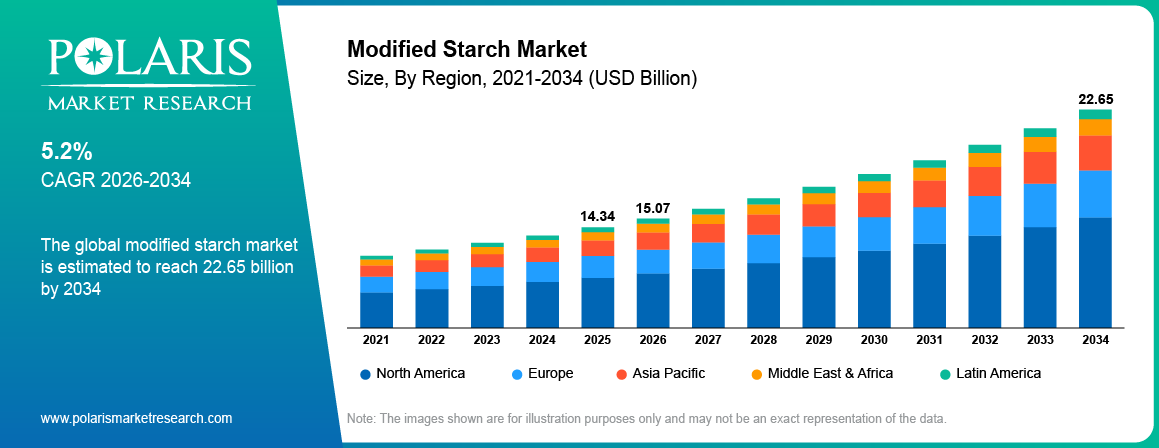
The modified starch market size was valued at USD 14.34 billion in 2025, exhibiting a CAGR of 5.2% during 2026–2034. The market growth is primarily driven by the increased adoption of modified starch in the food and beverage industry and rising demand from emerging economies.
Market Statistics
Modified Starch Market Key Insights
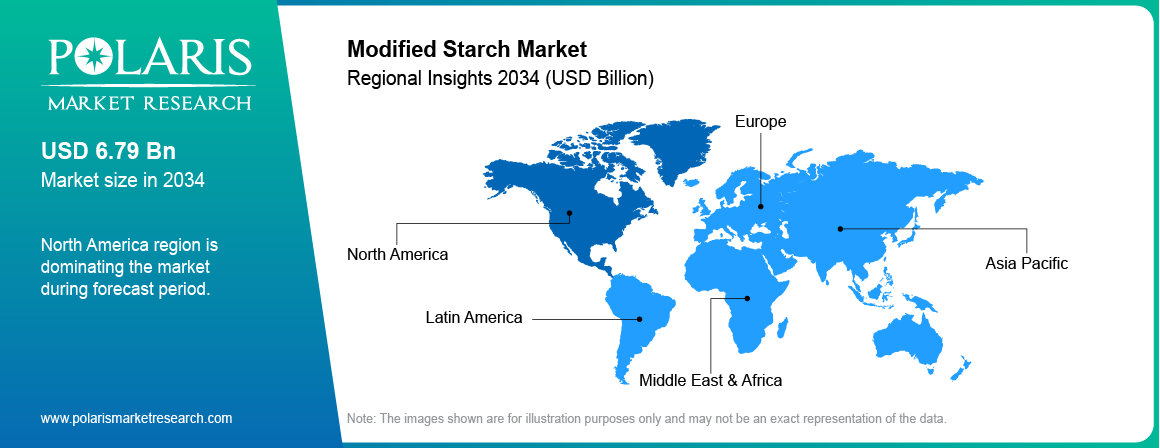
- North America dominated the market with a 30.0% revenue share in 2025. The region’s leading market share is due to its well-established food and beverage sector and high awareness about the benefits of modified starch across various applications.
- Asia Pacific is projected to witness notable growth at a 6.8% CAGR. The presence of major starch-producing countries drives regional market growth.
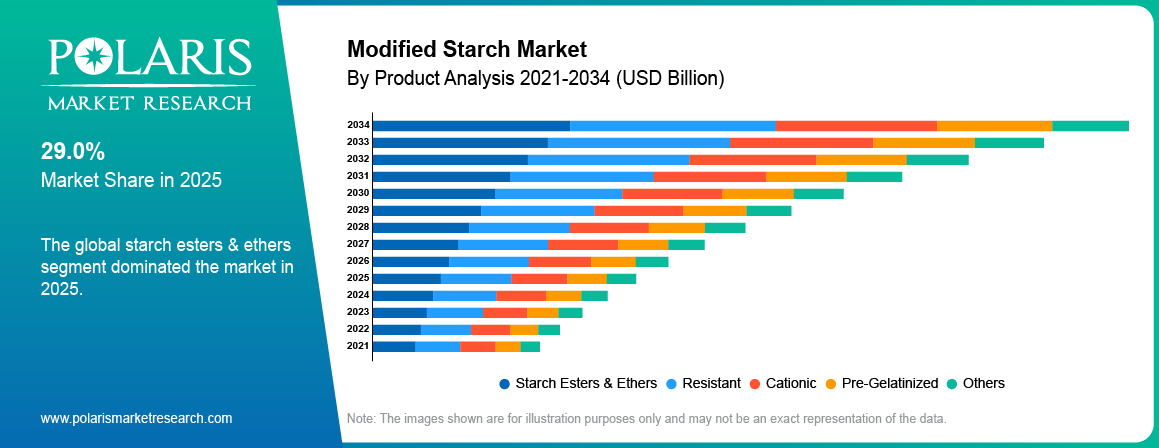
- The starch esters & ethers segment accounted for the largest market share of 29.0% in 2025. The segment’s leading market share is primarily attributed to the extensive applications of starch esters and ethers across various industries.
- The cassava segment is projected to witness significant growth at a 5.8% CAGR. This is primarily due to the rising demand for clean-label and natural ingredients.
- The food & beverage segment led with a 44.2% market share in 2025. This is owing to the high demand for texturizers and stabilizers in the industry.
Note: Figures and projections outlined in this report are the result of Polaris Market Research’s proprietary analytical processes, grounded in the latest available datasets and market observations.
Modified Starch Market Dynamics
- The rising global consumption of processed food, where modified starches are essential for their thickening and emulsifying properties, drives market growth.
- Growing applications of modified-staraches in sectors such as pharmaceuticals, textiles, and paper manufacturing fuel market expansion.
- Increased emphasis on the development of modified starch solutions that align with consumer preferences for natural and clean label products presents several market opportunities.
- A preference for gum arabic over modified starch may present market challenges.
Impact of Artificial Intelligence on Modified Starch Production
- AI is capable of assisting in enhancing the production of modified starch through optimization of process parameters.
- The technology helps in the development of products by analyzing food industry trends and developing starches with unique functionalities.
- Quality assurance is also improved through variation detection of raw materials and uniform product delivery.
- AI enables cost saving through efficient production processes.
Source: Polaris Market Research Analysis
To Understand More About this Research: Download Sample Report
What Is Modified Starch and How Is It Produced?
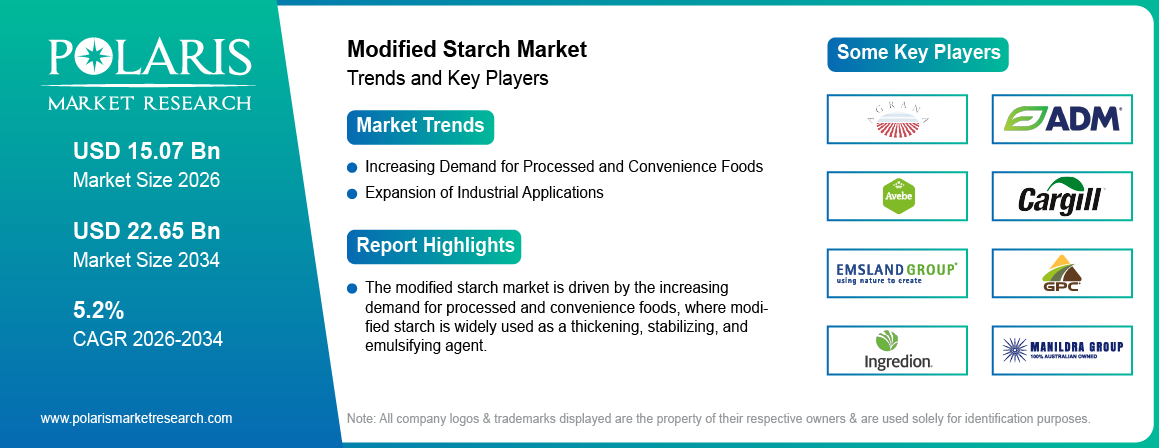
The modified starch market is driven by the increasing demand for processed and convenience foods, where modified starch is widely used as a thickening, stabilizing, and emulsifying agent. The growing adoption of modified starch in the food and beverage industry, particularly in bakery, dairy, and confectionery products, is a significant factor propelling modified starch market expansion. Additionally, the rising utilization of modified starch in industrial applications such as pharmaceuticals, textiles, paper manufacturing, and biofuels is further fueling demand. The shift towards clean-label and plant-based ingredients has also led manufacturers to develop non-GMO and organic modified starch variants to meet evolving consumer preferences.
The increasing regulatory scrutiny of and the growing preference for natural and minimally processed ingredients may impact synthetic modifications. Advancements in starch modification technologies, including enzymatic and physical modifications, are enhancing the functionality and application scope of modified starch. The market also benefits from the rising demand in emerging economies, where rapid urbanization and dietary shifts are driving consumption.
Modified Starch vs Native Starch
| Properties | Modified Starches | Native Starches |
| Stability | High stability during processing | Low stability |
| Thermal Stability | Good thermal stability | Low thermal stability |
| Shelf Life | Good support for shelf life | Low shelf life ability |
| Performance in Texture | Good texture and viscosity performance | Low texture stability |
| Industries | Versatile uses in industries | Limited industrial performance |
| Processing | Suitable for complex processing conditions | Sensitive to processing conditions |
Source: Polaris Market Research Analysis
Market Dynamics
Increasing Demand for Processed and Convenience Foods
The global rise in consumption of processed and convenience foods significantly drives the market. Modified starches are essential in these products for their thickening, stabilizing, and emulsifying properties, enhancing texture and shelf life. The US Department of Agriculture (USDA) reported that corn production, a primary source of starch, was estimated at 15.3 billion bushels in 2023, indicating a robust supply to meet this growing demand. This trend is expected to continue as consumers seek ready-to-eat and easy-to-prepare food options, further propelling the modified starch market growth.
Expansion of Industrial Applications
Beyond the food industry, modified starches have found extensive industrial starch applications in various sectors, including pharmaceuticals, textiles, and paper manufacturing. In the pharmaceutical industry, modified starches serve as binders and disintegrants in drug formulations, improving tablet integrity and dissolution rates. The growth in pharmaceutical sector driven by government initiatives to promote development and increase in demand for pharma products necessitates increased use of excipients such as modified starches. Similarly, in the paper industry, modified starches improve paper strength and printability, meeting the rising demand for high-quality paper products and thereby driving the growth of the modified starch market.
Clean-Label and Natural Ingredient Trends
Food manufacturers are moving towards clean label products because people are becoming increasingly aware of their nutritional requirements. The demand for transparency is driving them to look at alternatives such as non-GMO, organic, and plant-based foods. It is also motivating food makers to reconsider their recipes by adding modified starch. Consumers are moving towards avoiding artificial preservatives and additives. Consumers are also preferring to avoid highly processed food components in their diets. Modified starch has therefore found its place, satisfying both the functional needs of food manufacturers and the health-conscious demands of consumers.
Bio-Based Materials and Bioplastics Development
Starch modification is currently being employed in biodegradable plastic products, packaging, and other materials derived from biological sources. In an era where waste reduction and non-reliance on petroleum-based products are increasingly important, initiatives are being taken to explore more viable options from environmentally sustainable and renewable raw materials. One such option that has emerged is the use of biodegradable plastics made from starch. These plastics are affordable and compatible with existing production techniques.
Source: Polaris Market Research Analysis
Segment Insights
Market Assessment by Product
The modified starch market is segmented by product into starch esters & ethers, resistant, cationic, pre-gelatinized, and others. The starch esters & ethers segment holds a dominant position with 29.0% share in 2025, primarily due to its extensive applications across various industries. These modified starches are prized for their ability to enhance food texture and extend shelf life, making them indispensable in the bakery, convenience, and dairy sectors. The versatility of starch esters and ethers allows manufacturers to improve product quality and meet diverse consumer preferences. Additionally, the growing food and beverage industries in emerging markets, such as China and India, further bolster the demand for these modified starches.
Market Evaluation by Material
The modified starch market segmentation, based on material, includes corn, cassava, wheat, potato, and others. The cassava segment is experiencing notable growth at a CAGR of 5.8% during the forecast period, driven by increasing demand for clean-label and natural ingredients. Cassava starch is perceived as a more wholesome alternative to synthetic additives, aligning with consumer preferences for natural products. This trend is particularly evident in Asia Pacific, where cassava serves as a significant raw material for starch production, catering to both food and industrial applications.
Source: Polaris Market Research Analysis
Regional Insights
By region, the study provides modified starch market insights into North America, Europe, Asia Pacific, Latin America, and the Middle East & Africa. North America holds the largest modified starch market share of 30.0% in 2025, primarily due to its well-established food and beverage sector and the growing demand for natural and sustainable ingredients. The region's high awareness regarding the benefits of modified starch across various applications and the presence of major market players further boost its market dominance.
The modified starch market in Asia Pacific is experiencing significant growth at a CAGR of 6.8% during the forecast period, propelled by its substantial food processing industry and the presence of major starch-producing countries such as China, Thailand, and India. The region's large population and increasing consumer demand for processed food products contribute to this expansion. Moreover, government policies promoting biofuels, such as India's shift towards corn-based ethanol production, have impacted local industries reliant on corn, including starch production. This policy change has led to increased corn imports and affected the availability of corn for other applications, influencing the dynamics of the market in the region.
Source: Polaris Market Research Analysis
Modified Starch Market Competitive Landscape
The modified starch market features several active key players, including Cargill, Incorporated; Archer Daniels Midland Company; Ingredion Incorporated; Tate & Lyle PLC; Roquette Frères; Avebe U.A.; Emsland Group; Grain Processing Corporation; Agrana Beteiligungs-AG; Global Bio-Chem Technology Group Company Limited; Tereos Syral; Südzucker AG; Penford Corporation; Manildra Group; and SPAC Starch Products (India) Ltd.
These companies are actively engaged in product development, strategic collaborations, and expansion initiatives to meet the evolving demands of various industries. For instance, Cargill focuses on sustainability and innovation, offering functional and clean-label starch solutions. Archer Daniels Midland Company leverages its strong research and development capabilities and global presence to provide high-quality modified starches. Similarly, Tate & Lyle PLC emphasizes innovation and customer collaboration, delivering customized starch products that address specific functional and nutritional requirements.
The competitive landscape is characterized by continuous improvement and adaptation to emerging market trends. Companies such as Roquette Frères are known for their plant-based ingredients and sustainable solutions, catering to the food, pharmaceutical, and industrial sectors. Additionally, regional players such as Avebe and Emsland Group contribute to the market with their specialized starch products and strong regional presence. Overall, the modified starch market is dynamic, with companies investing in research and development, strategic partnerships, and sustainable practices to maintain their competitive edge.
Cargill, Incorporated is a global food corporation based in the United States. It operates in various sectors, including agriculture, food production, and industrial products. The company trades, purchases, and distributes agricultural commodities and manufactures food ingredients like starches and vegetable oils. Cargill also offers financial services and industrial products, showcasing a diverse portfolio that caters to a wide range of industries.
Archer Daniels Midland Company (ADM), headquartered in Chicago, Illinois, is a multinational food processing and commodities trading corporation. ADM specializes in processing cereal grains and oilseeds, producing products such as corn syrup, vegetable oil, and ethanol. The company also operates an extensive network for the procurement, transportation, storage, and processing of agricultural commodities, serving markets worldwide.
Leading Modified Starch Manufacturers and Suppliers
- Agrana Beteiligungs-AG
- Archer Daniels Midland Company
- Avebe U.A.
- Cargill, Incorporated
- Emsland Group
- Grain Processing Corporation
- Ingredion Incorporated
- Manildra Group
- Penford Corporation
- Roquette Frères
- SPAC Starch Products (India) Ltd.
- Südzucker AG
- Tate & Lyle PLC
- Tereos Syral
Modified Starch Market Recent Developments
- January 2026: Agbeyewa Industries Limited revealed the acquisition of Nigerian cassava starch processor, Matna Foods Company Limited. With the acquisition, Agbeyewa aims to strengthen its Cassava value chain. (source: agbeyewa.com)
- March 2025: Cargill, in partnership with Saatvik Agro Processors, inaugurated a new corn milling plant to strengthen its starch ingredient capabilities, producing high-quality starch derivatives for the confectionery, infant formula, and dairy sectors. (Source: cargill.com)
Modified Starch Market Segmentation and Forecast
By Product Outlook (Revenue-USD Billion, 2021–2034)
- Starch Esters & Ethers
- Resistant
- Cationic
- Pre-Gelatinized
- Others
By Material Outlook (Revenue-USD Billion, 2021–2034)
- Corn
- Cassava
- Wheat
- Potato
- Others
By End Use Outlook (Revenue-USD Billion, 2021–2034)
- Food & Beverage
- Animal Feed
- Paper
- Pharmaceuticals
- Textiles
- Others
By Regional Outlook (Revenue-USD Billion, 2021–2034)
- North America
- US
- Canada
- Europe
- Germany
- France
- UK
- Italy
- Spain
- Netherlands
- Russia
- Rest f Europe
- Asia Pacific
- China
- Japan
- India
- Malaysia
- Suth Korea
- Indnesia
- Australia
- Vietnam
- Rest f Asia Pacific
- Middle East & Africa
- Saudi Arabia
- UAE
- Israel
- Suth Africa
- Rest f Middle East & Africa
- Latin America
- Mexic
- Brazil
- Argentina
- Rest f Latin America
Modified Starch Market Report Scope and Methodology
| Report Attributes | Details |
| Market Size Value in 2025 | USD 14.34 billion |
| Market Size Value in 2026 | USD 15.07 billion |
| Revenue Forecast by 2034 | USD 22.65 billion |
| CAGR | 5.2% from 2026 to 2034 |
| Base Year | 2025 |
| Historical Data | 2021–2024 |
| Forecast Period | 2026–2034 |
| Quantitative Units | Revenue in USD billion and CAGR from 2026 to 2034 |
| Report Coverage | Revenue Forecast, Market Competitive Landscape, Growth Factors, and Industry Trends |
| Segments Covered |
|
| Regional Scope |
|
| Competitive Landscape |
|
| Report Format |
|
| Customization | Report customization as per your requirements with respect to countries, regions, and segmentation. |
Source: Polaris Market Research Analysis
Modified Starch Market Frequently Asked Questions
The modified starch market size was valued at USD 14.34 billion in 2025 and is projected to grow to USD 22.65 billion by 2034.
The market is projected to register a CAGR of 5.2% during the forecast period, 2024-2034.
North America dominated the market with a 30.0% revenue share in 2025.
The modified starch market features several active key players, including Cargill, Incorporated; Archer Daniels Midland Company; Ingredion Incorporated; Tate & Lyle PLC; Roquette Frères; Avebe U.A.; Emsland Group; Grain Processing Corporation; Agrana Beteiligungs-AG; Tereos Syral; Südzucker AG; Penford Corporation; Manildra Group; and SPAC Starch Products (India) Ltd.
The starch esters & ethers segment accounted for the largest market share of 29.0% in 2025.
Modified starch is a processed form of natural starch that has been physically, enzymatically, or chemically altered to improve its functional properties. These modifications enhance characteristics such as stability, solubility, texture, and resistance to heat, acid, or shear, making it more suitable for various industrial applications. Modified starch is widely used in the food and beverage industry as a thickener, stabilizer, emulsifier, and gelling agent. It is also utilized in pharmaceuticals as a binder in tablet formulations, in textiles for fabric finishing, and in the paper industry to improve paper strength and printability. The modifications allow starch to perform better under specific processing conditions, extending its usability across diverse sectors.
Download Sample Report of Modified Starch Market
Please fill out the form to request a customized copy of the research report.


