
Industrial Burner Market Share, Size, Trends, Industry Analysis Report, 2026 - 2034
REPORT DETAILS
Industrial Burner Market Summary
The global industrial burner market was valued at USD 7.11 billion in 2025 and is expected to grow at a CAGR of 5.34% during the forecast period. The growing demand for industrial burners in a variety of applications including heat exchangers such as hot water boilers, steam boilers, or air heaters, as well as certain process applications, is expected to propel the growth of the industrial burner market.
Market Statistics
Key Takeaways
- Asia Pacific dominated with the largest share of 38.0% in 2025. This is due to growing industrialization and rising population size.
- North America is projected to account for a significant share of 4.75%. This is owing to rising investment in mining and other industrial burner applications.
- The power generation segment is expected to register the highest CAGR of 4.60%. The rising demand for power worldwide contributes to the segment’s growth.
- The dual fuel segment is expected to witness the fastest growth at a 6.20% CAGR. The availability of dual fuel industrial burners in a wide range of specifications contributes to the segment’s growth.
- The direct fired burner segment led with a 34.0% share in 2025. The simplicity and cost-effectiveness of direct fired burners contribute to their widespread use across industries.
Note: Figures and projections outlined in this report are the result of Polaris Market Research’s proprietary analytical processes, grounded in the latest available datasets and market observations.
Industry Dynamics
- Rising demand from government to offer energy-efficient heating solutions boosted the industry.
- Rising use of industrial burners on heavy-duty boilers is fueling the industry growth.
- Technological advancement in the industrial burners is driving the growth.
- High initial investment required for advanced, low-emission and energy‑efficient burner systems is limiting the growth.
AI Impact on Industrial Burner Market
- Artificial intelligence improves the efficiency of burners in industries through optimal use of fuel and combustion.
- AI ensures that the operating conditions of the burners are optimized for maximum stability and efficiency.
- AI detects possible equipment problems ahead of time to avoid breakdowns and reduce maintenance costs.
- AI helps manage and control the use of energy in the processes.
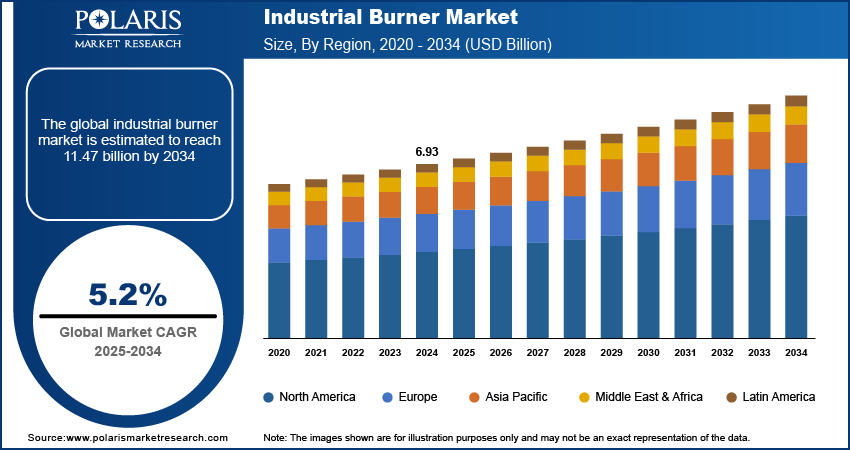
Source: Polaris Market Research Analysis
To Understand More About this Research: Download Sample Report
What is an Industrial Burner?
Industrial burner is a mechanical assembly that combines fuel (gas, oil, or solid fuel) and air in a specified ratio, to form a regulated flame or high-temperature heat for industrial applications. It is commonly applied in furnaces, boilers, kilns and dryers in industries of food, petrochemicals, power and metals for providing exact control of combustion efficiency, emissions and thermal energy output.
What Industrial Burner Market Includes?
The industrial burner market is undergoing a progressive transformation due to the energy and emissions challenge relating to heavy industries. While the production camp has to cope with stricter environmental norms and higher cost of fuel, the preference is shifting toward advanced combustion technologies, e.g., low-NOx and self-recuperative burners, that reduce the fuel consumption while the carbon footprint. The market is also observing a slow shift toward dual-fuel and hydrogen-ready burners from traditional fossil fuel-based systems which resonates the worldwide commitment toward decarbonization. End-use industries such as food and drink, petrochemicals, power generation, and metals are the main drivers, with retrofits and replacements adding to new build work.
Furthermore, the demand is also driven by the rising use of industrial burners on heavy-duty boilers, as they are capable of overcoming high combustion chamber resistances. In addition, the demand for the industrial burner market is attributed to the increased need of equipment purchasers and machinery manufacturers for good reliable, more efficient as well as low-emission industrial heating devices for various applications.
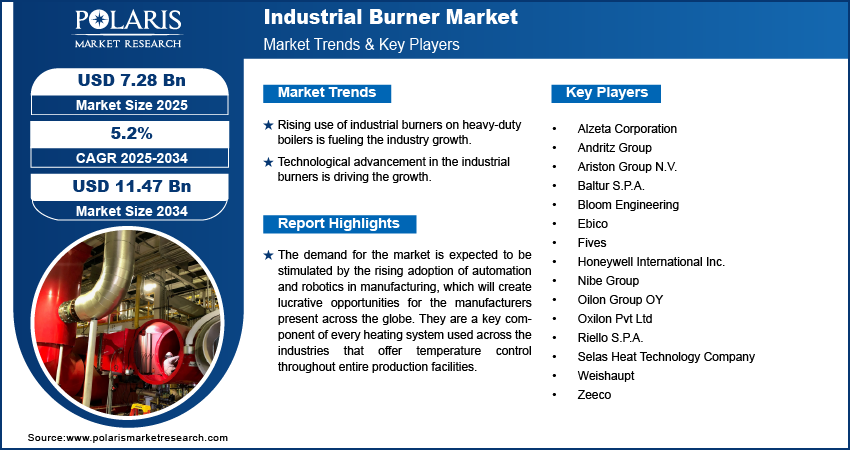
Source: Polaris Market Research Analysis
Industry Dynamics
Growth Drivers
As a result of numerous government requirements around the world, it has become necessary for all manufacturers to offer energy-efficient heating solutions. Aside from decreasing emissions from industrial furnaces, many manufacturers are now focusing on innovative technologies that will lower manufacturing costs. With a growing emphasis on decreasing emissions in order to minimize adverse climate change, it is becoming increasingly vital to use renewable fuel for operations. The demand for smart heating devices has grown as a result of technological advancements, research activities, and continuous development. Additionally, the technological advancement associated with the emergence of heating technology is further expected to propel the growth of the industrial burner market over the forecast period. There is an increased usage of combustion technology by manufacturers to increase heating efficiency.
Focus on Energy-Efficient Combustion Technologies
Modern industrial processes and technologies have recognized the importance of energy-efficient combustion methods that result in saving fuel, reducing operating costs, and optimizing the environmental impact of industrial activities. Advanced combustion systems are now used by many manufacturers, which include various controls and features that allow increasing thermal efficiency and limiting energy losses. For example, variable speed control, oxygen monitoring, and automated burner adjustment can all be considered some of the most important components of modern industrial systems, which ensure consistent performance and high energy efficiency. Given the current trends related to energy efficiency and environmental issues, the demand for such technology solutions is set to increase in the future.
Introduction of Low-NOx & Emission Reduction Burners
Low-NOx and NOx reduction burners are becoming more critical in today’s world as companies try to meet the new environmental standards being imposed by the government. Burners like this are specifically designed to limit NOx emissions that are usually associated with the combustion processes used in industries. Some of the techniques applied to limit emissions include staging of the combustion process, recirculation of flue gas, and optimal fuel-air mixture. The use of such burners enables industries to limit their negative environmental impact without affecting their efficiency. The need for such burners is currently increasing in various industrial settings such as electricity generation, chemicals, metals, cement, glass, and manufacturing.
Report Segmentation
The market is primarily segmented based on fuel type, burner type, operating temperature, power rating, end use, and region.
| By Fuel Type | By Burner Type | By Operating Temperature | By Power Rating | By End Use | By Region |
|
|
|
|
|
|
Source: Polaris Market Research Analysis
Know more about this report: Download Sample Report
Insight by End-Use
Based on the end-use, the power generation segment is expected to register the highest 4.60% CAGR during the forecast period. The increasing demand for power across the globe is further accelerating the need for industrial heating products that are used in boilers in the steam power plants, gas turbine-based power plants, coal-fired power plants, and diesel-fired power plants to generate electricity.
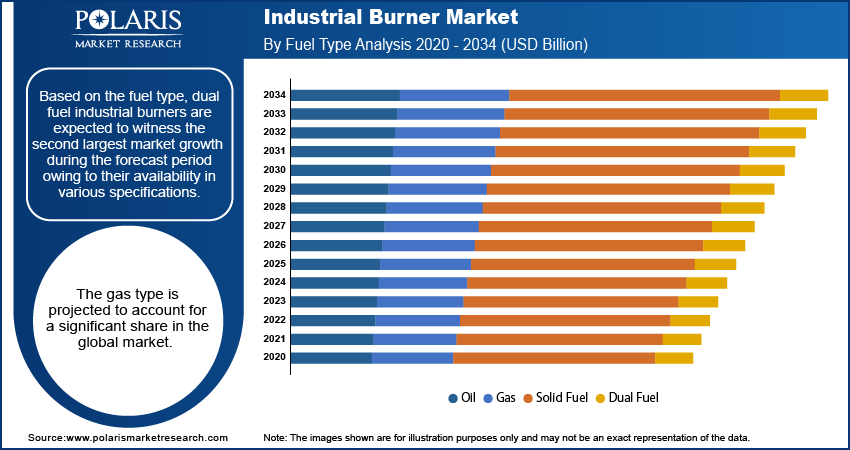
Source: Polaris Market Research Analysis
Insight by Fuel Type
Based on the fuel type, dual fuel industrial burners are expected to witness fastest growth with 6.20% CAGR during the forecast period owing to their availability in various specifications. These are best known for their features such as easy operation, compact design, durability, energy efficiency, and enhanced performance.
Furthermore, the gas type held 45.0% share in the global market in 2025. The high demand is attributed to the rising use of gas heating equipment for various applications across several industries such as bakery and ovens, boilers, furnaces, automobile workshops, metal industries, etc. due to the features such as high tensile strength, longer service life, optimum performance, reliable and durable.
Geographic Overview
Asia Pacific dominate the global market with largest share of 38.0% in 2025. Factors such as the rapid industrialization, rise in population, increased power demand as well as cost advantage of the low cost of labor are likely to accelerate the growth of the industry in the region over the forecast period. Additionally, as a consequence of enhanced technological innovations, rising electricity consumption and the growing presence of several manufacturers across the region are further contributing to the rising need for the market.
North America is projected to account for 4.75% CAGR during the forecast period in the global market. The expansion of the industrial burners market is accelerating in the North American countries as a result of continuous investments in mining, LNG, chemicals, and other industries, as well as the development of domestic manufacturing.
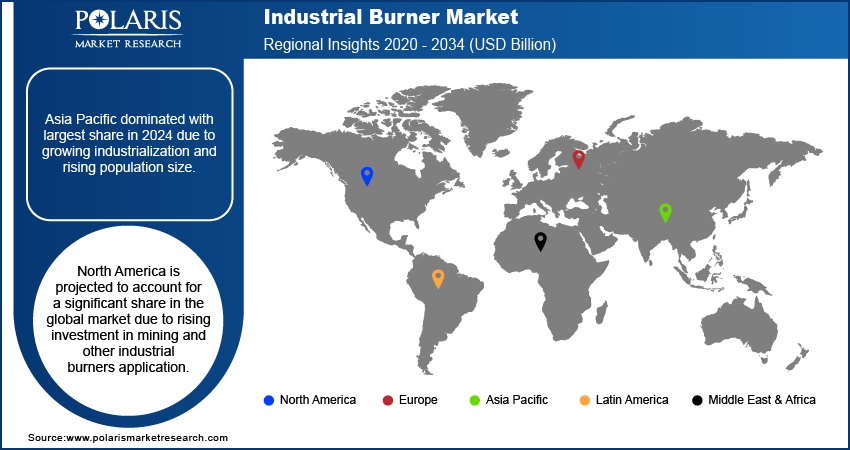
Source: Polaris Market Research Analysis
Competitive Insight
There is high competition in the industrial burner market, with firms seeking innovative approaches that increase efficiency and cut down emissions in order to have a stronger market position. The trend today is toward the development of more advanced burners like the low-NOx burners, hydrogen-combustion-ready burners, smart burner technology, and digital technology in monitoring. There is also increased investment in product improvement and technology to enhance performance and meet regulations. Additionally, the firm may pursue partnerships and acquisitions to foster growth in the market.
Some of the major players operating in the global market include ALZETA Corporation; ANDRITZ AG; Ariston Holding N.V.; Baltur S.p.A.; Bloom Engineering Company, Inc.; EBICO; Fives; Honeywell International Inc.; Max Weishaupt SE; Oilon Group Oy; Selas Heat Technology Company; Zeeco, Inc.
Key Companies
- ALZETA Corporation
- ANDRITZ AG
- Ariston Holding N.V.
- Baltur S.p.A.
- Bloom Engineering Company, Inc.
- EBICO
- Fives
- Honeywell International Inc.
- Max Weishaupt SE
- Oilon Group Oy
- Selas Heat Technology Company
- Zeeco, Inc.
Recent Developments
- February 2026: Honeywell announced the introduction of its Hybrid Heating Solution. The solution allows industrial manufacturers to integrate electric energy and traditional natural gas sources for industrial process heating. (source: honeywell.com)
- February 2026: Zeeco revealed the completion of the acquisition of Japan-based combustion company, Applicot Corporation. According to Zeeco, the strategic move expands its footprint in the Japanese domestic market and improves local support for EPC customers. (source: zeeco.com)
- January 2026: Raadman Industrial Group launched Iran’s first hydrogen burner, marking a major breakthrough in clean combustion technology. The advanced, locally developed burner operates solely on hydrogen, delivering high performance with near-zero emissions and reinforcing Iran’s shift toward a low-carbon future. (Source: raadmanburner.com)
- June 2025: Alfa Laval won an order for the world’s first marine boiler system designed for ammonia emissions incineration. The solution will be installed on four ammonia dual-fuel vessels under a joint project, with deliveries scheduled for 2027–2028. (Source: alfalaval.com)
- January 2025: ClearSign Technologies Corporation announced it secured a USD 400,000 grant from the U.S. Department of Energy’s EERE Industrial Efficiency and Decarbonization Office, in collaboration with a national laboratory. The funding will support development of its ultra-low NOx industrial hydrogen burner to advance decarbonization of high-temperature industrial processes. (Source: clearsign.com)
Industrial Burner Market Report Scope
| Report Attributes | Details |
| Market size value in 2025 | USD 7.11 Billion |
| Market size value in 2026 | USD 7.49 Billion |
| Revenue forecast in 2034 | USD 11.36 Billion |
| CAGR | 5.34% from 2026 - 2034 |
| Base year | 2025 |
| Historical data | 2021 - 2024 |
| Forecast period | 2026 - 2034 |
| Quantitative units | Revenue in USD Billion and CAGR from 2026 to 2034 |
| Segments covered | By Fuel Type, By Burner Type, By Operating Temperature, By Power Rating, By End Use, By Region |
| Regional scope | North America, Europe, Asia Pacific, Latin America, Middle East & Africa |
| Key companies | ALZETA Corporation; ANDRITZ AG; Ariston Holding N.V.; Baltur S.p.A.; Bloom Engineering Company, Inc.; EBICO; Fives; Honeywell International Inc.; Max Weishaupt SE; Oilon Group Oy; Selas Heat Technology Company; Zeeco, Inc. |
Source: Polaris Market Research Analysis
Industrial Burner Market FAQ's
• The market size was valued at USD 7.11 billion in 2025 and is projected to grow to USD 11.36 billion by 2034.
• The market is projected to register a CAGR of 5.34% during the forecast period.
• A few of the key players in the market are ALZETA Corporation; ANDRITZ AG; Ariston Holding N.V.; Baltur S.p.A.; Bloom Engineering Company, Inc.; EBICO; Fives; Honeywell International Inc.; Max Weishaupt SE; Oilon Group Oy; Selas Heat Technology Company; Zeeco, Inc.
• The power generation is expected to register the highest 4.60% CAGR.
• The dual fuel segment is expected to witness the fastest growth at a 6.20% CAGR.
• An industrial burner is a mechanical device that combusts fuel to generate controlled heat for applications like boilers, furnaces, heat exchangers, and process heating systems.
• Key trends include rising demand for energy-efficient, low-emission burners, growing dual-fuel system adoption, smart combustion technology, and increased deployment across power generation and industrial applications.
Download Sample Report of Industrial Burner Market
Please fill out the form to request a customized copy of the research report.


