
Electrolyzer Market Size, Industry Share, Growth Analysis Report, 2026-2034
REPORT DETAILS
Electrolyzer Market Summary
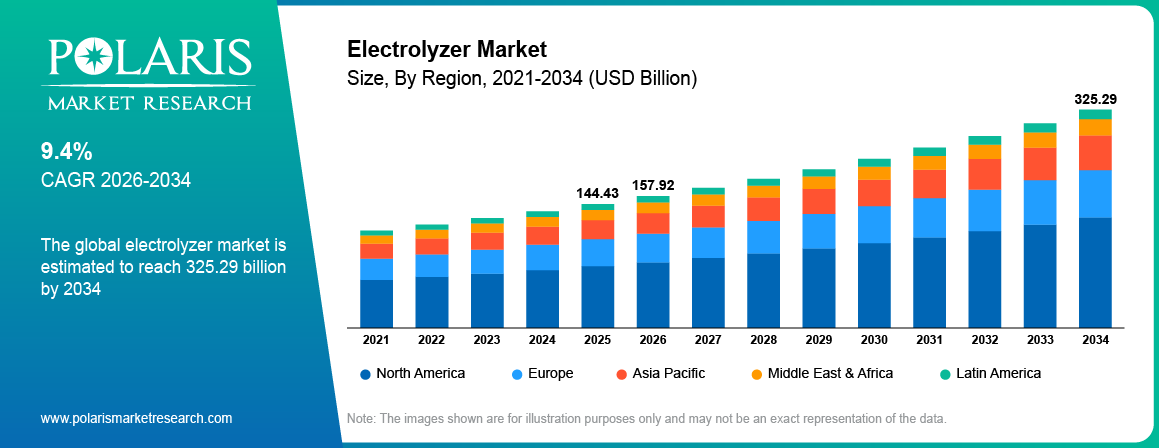
The global electrolyzer market was valued at USD 144.43 billion in 2025 and is projected to rise from USD 157.92 billion in 2026 to USD 325.29 billion by 2034, growing at a CAGR of 9.4% over the 2026-2034 period. Growth is being driven by the global push toward net-zero emissions, which is boosting demand for green hydrogen across sectors such as power generation, transportation, and chemicals, supported by government policies and subsidies. In addition, the rapid expansion of solar and wind installations, along with technological advances that improve electrolyzer efficiency and scalability, is further accelerating market
Market Statistics
Key Takeaways
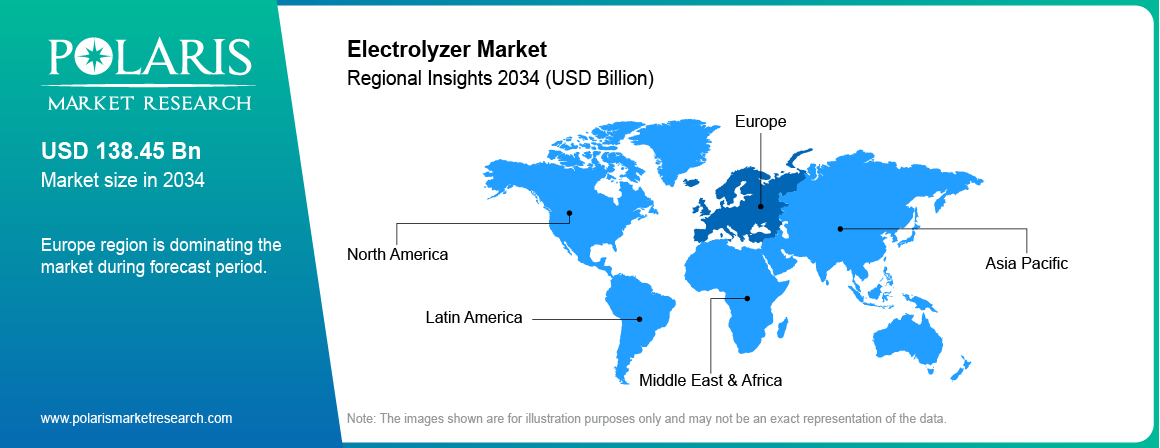
- In 2025, Europe accounted for the largest market share of 34.2%. The dominance is attributed to its robust policy framework and substantial investments in green hydrogen infrastructure.
- Germany dominated the regional market with 26.9% share in 2025. This is driven by the country’s emphasis on achieving carbon neutrality.
- The Asia Pacific electrolyzer market is expected to record the highest CAGR of 10.62% during the forecast period. This is due to rising investments in renewable energy infrastructure and strong government policies promoting hydrogen adoption.
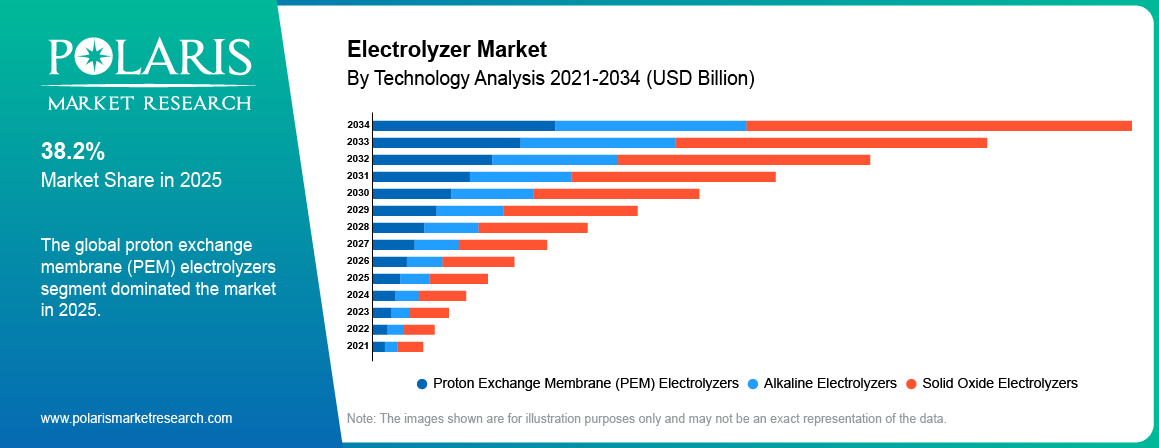
- Based on technology, the proton exchange membrane (PEM) electrolyzers segment held the largest share of 38.2% in 2025. The dominance is driven by their ability to deliver high-purity hydrogen and operate efficiently at varying scales.
- By application, in 2025, the industrial segment accounted for the largest market share of 45.0%. This is attributed to the rising adoption of green hydrogen for industrial decarbonization and sustainable manufacturing processes.
Note: Figures and projections outlined in this report are the result of Polaris Market Research’s proprietary analytical processes, grounded in the latest available datasets and market observations.
What is an electrolyzer?
An electrolyzer is a device that uses electricity to split water into hydrogen and oxygen through a process called electrolysis. It is a key technology for producing green hydrogen and for storing energy, and it is used across industrial processes and in the integration of renewable power. By enabling low-carbon hydrogen, electrolyzers support decarbonization in sectors such as transportation, chemicals, refining, and power generation.
The global electrolyzer market forms the backbone of the emerging hydrogen economy. These systems produce green hydrogen by splitting water with electricity from renewable sources like solar and wind. Because they allow industries to move away from fossil fuels toward cleaner energy systems, electrolyzers play a central role in decarbonizing power generation, transportation, and chemical manufacturing.
Market growth is driven mainly by the global push toward net-zero emissions and the resulting rise in demand for green hydrogen. Supportive government policies and subsidies are accelerating adoption, while growing demand for clean energy across industries adds further momentum. Ongoing improvements in electrolyzer efficiency and scalability, together with the rapid expansion of solar and wind installations, are also widening the market's reach.
Impact of AI and Smart Energy Management Systems
- AI-enabled control systems optimize electrolyzer efficiency. They adjust operating parameters in real time.
- Smart energy management platforms are used to enhance load balancing between renewable energy sources and hydrogen production systems.
- Predictive maintenance tools use AI analytics to reduce unplanned downtime.
- Machine learning (ML) algorithms help improve energy consumption efficiency and lower operational costs.
- Digital monitoring systems are adopted to improve performance tracking, operational reliability, and system lifespan.
Source: Polaris Market Research Analysis
To Understand More About this Research: Download Sample Report
Market Dynamics
Increasing Demand for Green Hydrogen
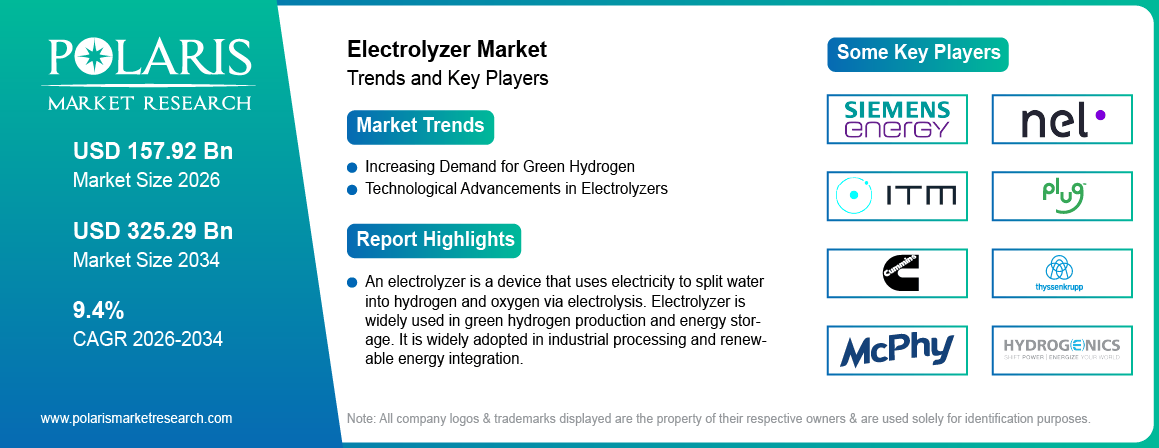
With hydrogen being a critical element in reducing global emissions, industries are increasingly adopting electrolyzers for sustainable hydrogen production. Market analysis indicates significant growth in the use of electrolyzers for industrial applications, particularly in chemical manufacturing, fuel cell vehicles, and energy storage. The scalability and modularity of electrolyzers are crucial for meeting the rising demand for green hydrogen. Governments are also introducing initiatives to promote green hydrogen, offering subsidies, tax incentives, and direct investments. For example, the European Union’s Hydrogen Strategy aims to install substantial electrolyzer capacities. Thus, the growing demand for green hydrogen is boosting the electrolyzer market development.
Technological Advancements in Electrolyzers
The rapid advancement in technology, particularly in proton exchange membrane (PEM) and solid oxide electrolyzers, is driving improvements in energy efficiency, reduced operational costs, and scalability of electrolyzer systems. PEM electrolyzers, in particular, are gaining traction due to their ability to operate under high pressure, making them ideal for compact and high-demand applications such as hydrogen fueling stations. Additionally, the integration of digital monitoring solutions for optimizing electrolyzer performance has revolutionized operational efficiency. As a result, technological advancements have boosted the demand for electrolyzers, with electrolyzer market analysis indicating increased adoption across diverse applications.
Challenges in the Electrolyzer Market
- High capital investment requirements for electrolyzer systems and supporting infrastructure hinder widespread market adoption.
- Increased electricity consumption and high dependence on affordable renewable energy sources raise operational costs.
- Challenges related to technology scalability, particularly for advanced electrolyzer systems, adversely affect mass deployment and manufacturing expansion.
- Supply chain constraints for critical materials and components negatively impact production capacity and project timelines.
Opportunity: Green Hydrogen Adoption in Steelmaking, Refining, and Transportation
Hard-to-abate sectors are becoming the largest source of demand for electrolyzer capacity. In steelmaking, producers are replacing coal-based blast furnaces with direct reduced iron (DRI) processes that use hydrogen as the reducing agent, which requires large-scale, continuous electrolysis. Refineries already consume large volumes of hydrogen for hydrotreating and hydrocracking, most of it from natural gas-based hydrogen generation. Switching to electrolytic hydrogen lets them cut direct emissions without redesigning their core processes. In transportation, demand is spreading from fuel cell trucks and buses to synthetic fuels, as aviation and shipping mandates push producers toward e-fuels such as e-SAF, e-methanol, and green ammonia. These applications favor multi-hundred-megawatt projects with long-term offtake agreements, which makes projects easier to finance and gives electrolyzer manufacturers more predictable order pipelines. As carbon pricing tightens and clean hydrogen incentives expand, these three sectors are expected to drive electrolyzer demand through 2034.
Opportunity: Advancements in PEM and Solid Oxide Electrolyzer Technologies
Manufacturers are investing heavily in PEM and solid oxide electrolyzers to improve their efficiency, flexibility, and cost competitiveness. PEM systems respond within seconds to changes in power input, which suits projects powered directly by solar and wind. Ongoing development focuses on reducing iridium and platinum loading, increasing current density, and extending stack life, all of which lower the cost of the hydrogen produced. Solid oxide electrolyzers operate at 600–1,000°C and use industrial waste heat to reduce electricity consumption, giving them the highest electrical efficiency among commercial technologies. That makes them attractive for steel plants, chemical complexes, and e-fuel facilities where surplus heat is available. Alongside these stack improvements, suppliers are adopting automated manufacturing, modular system designs, and digital monitoring to improve reliability and shorten installation time. Together, these advances strengthen the business case for both technologies and widen the range of applications where electrolyzers make economic sense.
Source: Polaris Market Research Analysis
Segment Insights
Assessment by Technology Outlook
The global electrolyzer market segmentation, based on technology, includes proton exchange membrane (PEM) electrolyzers, alkaline electrolyzers, and solid oxide electrolyzers. In 2025, the proton exchange membrane (PEM) electrolyzers segment held the largest market share of 38.2% due to their ability to deliver high-purity hydrogen and operate efficiently at varying scales. These electrolyzers are highly suitable for integration with renewable energy sources, driving their adoption in green hydrogen projects. Moreover, advancements in materials, such as platinum-group metals, have enhanced the efficiency and durability of PEM electrolyzers, supporting the segment’s growth in the global market.
Evaluation by Application Outlook
The global electrolyzer market segmentation, based on application, includes power generation, transportation, and industrial. In 2025, the industrial segment accounted for the largest market share of 45.0% due to the increasing adoption of green hydrogen for industrial decarbonization and sustainable manufacturing processes. Key industries such as chemicals, steel, and ammonia production are transitioning to green hydrogen to reduce their reliance on fossil fuels and meet stringent global emission regulations. The chemical industry is driving the demand for electrolyzers, as hydrogen is a critical feedstock for processes like ammonia synthesis and methanol production. Furthermore, the steel industry is leveraging electrolyzers to produce green hydrogen for direct reduction of iron (DRI), a cleaner alternative to conventional coal-based methods. The scalability and efficiency of modern electrolyzer technologies, such as proton exchange membrane (PEM) and alkaline systems, have also enabled large-scale adoption in industrial applications.
Alkaline vs PEM vs Solid Oxide Electrolyzers
| Parameter | Alkaline Electrolyzers | PEM Electrolyzers | Solid Oxide Electrolyzers (SOEC) |
| Market Position (2025) | Established segment with the largest installed base | Largest revenue share at 38.2% | Smallest segment; early commercialization stage |
| Capital Cost | Lowest; mature supply chain and no precious-metal catalysts | Higher; dependent on platinum and iridium | Highest; advanced ceramics and limited production volumes |
| Energy Efficiency | Comparable to PEM at current system level | Comparable to alkaline; improving with newer stack designs | Highest electrical efficiency when external heat is available |
| Fit with Solar and Wind Power | Moderate; slower response to fluctuating input | Excellent; fast ramping and wide operating range | Limited; suited to steady, continuous operation |
| Footprint | Larger plant footprint per MW | Compact, high-pressure output | Compact stacks but needs thermal integration |
| Typical Project Scale | Large industrial plants (hundreds of MW) | Distributed to large-scale (kW to hundreds of MW) | Pilot and mid-scale industrial installations |
| Key Cost and Supply Risk | Low materials risk | Iridium supply constraints | Material degradation and thermal cycling |
| Primary End Uses | Ammonia, refining, chemicals | Green hydrogen hubs, mobility, energy storage | Synthetic fuels, steel, industrial waste heat recovery |
| Growth Outlook | Steady demand from large-scale industrial decarbonization | Strong growth driven by renewable-coupled projects | Emerging opportunity in power-to-X and e-fuels |
Source: Polaris Market Research Analysis
Source: Polaris Market Research Analysis
Regional Analysis
By region, the study provides market insights into North America, Europe, Asia Pacific, Latin America, and the Middle East & Africa.
Europe Electrolyzer Market Assessment
In 2025, Europe accounted for the largest market share of 34.2% due to its robust policy framework, substantial investments in green hydrogen infrastructure, and a strong commitment to achieving carbon neutrality. The EU's REPowerEU Plan sets a target of 10 million tonnes of domestic renewable hydrogen production and 10 million tonnes of renewable hydrogen imports by 2030 to replace fossil fuels in hard-to-decarbonize industries and transport. This target has been instrumental in driving electrolyzer demand, as meeting it requires large-scale electrolysis capacity across member states. The region benefits from a well-established renewable energy base, particularly wind and solar, which is essential for powering electrolyzers sustainably. Europe is also home to several leading electrolyzer manufacturers, such as Siemens Energy, Nel ASA, and thyssenkrupp nucera, which use advanced technologies to meet growing demand for green hydrogen. Large projects are moving forward, including Moeve's 300 MW Project Onuba in Spain, and investments in hydrogen valleys and cross-border hydrogen networks continue to strengthen Europe's position as the global market leader.
Germany Electrolyzer Market Overview
Germany dominated the European market with a 26.9% share in 2025, driven by the country's emphasis on achieving carbon neutrality and strong demand for green hydrogen across its steel, chemicals, and refining industries. Flagship projects such as Westküste 100 demonstrate the integration of offshore wind with large-scale hydrogen production. Germany is also securing future supply through import partnerships, including a joint H2Global auction with Australia worth around EUR 400 million to guarantee European buyers for Australian renewable hydrogen.
Asia Pacific Electrolyzer Market Trends
The Asia Pacific electrolyzer market is expected to grow at the fastest CAGR, 10.62%, during the forecast period. Growth is driven by increasing investment in renewable energy infrastructure, strong government policies promoting hydrogen adoption, and rising demand for green hydrogen in industrial applications. China leads the region in electrolyzer manufacturing and installed capacity, while Japan and South Korea are advancing hydrogen use in power generation and mobility. In India, the National Green Hydrogen Mission targets at least 5 million tonnes of annual green hydrogen production capacity by 2030 and is driving domestic electrolyzer manufacturing. Partnerships support this, such as BHEL's July 2026 agreement with thyssenkrupp nucera to localize alkaline electrolyzer production. Australia's 2024 National Hydrogen Strategy targets at least 15 million tonnes of hydrogen production a year by 2050, with a base export target of 0.2 million tonnes a year by 2030. The region's rapidly growing chemicals and steel sectors are also adopting green hydrogen to cut emissions, reinforcing demand for advanced electrolyzer technologies.
Source: Polaris Market Research Analysis
Key Players and Competitive Insights
The competitive landscape of the electrolyzer market is characterized by intense competition among key players focusing on innovation, strategic collaborations, and capacity expansions to meet the surging demand for green hydrogen. Leading companies such as Nel ASA, Siemens Energy, ITM Power, and Plug Power dominate the market by leveraging advanced technologies like proton exchange membrane (PEM), alkaline, and solid oxide electrolyzers. These players are heavily investing in research and development to enhance efficiency, scalability, and cost-effectiveness, which are critical to driving electrolyzer market growth. Strategic partnerships with energy companies, governments, and industrial end-users further strengthen their market position. Additionally, the entry of new players and the expansion of existing ones into emerging markets contribute to increased competition. Government emphasis on hydrogen infrastructure development and supportive policies also create opportunities for both established companies and startups. This competitive environment is fostering rapid technological advancements, ensuring the market for electrolyzers remains dynamic and progressive.
Siemens Energy is engaged in the electrolyzer market, leveraging its advanced PEM electrolyzer technology to deliver efficient and scalable solutions for green hydrogen production. The company has been instrumental in large-scale projects such as the Westküste 100 in Germany, where renewable energy integration is at the forefront. Siemens Energy partners with global energy players to expand hydrogen infrastructure, strengthening its market presence.
Nel ASA is engaged in the electrolyzer market, known for its innovative alkaline and PEM electrolyzers. The company’s focus on large-scale green hydrogen projects has solidified its market position. Nel ASA’s fully automated electrolyzer production line aims to reduce costs and increase scalability, aligning with the growing global demand for electrolyzers.
List of Key Companies
- Siemens Energy
- Nel ASA
- ITM Power
- Plug Power Inc.
- Cummins Inc.
- Thyssenkrupp AG
- McPhy Energy
- Hydrogenics Corporation (acquired by Cummins)
- Enapter
- H2B2 Electrolysis Technologies
- Bloom Energy
- Sunfire GmbH
- Ballard Power Systems
- Toshiba Energy Systems & Solutions
- Green Hydrogen Systems
Electrolyzer Recent Developments
- September 2026: Plug Power signed a strategic agreement with Arcadia eFuels that starts with a 280 MW supply of its GenEco PEM electrolyzers for Project ENDOR at the Port of Vordingborg, Denmark. The plant will run on renewable grid power and produce about 110 tons of renewable hydrogen a day. Arcadia will combine that hydrogen with captured CO₂ to make sustainable aviation fuel. The deal also makes Plug the preferred supplier for four more Arcadia projects in Europe and the Americas, totaling over 1 GW of potential capacity. (Source: globenewswire.com)
- July 2026: Bharat Heavy Electricals Limited (BHEL) signed a Strategic Collaboration Agreement with Thyssenkrupp Nucera India for alkaline electrolyzer systems. The partnership covers supply and phased indigenization of these systems for green hydrogen projects in India. It supports the National Green Hydrogen Mission and the Make in India push for domestic manufacturing. (Source: psuwatch.com)
- March 2026: Spanish energy company Moeve ordered 300 MW of Thyssenkrupp Nucera's alkaline electrolyzers for Project Onuba. It is Spain's largest green hydrogen plant to reach a final investment decision. The project is part of the Andalusian Green Hydrogen Valley and is expected to become Southern Europe's largest green hydrogen plant. (Source: thyssenkrupp-nucera.com)
Electrolyzer Market Segmentation
By Technology Outlook (Revenue – USD Billion, 2021–2034)
- Proton Exchange Membrane (PEM) Electrolyzers
- Alkaline Electrolyzers
- Solid Oxide Electrolyzers
By Application Outlook (Revenue – USD Billion, 2021–2034)
- Power Generation
- Transportation
- Industrial
By Capacity Outlook (Revenue – USD Billion, 2021–2034)
- <500 kW
- 500 kW–2 MW
- 2 MW
By Regional Outlook (Revenue – USD Billion, 2021–2034)
- North America
- US
- Canada
- Europe
- Germany
- France
- UK
- Italy
- Spain
- Netherlands
- Russia
- Rest of Europe
- Asia Pacific
- China
- Japan
- India
- Malaysia
- South Korea
- Indonesia
- Australia
- Vietnam
- Rest of Asia Pacific
- Middle East & Africa
- Saudi Arabia
- UAE
- Israel
- South Africa
- Rest of Middle East & Africa
- Latin America
- Mexico
- Brazil
- Argentina
- Rest of Latin America
Electrolyzer Market Report Scope and Segmentation
| Report Attributes | Details |
| Market Size Value in 2025 | USD 144.43 billion |
| Market Size Value in 2026 | USD 157.92 billion |
| Revenue Forecast by 2034 | USD 325.29 billion |
| CAGR | 9.4% from 2026 to 2034 |
| Base Year | 2025 |
| Historical Data | 2021–2024 |
| Forecast Period | 2026–2034 |
| Quantitative Units | Revenue in USD billion and CAGR from 2026 to 2034 |
| Report Coverage | Revenue Forecast, Market Competitive Landscape, Growth Factors, and Trends |
| Segments Covered |
|
| Regional Scope |
|
| Competitive Landscape |
|
| Report Format |
|
| Customization | Report customization as per your requirements with respect to countries, regions, and segmentation. |
Source: Polaris Market Research Analysis
Electrolyzer Market FAQ's
The market was valued at USD 144.43 billion in 2025 and is projected to grow to USD 325.29 billion by 2034.
The global market is projected to register a CAGR of 9.4% during the forecast period.
In 2025, Europe accounted for the largest market share of 34.2%.
Some of the key players in the market are Siemens Energy, Nel ASA, ITM Power, Plug Power Inc., Cummins Inc., Thyssenkrupp AG, McPhy Energy, Hydrogenics Corporation (acquired by Cummins), Enapter, H2B2 Electrolysis Technologies, Bloom Energy, Sunfire GmbH, Ballard Power Systems, Toshiba Energy Systems & Solutions, and Green Hydrogen Systems.
The proton exchange membrane (PEM) electrolyzers segment held the largest share of 38.2% in 2025.
In 2025, the industrial segment accounted for the largest market share of 45.0%.
An electrolyzer is a device that uses electricity from renewable sources to split water into hydrogen and oxygen, enabling clean green hydrogen production.
Key trends include rising green hydrogen adoption, advancements in PEM technology, industrial decarbonization, growing government subsidies, and expanding renewable energy-powered hydrogen infrastructure globally.
There are four main types of water electrolysis. Alkaline water electrolysis (AWE) is the most mature and lowest-cost option. Proton exchange membrane (PEM) electrolysis is best suited to variable solar and wind power. Solid oxide electrolysis (SOEC) offers the highest efficiency when high-temperature heat is available. Anion exchange membrane (AEM) electrolysis is an emerging technology that uses low-cost, platinum-free materials.
Download Sample Report of Electrolyzer Market
Please fill out the form to request a customized copy of the research report.


