
Digital Banking Platforms Market Size, Share & Trends Report, 2026-2034
REPORT DETAILS
Digital Banking Platforms Market Summary
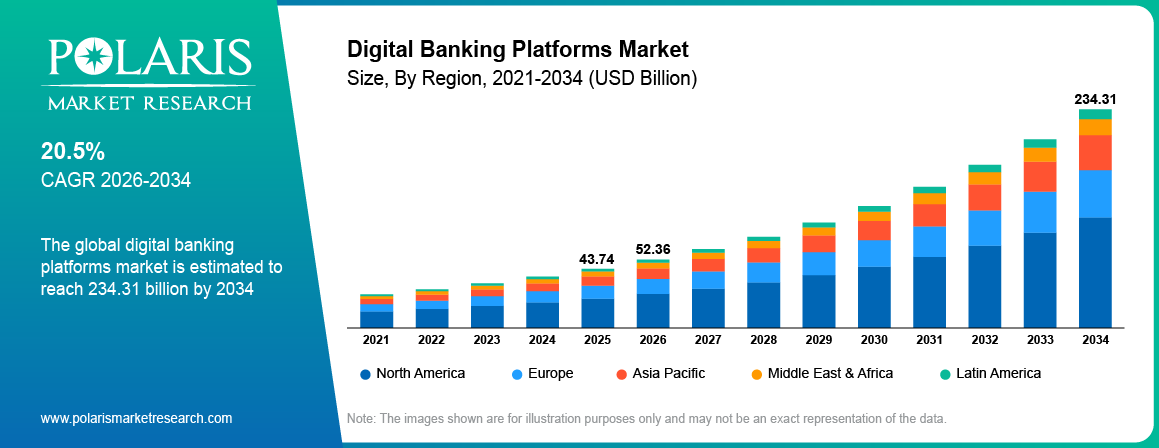
The global digital banking platforms market was valued at USD 43.74 billion in 2025 and is expected to grow at a CAGR of 20.5% during the forecast period. The increasing usage of smartphones is expected to continue fueling the growth of the digital banking platforms market as more consumers demand convenient, accessible, and secure banking services from their mobile devices.
Market Statistics
Digital Banking Platforms Market Key Takeaways
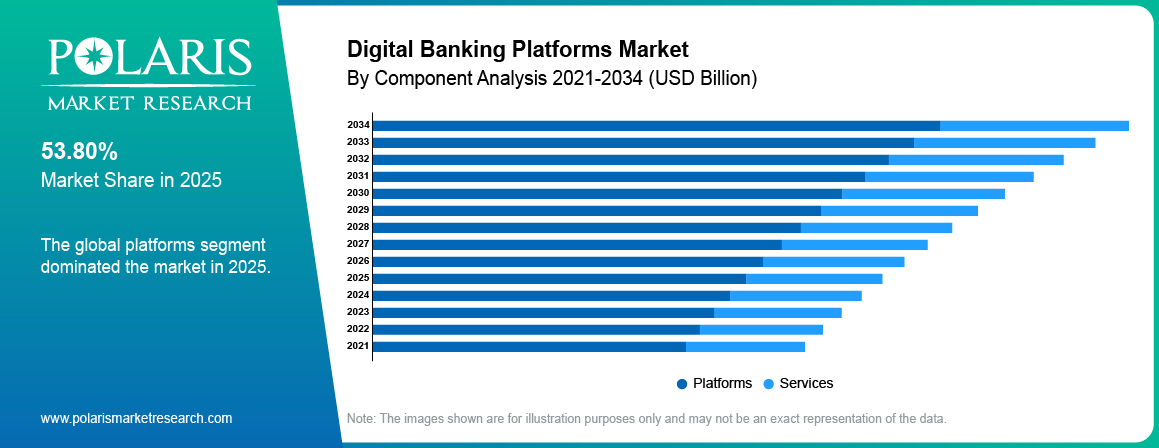
- By component, the platforms subsegment held the largest share of 53.80% in 2025. This is attributed to the foundation, which supports a plethora of digital banking services such as the processing of transactions and the management of customers.
- By deployment type, the cloud subsegment held the largest share of 43.50% in 2025, as it is the model that many financial institutions are adopting. This is mainly because of the numerous advantages the model tends to offer, which include flexibility, reduced costs, and the growing demand for scalability.
- By banking type, the retail banking segment held the largest share of 57.20% in 2025. This is due to the large customer base and high volume of transactions that generate strong demand for easy-to-use and convenient digital solutions.
- By banking mode, online banks held the largest share of 40.41% in 2025 as they have a strong prominence and multitude of use cases. This is primarily due to the strong legacy physical infrastructure and widespread adoption of the internet among traditional bank customers.
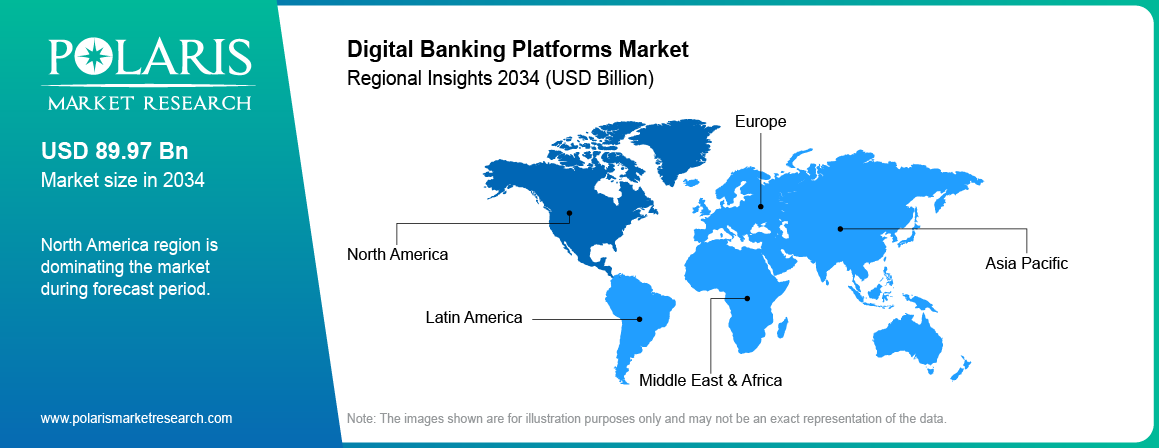
- By region, North America held the largest share of 38.40% in 2025. This is as a result of having a strong, developed technological system in place.
Note: Figures and projections outlined in this report are the result of Polaris Market Research’s proprietary analytical processes, grounded in the latest available datasets and market observations.
Digital Banking Platforms Market Trends and Growth Dynamics
- The strong demand from customers for bank services that are easy and accessible is a major fuel for growth. With the increasing demand for mobile phones and other digital technological devices, customers are now able to monitor their balances or manage their bank accounts from any place and at any time.
- For operational streamlining and cost optimization, banks are migrating from traditional manual practices to automated systems to enhance productivity in financially aided decision-making, real-time data utilization, and timely service delivery.
- The market growth has also been fueled by the fast incorporation of new technologies such as artificial intelligence, machine learning, and cloud computing.
Source: Polaris Market Research Analysis
To Understand More About this Research: Download Sample Report
AI and Generative AI Impact on Digital Banking Platforms
- AI helps to enhance customer experience through personalized services, predictive analytics, and real-time support across digital banking platforms.
- AI helps to analyze transaction patterns and flags suspicious activities with greater accuracy.
- AI-driven chatbots and virtual assistants streamline customer service, reducing operational costs and improving user satisfaction in digital banking.
- Intelligent automation powered by AI accelerates loan processing, compliance checks, and onboarding, boosting efficiency and reducing human intervention.
What Is a Digital Banking Platform and How Does It Work?
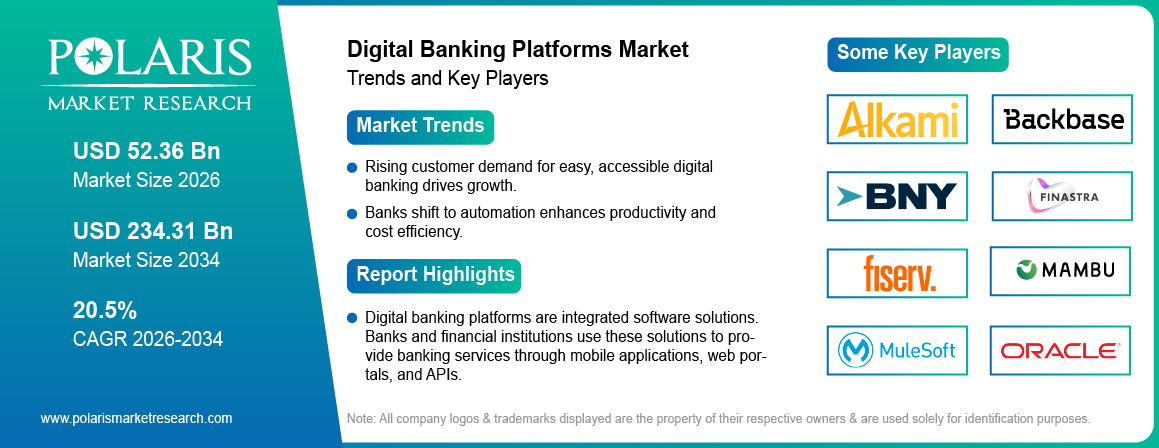
Digital banking platforms are integrated software solutions. Banks and financial institutions use these solutions to provide banking services through mobile applications, web portals, and APIs. These platforms support account management, digital payments, lending, customer engagement, and financial transactions. They help improve operational efficiency, scalability, security, and user experience across modern digital financial ecosystems.
Digital Banking vs Traditional Banking
| Parameter | Digital Banking | Traditional Banking |
| Accessibility | Provides 24/7 access through mobile apps, websites, and digital channels from any location. | Limited to physical branch locations and operating hours for most banking services. |
| Cost Structure | Lower operational costs due to automation, cloud infrastructure, and reduced branch dependency. | Higher operational expenses driven by branch networks, staffing, and physical infrastructure maintenance. |
| Transaction Speed | Enables real-time or near-instant transactions, approvals, and account services. | Processing times are often slower because of manual verification and branch-based procedures. |
| Customer Experience | Offers personalized, seamless, and self-service experiences supported by AI, analytics, and digital interfaces. | Relies heavily on face-to-face interactions and manual customer support processes. |
| Operational Efficiency | Streamlines workflows using automation, APIs, and digital integration to improve scalability and productivity. | Operational processes are comparatively slower and resource-intensive due to paper-based and manual systems. |
| Service Availability | Services are continuously available through smartphones, tablets, and online banking platforms. | Availability depends on branch timings and in-person service access. |
| Scalability | Easily scalable across regions and customer segments using cloud-based infrastructure. | Expansion requires significant investment in branches and workforce. |
| Security Approach | Uses biometric authentication, encryption, AI-based fraud detection, and multi-factor authentication. | Depends more on physical verification, branch controls, and traditional security systems. |
| Customer Reach | Can quickly serve remote and underserved populations through digital channels. | Customer reach is constrained by branch presence and geographic limitations. |
| Data & Analytics | Provides real-time customer insights and data-driven financial services. | Limited real-time analytics due to fragmented legacy systems and manual processes. |
Source: Polaris Market Research Analysis
The increasing adoption of smartphones is expected to fuel the market's growth. With the growing use of smartphones, more people are accessing digital banking platforms from their mobile devices. This has led to a surge in demand for digital banking services and has allowed digital banking platforms to grow. Consumers are increasingly demanding convenient, personalized, and easy-to-use banking services. Digital banking platforms have provided this service and convenience, leading to increased adoption. According to online retailer Flipkart in the first half of 2022, premium smartphone demand increased by 25%, with Tier-2 towns driving growth.
Source: Polaris Market Research Analysis
Digital Banking Platforms Market Drivers, Opportunities and Challenges
Digital Banking Platforms Market Growth Drivers
Rapid technological advancement has enabled digital banking platforms to provide customers with innovative and secure banking services. For example, using artificial intelligence, machine learning, and data analytics has enabled digital banks to offer personalized services to their customers. The need for cost optimization is fuelling the growth of the market. Traditional banks have high overhead costs, making offering competitive rates and fees difficult. Digital banking platforms have lower operating costs, making it easier for them to offer attractive rates and prices to their customers. Governments and regulatory bodies support the growth of digital banking platforms as they provide greater financial inclusion and access to banking services. This has led to increased investment and development in the sector.
Digital Banking Platform Challenges: Cybersecurity, Compliance and Legacy Integration
- Cybersecurity Risks: Digital transactions and cloud-based banking operations are increasing across the world. They expose institutions to cyberattacks, data breaches, fraud, ransomware, and identity theft threats.
- Regulatory Complexities: Evolving financial regulations, data privacy laws, anti-money laundering (AML) requirements, and compliance standards increase operational complexity and implementation costs.
- Legacy System Integration: Many banks operate on outdated core banking infrastructure. They may not integrate efficiently with modern digital platforms, APIs, AI technologies, and cloud-based systems.
- High Technology Upgrade Costs: Continuous investments in cloud infrastructure, cybersecurity tools, AI integration, and digital transformation initiatives create financial pressure for banks and financial institutions.
- Digital Skill Gaps: Lack of skilled IT professionals, cybersecurity experts, and digital banking specialists hinder platform deployment, innovation, and operational efficiency.
Digital Banking Platforms Market Segmentation Analysis
The market is primarily segmented based on component, deployment type, banking type, banking mode and region.
| By Component | By Deployment Type | By Banking Type | By Banking Mode | By Region |
|
|
|
|
|
Source: Polaris Market Research Analysis
For Specific Research Requirements: Request for Customized Report
Platforms Segment Led the Digital Banking Platforms Market with 53.80% Share in 2025
The platforms segment is projected to have a higher growth rate. Digital banking platforms provide open APIs (Application Programming Interfaces) that enable third-party developers to create applications and services that integrate with the platform. This allows for greater customization and flexibility for both banks and customers. This will propel the growth of the market. Digital banking platforms are designed to provide an intuitive and user-friendly interface that makes it easy for customers to navigate and use the forum. This includes features such as chatbots and virtual assistants that can answer customer questions and provide support. This offers a wide range of opportunities for the growth of the market.
Cloud Deployment Led the Digital Banking Platforms Market with 43.50% Share in 2025
The cloud segment accounted for the largest market share in 2025. The benefits of cloud-based deployment drive the development of the digital banking platforms market as more banks adopt digital banking platforms to improve their customer service, reduce costs, and stay competitive. The cloud segment also benefits from the increasing adoption of cloud computing technology across industries. As more businesses move their operations to the cloud, there is a growing demand for cloud-based digital banking platforms that integrate with other cloud-based systems.
Retail Banking Led the Digital Banking Platforms Market with 57.20% Share in 2025
The retail Banking segment is expected to grow more in the coming years. Retail banking provides financial services to individual consumers rather than businesses or other institutions. The development of retail banking has led to an increasing demand for digital banking services that can provide customers with easy access to their accounts, convenient payment options, and personalized financial advice. As more consumers switch to digital banking services, there is an increasing demand for digital banking platforms that deliver timely and customized experiences. For example, many banks now offer mobile payments, peer-to-peer (P2P) lending, and robo-advisory services to their customers through digital banking platforms.
Mobile Banking Platforms to Record Strong Growth During 2026-2034
The Mobile Banking segment is projected to witness a higher revenue share. With the growing popularity of smartphones, more consumers have access to mobile banking services. According to a report by Statista, the number of smartphone users worldwide is expected to reach over 3.8 billion in 2021, providing a large potential market for mobile banking services. Mobile banking offers a convenient and accessible way for consumers and businesses to manage their finances. With mobile banking, customers can access their accounts from anywhere and anytime, making checking account balances, making payments, and performing other banking tasks easier. This will fuel the growth of the market in the upcoming years.
Source: Polaris Market Research Analysis
The demand in Asia Pacific is expected to witness highest growth rate in coming years
Asia Pacific will witness a higher growth rate in the coming years. The Asia Pacific region is home to many fintech startups introducing innovative digital banking platforms and disrupting traditional banking models. Fintech has dominated India's investors, customers, and entrepreneurs over the past few years due largely to the smartphone revolution and affordable data plans. According to an EY analysis, India has a fintech adoption rate of 87%, a staggering 20% higher than the global average of 64%. According to the estimate, the Indian fintech business will be worth USD 200 billion overall by 2030. This is driving competition and innovation in the market and is contributing to the growth of the market in the region.
North America is expected to have the largest revenue share of 38.40% in the market due to the region's high level of technology adoption, strong customer demand for digital banking services, and large banks investing heavily in digital banking infrastructure. North America is one of the most technologically advanced regions in the world, with a high level of technology adoption among consumers and businesses. By 2025, 5G adoption is predicted to completely dominate the wireless services market in North America, according to GSMA Intelligence. This creates a favorable environment for the growth of digital banking platforms, which offer fast, efficient, and convenient financial services.
Source: Polaris Market Research Analysis
Digital Banking Platforms Market Competitive Landscape
Some of the major players operating in the global market include Alkami, Appway, Backbase, BNY Mellon, EdgeVerve, Finastra, Fiserv, Mambu, MuleSoft, NETinfo, Oracle, SAP, Sopra Banking, TCS, Temenos, TPS, Velmie and Worldline.
Leading Digital Banking Platform Companies
- Alkami
- Appway
- Backbase
- BNY Mellon
- EdgeVerve
- Finastra
- Fiserv
- Mambu
- MuleSoft
- NETinfo
- Oracle
- SAP
- Sopra Banking
- TCS
- Temenos
- TPS
- Velmie
- Worldline
Digital Banking Platforms Market Recent Developments
- April 2026: BMO announced the national U.S. rollout of a simplified Online Banking for Business (OLBB) experience. It is designed for small and midsized enterprises (SMEs) and Emerging Middle Market (EMM) clients. The new platform would provide an easier-to-use online banking experience built for everyday business requirements. (Source: PRNewswire)
- In February 2025, Temenos reached an agreement to divest Multifonds to Montagu Private Equity for approximately USD 400 million, as part of its strategy to concentrate on core banking solutions. (Source: temenos.com)
Digital Banking Platforms Market Report Scope
| Report Attributes | Details |
| Market size value in 2025 | USD 43.74 billion |
| Market size value in 2026 | USD 52.36 billion |
| Revenue forecast in 2034 | USD 234.31 billion |
| CAGR | 20.5% from 2026- 2034 |
| Base year | 2025 |
| Historical data | 2021- 2024 |
| Forecast period | 2026 - 2034 |
| Quantitative units | Revenue in USD billion and CAGR from 2026 to 2034 |
| Segments covered | By Component, By Deployment Type, By Banking Type, By Banking Mode, By Region |
| Regional scope | North America, Europe, Asia Pacific, Latin America; Middle East & Africa |
| Key companies | Alkami, Apiture, Appway, Backbase, BNY Mellon, CR2, EdgeVerve, ebankIT, Finastra, Fiserv, Intellect Design Arena, Mambu, MuleSoft, nCino, NCR, NETinfo, Oracle, SAP, Sopra Banking Software, TCS, Technisys, Temenos, TPS, Velmie and Worldline. |
Source: Polaris Market Research Analysis
Digital Banking Platforms Market FAQs
The digital banking platforms market report covering key segments are component, deployment type, banking type, banking mode and region.
Digital Banking Platforms Market Size Worth $234.31 Billion By 2034.
The global digital banking platforms market expected to grow at a CAGR of 20.5% during the forecast period.
North America held the largest share of 38.40% in 2025. This is as a result of having a strong, developed technological system in place
key driving factors in digital banking platforms market are increase in focus of organizations on digitalizing their financial services.
Download Sample Report of digital banking platforms market
Please fill out the form to request a customized copy of the research report.


