
Carrageenan Market Size & Growth Forecast (2027–2034) by Type, Grade, Application and Region
REPORT DETAILS
Carrageenan Market Summary
The global carrageenan market is estimated at USD 996.03 million in 2026 and is projected to reach USD 1.05 billion in 2027, expanding to USD 1.57 billion by 2034 at a CAGR of 5.9% during 2027–2034. Food makers use carrageenan to thicken, gel and stabilise dairy, meat and plant-based products, and demand is rising with dairy alternatives and processed meats. Its plant-based, seaweed origin makes it a common replacement for animal gelatin in vegan and halal products.
Market Statistics
Key Takeaways
• Kappa carrageenan holds the largest type share, an estimated 65.7% of revenue in 2026, because it forms the firm gels used in meat, dairy desserts and pet food.
• The semi-refined carrageenan segment leads by processing technology with an estimated 50.0% share in 2026, reflecting its cost competitiveness and broad industrial use..
• Food and beverages lead applications with an estimated 71.2% share in 2026, while personal care and pharmaceuticals form a smaller, higher-value niche.
• Supply depends on farmed red seaweed from Indonesia and the Philippines, so weather and seaweed prices strongly affect costs.
• Europe holds the largest regional share, at an estimated 33.8% in 2026, supported by established food processing and texturant consumption.
• Asia Pacific accounts for an estimated 29.0% regional share and is expected to grow fastest.
• Consolidation among large texturant suppliers is reshaping the competitive field, led by deals involving Tate & Lyle, CP Kelco and Ingredion.
Carrageenan is a natural additive used as a thickener, emulsifier, and to preserve food and drinks. It is extracted from red seaweeds also known as Irish moss and is a common ingredient in yogurt, nut milk, and meat products.
Know more about this report: Download Sample Report
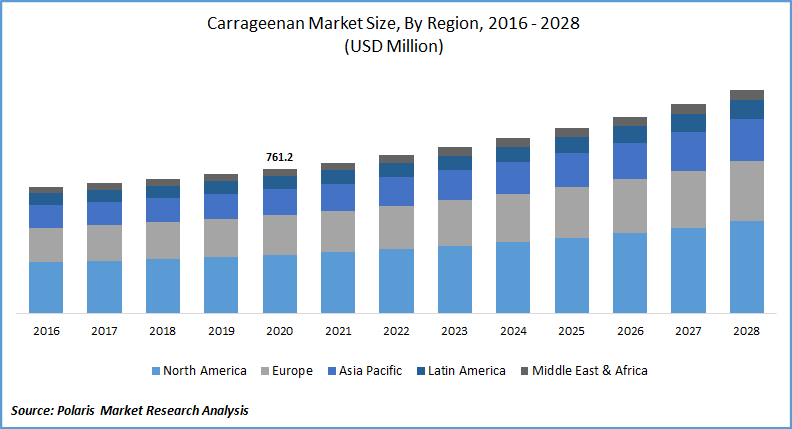
Key factors responsible for the carrageenan market growth include rising demand for thickeners and gelling agents in cosmetics, pharmaceutical, food, personal care industries, particularly in emerging nations, and growing consumer shift towards carrageenan as a substitute for gelatin, owing to its vegan origin.
Product is being used in several food sectors such as meat products, sauces, stabilizing agents, dairy products, and bakery and confectionery. Moreover, the growing preference of consumers towards natural ingredients also favoring the uptick in market demand for carrageenan.
Know more about this report: Download Sample Report
Carrageenan Market Report Scope
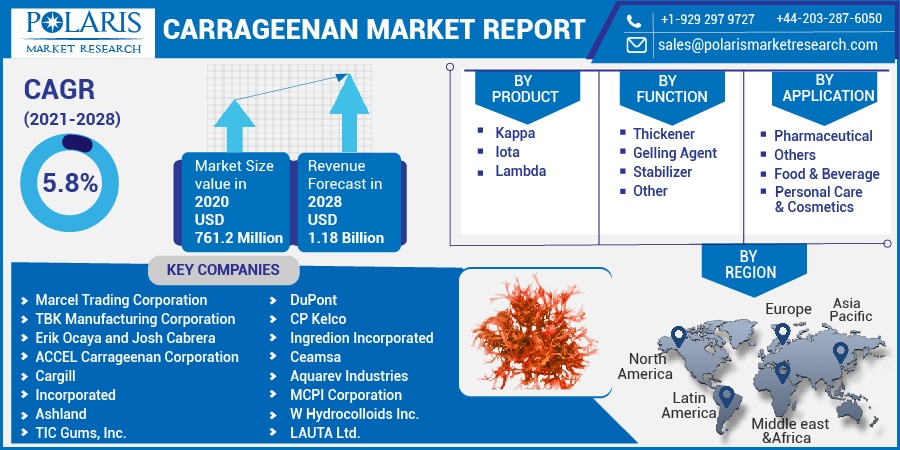
The market is primarily segmented on the basis of product, function, application, and geographic region.
| By Product | By Function | By Application | By Region |
|
|
|
|
Source: Polaris Market Research Analysis
Know more about this report: Download Sample Report
Insight by Product
Kappa market segment accounted for the largest revenue share, in 2020 and likely to witness the highest growth rate over the carrageenan market forecast period. This is one of the natural extracted from red seaweed species, which are later processed and farmed at the refining facilities. It is used as a thickener, gelling, binding, stabilizer, and emulsifier agent. Majorly, it is used in cooked ham, poultry rolls, and turkey breast.
It was estimated that more than 70 percent of the global carrageenan production comprises of kappa type and majorly utilized in the food and beverage industry, where acts as a binder and emulsifying agent in cheese, chocolates, and ice-creams. It also forms a gel with calcium salts. It is also known for its gelling capacity.
The Lambda market segment is projected to witness a lucrative market growth rate over the study period. It is cold, water-soluble, and used as a thickener, which develops a creamy sensation in dairy products. This is the type that requires high temperature for hydration, having more than 35 percent of ester sulfate and a small proportion of 3.6 percent anhydro galactose, which makes it more viscous and denser.
Insight by Function
In 2020, the thickener market segment accounted for the largest share. These are the substances that are used to enhance viscosity without damaging other properties and classified as food and non-food-grade thickeners. Also used as an additive in the food & beverage industry and is approved by concerned administrative institutions.
The growing adoption of natural food-grade thickeners is also one of the prominent factors boosting the market growth for carrageenan. A surge in healthy, nutritional food products, sustaining demand for carrageenan as a thickening agent is also likely to support market growth. Moreover, a growing trend towards clean label products also opening few opportunities for novel food formulations in the food & beverage industry thereby driving carrageenan market demand.
Gelling agent market segment is projected to witness the highest growth rate over the assessment period. All three major types of carrageenan possess excellent gelling properties. Lambda forms less rigid and more elastic, and kappa makes stiff gel.
Growing applications of these agents in the bakery & confectionary industry to have desired texture also favoring its market growth. Moreover, growing consumption and changing eating patterns in developing nations also anticipated boosting the market demand for carrageenan.
Geographic Overview
In 2020, the North America carrageenan industry accounted for a significant share of the global market. The U.S. is the largest contributor, followed by Canada, owing to its high agricultural activities seeking high productivity, leading to the high demand for bio-stimulants products in the region, which majorly prefers agar and carrageenan, offering high productivity. These factors are likely to fuel the region’s growth prospects.
This high carrageenan demand is mostly driven by the food & beverage industry, as there is a growing inclination towards ingredients-based food formulation products. However, rising consumer awareness regarding toxicity led to more use of natural additives. Moreover, rapid research and development to find new natural additives in the industry benefiting market growth for carrageenan.
List Of Key Companies
- carrageenan are DuPont
- CP Kelco
- Ingredion Incorporated
- Ceamsa
- Aquarev Industries
- MCPI Corporation
- W Hydrocolloids Inc.
- LAUTA Ltd.
- Marcel Trading Corporation
- TBK Manufacturing Corporation
- Erik Ocaya and Josh Cabrera
- ACCEL Carrageenan Corporation
- Cargill
- Incorporated
- Ashland
- TIC Gums, Inc.
Carrageenan Industry Developments
In August 2026, Bracco Imaging announced that its ultrasound contrast delivery system, VueJect, has received U.S. FDA 510(k) clearance and Health Canada authorization. “It's a system specifically designed for contrast-enhanced ultrasound exams in cardiology which allows for more standardized and consistent administration of ultrasound contrast agents. The development underscores rising investment compared to delivery systems that bolster diagnostic imaging efficiency and examination consistency. (Source: Bracco Imaging)
In June 2026, Bayer announced that the U.S. Food and Drug Administration approved AMBELVIST (gadoquatrane) a macrocyclic gadolinium-based contrast agent for magnetic resonance imaging. This product is indicated for the detection and visualization of lesions with abnormal vascularity within the central nervous system and other areas of the body in adult and pediatric patients including term neonates. The approval supports the development of low-dose contrast media technologies and strengthens Bayer’s diagnostic imaging portfolio. (Source: Bayer)
In April 2026, GE HealthCare announced the dosing of the first patient in its international Phase 2/3 LUMINA clinical trial evaluating mangaciclanol, an investigational manganese-based MRI contrast agent. The company has started dosing patients at Mayo Clinic in Rochester, Minnesota, in its work to develop alternatives to gadolinium-based contrast agents. The development reflects growing research investment in alternative contrast media formulations, although the agent is still investigational. (Source: GE HealthCare)
Carrageenan Market FAQ's
The carrageenan market is valued at USD 996.03 million in 2026 and is expected to reach USD 1.05 billion in 2027 and USD 1.57 billion by 2034, according to Polaris Market Research.
The carrageenan market is projected to grow at a CAGR of 5.9% from 2027 to 2034, adding roughly USD 519.00 million in value over the forecast period.
Food makers use carrageenan to thicken, gel and stabilise dairy, meat and plant-based products, and demand is rising with dairy alternatives and processed meats. Its plant-based, seaweed origin makes it a common replacement for animal gelatin in vegan and halal products.
The main applications are dairy, meat and poultry, plant-based foods, beverages, personal care, and pharmaceuticals. Plant-based dairy and meat alternatives are the fastest-growing users.
Growing consumer preference for natural, plant-based ingredients, clean-label products, dairy alternatives, processed meats, and vegan alternatives to gelatin drives increasing carrageenan demand globally.

Download Sample Report of Carrageenan Market
Please fill out the form to request a customized copy of the research report.


