
Automation Testing Market Size, Share,Trends, Industry Analysis Report, 2026 - 2034
REPORT DETAILS
Automation Testing Market Summary
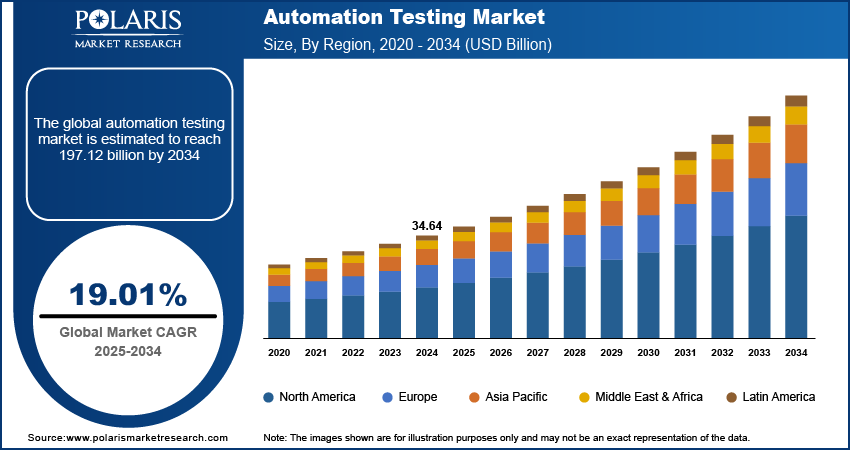
The global automation testing market size was valued at USD 36.44 billion in 2025. The market is projected to grow at a CAGR of 14.6% during 2026 to 2034. Key factors driving demand for automation testing include increasing software complexity, widespread use of mobile applications, and integration of artificial intelligence and machine learning.
Market Statistics
Key Takeaways
- North America had the largest revenue share of 38.71% in 2025, due to the widespread dispersion of technology suppliers.
- Asia Pacific is expected to witness the fastest CAGR of 15.3% in the global market during the forecast period, owing to the increasing adoption of mobile and web-based apps and cloud-based services.
- The U.S. led the North American market with 78.80% share in 2025. Rising demand for smart consumer electronics such as smart TVs, home appliances, and laptops in the U.S. drives the dominance.
- Based on the service segment, the implementation services segment is expected to grow at a CAGR of 14.6% during the forecast period.
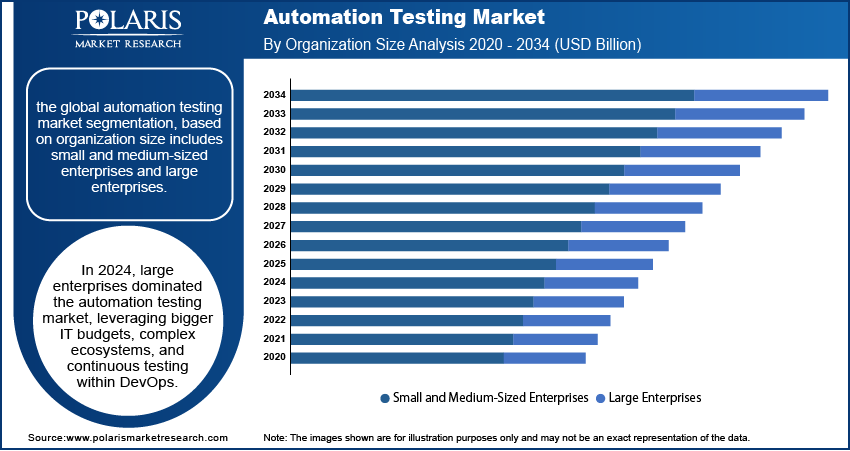
- The large enterprises segment dominated with 69.10% revenue share in 2025. Large enterprises comprise complex systems, multiple applications, and a high volume of test cases. Hence, they adopt automation testing to enhance efficiency and reduce manual effort.
Industry Dynamics
- The growing usage of mobile applications is creating the demand for automation testing.
- The increasing development of online gaming platforms is further propelling the market growth.
- The ongoing digital transformation across the globe will create lucrative automation testing market opportunities in the coming years.
- Stringent government rules and regulations hamper the market growth.
Impact of AI in Automation Testing Market
- AI helps in smarter test case generation and faster defect detection.
- The technology improves test coverage through predictive analytics.
- It allows testers to create scripts with minimal coding.
- The technology transforms the market through self-healing test automation, where scripts automatically adapt to UI changes without manual intervention
- AI-powered platforms enable intelligent test prioritization, reducing execution time while improving defect detection accuracy.
What is Automation Testing?
Automation testing is the process of using specialized software tools and scripts to execute test cases automatically. It is used to compare actual outcomes with expected results and generate reports. The automated testing reduces manual effort and improves testing speed. It also ensures consistent quality across software applications in complex and large-scale development environments.
How Automation Testing Works?
Automation testing creates predefined test scripts. These scripts simulate user actions and system responses. They are executed through testing tools across browsers, devices, and platforms. The systems validate functionality, performance, and reliability. Using the process, defects are identified early and reported for faster issue resolution
Source: Polaris Market Research Analysis
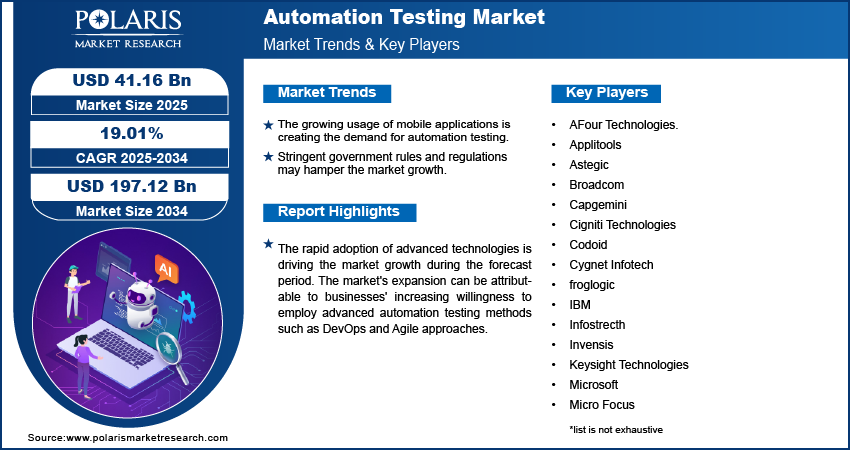
The rapid adoption of advanced technologies is driving the market growth during the forecast period. The market's expansion can be attributable to businesses' increasing willingness to employ advanced automation testing methods such as DevOps and Agile approaches. These approaches assist firms in shortening the time it takes to commercialize their software solutions by reducing the time it takes to automate analysis. Quick bug elimination, post-deployment debugging, and software integration of unforeseen changes are also provided by Agile, and DevOps approaches. These advantages are anticipated to increase demand for elegant and DevOps-based automated analysis across various sectors, including monetary services, telecommunications, automotive, government, and public. To stay competitive, different market competitors are focusing on building test automation solutions based on Agile and DevOps methodologies.
Each test cycle produces a large amount of data that can be utilized to discover and resolve test failures. The data from each test run can be sent back to the AI algorithms. With the growing benefits of incorporating AI into analysis, the need for technology has risen. With more AI being used in the development of test tools, the tools will self-heal at runtime. Self-healing test automation analysis is expected to be one of the most popular automation analysis trends in the coming years. Thus, market players are introducing new products into the automation testing market.
Modern technologies such as IoT, AI, and machine learning continue to expand. The automated analysis market has tremendous potential to evaluate advanced technical applications. The majority of the company's work is managed digitally and through rule-based software. When it comes to dealing with serious situations, this strategy is limited.
What is the Difference Between manual vs automation testing?
Comparison Matrix: Manual Testing vs Automation Testing
| Aspect | Manual Testing | Automation Testing |
| Definition | Testing performed manually by human testers without tools or scripts | Testing performed using automated tools and scripts |
| Execution Speed | Slow and time-consuming | Fast and efficient |
| Accuracy | Prone to human errors | High accuracy with consistent results |
| Cost | Lower initial cost but higher long-term effort | Higher initial setup cost but cost-effective long-term |
| Best Suited For | Exploratory, usability, and ad-hoc testing | Regression, performance, and repetitive testing |
| Skill Requirement | Basic testing knowledge required | Requires programming and tool expertise |
| Test Reusability | Low (tests must be repeated manually) | High (scripts can be reused multiple times) |
| Scalability | Limited for large projects | Highly scalable for complex applications |
| Maintenance Effort | Low | Moderate to high (scripts need updates) |
| Human Intervention | Required throughout the process | Minimal once scripts are developed |
Source: Polaris Market Research Analysis
Automation Testing ROI & Cost Economics
Automation testing delivers a strong ROI by reducing manual effort, improving software quality, and accelerating release cycles. Although organizations face initial costs for tools, setting up frameworks, infrastructure, and training, these expenses are balanced by long-term savings. Agile test automation facilitates quick regression testing during short sprints. It reduces testing time by 40 to 70% and shortens release delays.DevOps automation testing enhances cost efficiency by incorporating automated tests into CI/CD pipelines. It reduces rework and defect-related costs after releases. As automation grows, the cost per test execution goes down. This enables wider test coverage across devices, browsers, and APIs without significant cost increases. Most companies see a return on investment within 6 to 18 months, especially in high-frequency release settings like SaaS and mobile apps. Overall, automation testing moves quality assurance away from labor-heavy methods to a more scalable and predictable cost model.
Source: Polaris Market Research Analysis
Automation Testing Market Drivers?
Rapid Adoption of Advanced Technologies
The use of technologies such as AI, machine learning, cloud computing, the Internet of Things, and big data analytics is increasing in many industries. Enterprises deploy complex, distributed applications that require faster release cycles and higher reliability. It makes manual testing impractical. DevOps automation testing has become essential as organizations integrate continuous integration/continuous deployment (CI/CD) pipelines to accelerate innovation while maintaining quality. For instance, AI-powered test automation tools help predict areas prone to defects, improve test coverage, and allow self-repairing test scripts. Similarly, cloud-native and microservices architectures need testing frameworks that can scale and automate. These frameworks should check APIs, performance, and security in various environments. Agile test automation helps with frequent code changes by allowing quick regression testing. This ensures that new technologies can be launched confidently and without delaying the time to market. Thus, the growing use of new technologies fuel the automation testing industry growth.
Increasing Adoption of Mobile and Web-Based Services
Numerous industries like banking, retail, healthcare, and media increasingly adopt mobile and web-based services. Users seek smooth performance across devices, browsers, and operating systems. This makes applications more complex and requires more testing. Agile test automation allows development teams to check frequent updates, user interface changes, and integrations during short sprint cycles. For example, digital banking apps need automated functional, security, and performance testing to maintain consistent service during feature updates. Likewise, e-commerce platforms depend on DevOps automation testing to validate web and mobile experiences during busy events like flash sales. Automation testing tools ensure compatibility across browsers, validate responsive designs, and find bugs more quickly. This enables the continuous delivery of reliable mobile and web-based services at scale. Thus, growing adoption of mobile and web-based services drives the market growth.
Automation Testing Market Restraints
Stringent Government Rules and Regulations
Governments establish data regulatory norms in various economies to protect data from unwanted access. Regulations such as GDPR in Europe, CCPA in the U.S., and emerging data protection laws in Asia require strict controls over how test data is accessed, stored, and processed. Other rules include the Health Insurance Portability and Accountability Act (HIPAA) in the U.S. and the Data Protection Directive in the European Union. Industry players must follow several regional rules regarding data storage, security, and privacy. Data stored on-premises is entirely secure/. However, data stored on the cloud is exposed to security risks. Ensuring data security in automation testing becomes more complex when organizations use production-like datasets for functional and performance testing. Automated test scripts often handle sensitive personal or financial information. This raises compliance risks if data masking, encryption, or access controls are not strong enough. These regulatory requirements can slow down DevOps automation testing efforts. Extra validation, audits, and approvals are necessary before launching automated frameworks. As a result, organizations may experience higher implementation costs and longer testing cycles. This undermines the speed and flexibility that agile test automation seeks to provide. Therefore, strict government rules about data protection and privacy hinder the growth of the automation testing market.
By Service
Automation testing by service is segmented into advisory and consulting, planning and development, support and maintenance, documentation and training, implementation, managed services, and others. The implementation services segment is expected to hold the global market revenue share in the coming years. With the help of implementation services, automation may be readily integrated into an existing software automation testing infrastructure. As a result, successful implementation of automated analysis solutions necessitates connecting the solutions with various hardware components and evaluating the overall system's functionality.
By Organization Size
Automation testing by organization size is segmented into small and medium-sized enterprises and large enterprises. The large enterprises segment dominated the revenue share in 2025. Large enterprises consist of complex systems, multiple applications, and a high volume of test cases. Thus, these enterprises adopt automation testing to enhance efficiency and reduce manual effort. Automation testing also help them increase test coverage and ensure the quality of software applications.
Automation Testing Adoption Patterns: Large Enterprises vs. SMEs
| Parameter | Large Enterprises | SMEs |
| Adoption Drivers | Digital transformation, risk mitigation, regulatory compliance | Faster time-to-market, cost efficiency, competitive pressure |
| Automation Scope | Enterprise-wide automation across web, mobile, API, and performance testing | Focused automation for core applications and regression testing |
| Approach | Mature agile test automation and DevOps automation testing integration | Selective automation aligned with agile teams |
| Tool Preference | Mix of commercial and enterprise-grade platforms | Open-source and cloud-based subscription tools |
| Investment Level | High upfront investment with long-term ROI focus | Lower initial spend with faster payback expectations |
| CI/CD Integration | Deep integration into complex CI/CD pipelines | Basic CI/CD or partial pipeline integration |
| Key Challenges | Test maintenance at scale, data security in automation testing | Skill gaps, budget constraints, limited infrastructure |
Source: Polaris Market Research Analysis
Source: Polaris Market Research Analysis
Geographic Overview
The automation testing market by region is segmented into North America, Europe, Asia Pacific, Latin America, and the Middle East & Africa. North America held the largest revenue share in 2025. The widespread dispersion of technology suppliers drove the North America automation testing market. Smart consumer electronics such as smart TVs, home appliances, and laptops are becoming increasingly popular in the U.S. are fueling market demand. In smart consumer gadgets, software, web applications, and operating systems (OS) are intricately linked. As these smart consumer products become more generally accepted, the demand for test automation services in the region will increase.
The Asia Pacific automation testing market is expected to witness a high CAGR in the global market in the coming years. The Asia Pacific region is the most promising since it includes essential economies like Australia, Japan, Singapore, China, New Zealand, and Hong Kong, all of which have significant growth potential for automation analysis organizations. Governments in the region are implementing initiatives to fasten the adoption of new technologies such as artificial intelligence and machine learning, automation, the Internet of Things, mobile and web-based apps, cloud-based services, and other innovations, which is driving the demand for automation testing.
Source: Polaris Market Research Analysis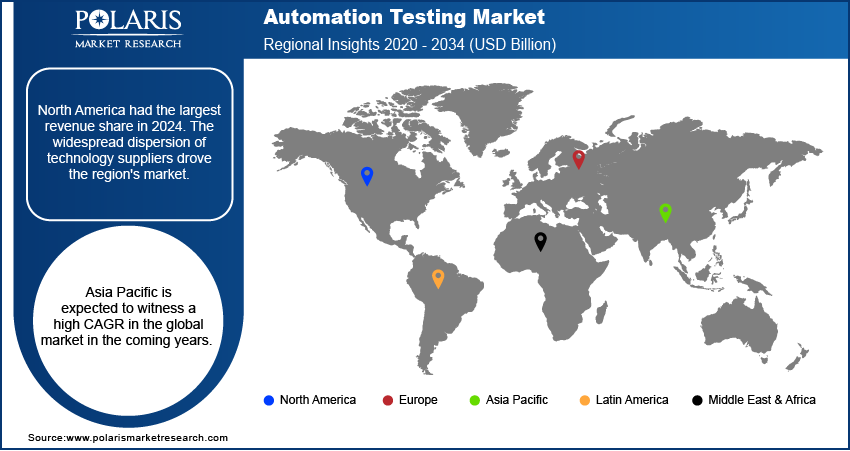
Competitive Insight
- Sauce Labs
- AFour Technologies.
- Invensis
- Keysight Technologies
- Broadcom
- Applitools
- Cygnet Infotech Astegic
- Mobisoft Infotech
- Parasoft
- ProdPerfect
- Microsoft
- Cigniti Technologies
- Infostrecth
- QA Source
- Codoid
- froglogic
- Capgemini
- Micro Focus
- IBM
- QA Mentor
- Ranorex
- Smartbear Software
- Testim.io
- Tricentis
- Thinksys
- Worksoft.
Recent Developments
- March 2025: Cognizant unveiled a USD 1 billion AI enablement initiative aimed at boosting productivity in automated testing and embedded engineering. (Source: cognizant.com)
- November 2024: SEALSQ Corp pivoted toward developing Quantum-Resistant chips, redefining security testing requirements for upcoming generations of applications. (Source: sealsq.com)
Automation Testing Market Segmentation
By Testing Type Outlook (Revenue – USD Billion, 2021–2034)
- Static Testing
- Dynamic Testing
- Functional
- Non-Functional
- Performance
- API
- Security
- Compatibility
- Compliance
- Usability
By Service Outlook (Revenue – USD Billion, 2021–2034)
- Advisory and Consulting
- Planning and Development
- Support and Maintenance
- Documentation and Training
- Implementation
- Managed Services
- Others
By Organization Size Outlook (Revenue – USD Billion, 2021–2034)
- Small and Medium-Sized Enterprises
- Large Enterprises
By Vertical Outlook (Revenue – USD Billion, 2021–2034)
- Banking
- Financial Services
- Insurance
- Automotive
- Defense and Aerospace
- Healthcare and Lifesciences
- Retail
- Telecom and IT
- Logistics and Transportation
- Energy and Utilities
- Media and Entertainment
- Other Verticals
By Regional Outlook (Revenue – USD Billion, 2021–2034)
- North America
- U.S.
- Canada
- Europe
- France
- Germany
- UK
- Italy
- Netherlands
- Spain
- Austria
- Asia Pacific
- China
- India
- Japan
- Malaysia
- South Korea
- Indonesia
- Rest of Asia Pacific
- Latin America
- Mexico
- Brazil
- Argentina
- Rest of Latin America
- Middle East & Africa
- UAE
- Saudi Arabia
- Israel
- South Africa
- Rest of Middle East & Africa
Automation Testing Market Report Scope
| Report Attributes | Details |
| Market Size in 2025 | USD 36.44 Billion |
| Market Size in 2026 | USD 41.74 Billion |
| Revenue Forecast by 2034 | USD 124.61 Billion |
| CAGR | 14.6% from 2026 to 2034 |
| Base Year | 2025 |
| Historical Data | 2022–2024 |
| Forecast Period | 2026–2034 |
| Quantitative Units | Revenue in USD Billion, 2021–2034 and CAGR from 2026 to 2034 |
| Report Coverage | Revenue Forecast, Market Competitive Landscape, Growth Factors, and Trends |
| Segments Covered |
|
| Regional Scope |
|
| Competitive Landscape |
|
| Report Format | PDF + Excel |
| Customization | Report customization as per your requirements with respect to countries, regions, and segmentation. |
Source: Polaris Market Research Analysis
automation testing market FAQ's
The global automation testing market is expected to reach USD 124.61 billion by 2034, at a CAGR of 14.6%.
AI and machine learning enable intelligent test case generation, predictive analysis, and adaptive testing. Integration of these technologies reduces maintenance time significantly and enhances test automation.
The banking segment leads automation testing adoption, driven by digital transformation requirements and regulatory compliance requirements.
Agile and DevOps adoption and cloud-based testing platforms drive automation testing demand. Also, increasing mobile applications and continuous deployment practices fuel the market growth.
Cloud-based automation tools offer scalability, cost-effectiveness, flexibility, and accessibility. These features make them attractive for SMEs and startups seeking efficiency.
Download Sample Report of automation testing market
Please fill out the form to request a customized copy of the research report.


