Twin screw extruders are among the most widely used industrial machines. These extruders allow industries to produce materials on a consistent basis. They also enable good control over processes and keep quality consistent. With growing adoption of advanced manufacturing and rising focus on sustainability, the demand for twin screw extruders is growing. This blog explains how twin screw extruders work and what their benefits are. It also details the factors driving the twin screw extruders market landscape.
What Are Twin Screw Extruders?
A twin screw extruder has two screws. These screws rotate inside a long barrel. They move and mix materials as they rotate. Depending on the specific requirements, the screws can turn in the same direction or in opposite directions.
The design of twin screw extruders allows for more even mixing of materials. Also, the melting and control is better than their single-screw counterparts. As such, they are used in many industries that need high accuracy. Examples include plastic compounds, specialty chemicals, and certain pharmaceuticals. They also find applications in the bulk food ingredients market.
How Do Twin Screw Extruders Work?
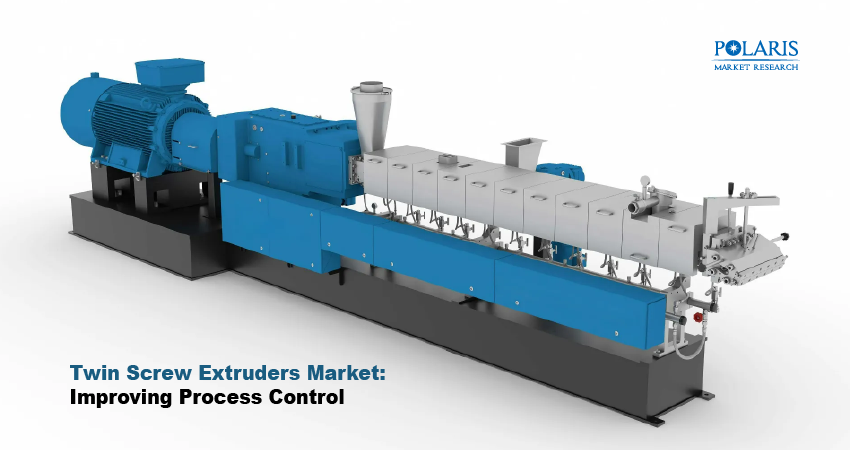
There are several components that make up twin screw extruders. These include the feeding system, barrel, screws, drive, heating/cooling, venting, die, controls, and downstream equipment.
Feeding System: The feeding system comes with a hopper that allows for the addition of raw materials. The movement of the materials takes place through a feed opening in the screws. If required, extra materials such as powder or liquid fillers may be added through side feeders.
Barrel: The barrel is a metal tube that covers the screws. It is engineered for handling high heat and pressure. There are heating and cooling parts present in the barrel to maintain steady temperatures. Sometimes, oil or water may be used to prevent overheating.
Screws: The two screws inside the barrel are the main working parts. They can push, mix, or knead the material. The shape and speed of screws determine how well the material is blended and moved forward.
Drive System: The motor and gearbox provide the power to rotate the screw. The gearbox has two functions: regulating the screw's speed and providing the appropriate force to the screw.
Venting System: Venting systems provide a means for removing excessive amounts of air and gas from a material by drawing out moisture and/or solvents. This is performed either by venting to the atmosphere or to a vacuum.
Die Assembly: The die assembly is used to form the final shape of the extruded material by passing it through a number of different die assemblies, including rods, tubes, and sheets.
Machine Control System: The machine control system monitors all components of the machine. This ensures that the quality of the extrusions produced meets defined quality standards and produces a steady, uniform extruded product.
Downstream Equipment: This refers to cooling, stretching, and finishing devices that process and prepare the final product for extrusion. The downstream equipment will vary depending on the specific requirements of the final product being extruded.
What’s Driving Market Growth?
The twin screw extruders market is anticipated to witness sustained growth, as per our latest market analysis. The market for these extruders stood at USD 2.91 billion in 2024. The market is projected to account for a CAGR of 5.06% between 2025 and 2034.
There has been an increase in global manufacturing. This has led to increased demand for twin screw extruders in polymer processing and compounding. The global expansion of supply chains has boosted investments in twin screw extrusion technologies.
What Are Twin Screw Extruder Types?
Co-Rotating Twin Screw Extruders
Co-rotating twin screw extruders have both screws rotating in the same direction. This allows for excellent dispersive and distributed mixing. Co-rotating extruders are suitable for demanding compounding and mixing applications. These include nanocomposites, polymer compounding, and bio-based polymers market.
Counter-Rotating Twin Screw Extruders
The screws in these extruders rotate in opposite directions. This allows for strong conveying forces and applies low shear between the screw flights. Counter-rotating extruders are suitable for processing materials that are shear-sensitive. They are preferred for shaping applications, which include pipe extrusion and PVC compounding.
Parallel Screw Extruders
The diameter of parallel screw extruders from the twin screw extruders market is constant along the length in these extruders. This makes parallel screw extruders suitable for compounding and research applications. Parallel screw extruders are highly suitable for compounding materials like plastics. They offer benefits such as consistent dispersion and self-cleaning capabilities.
What’s New in Twin Screw Extruders Industry?
cpc Improves Performance with C-BEYOND
In July 2025, Colorplasticchemie (cpc) in Germany upgraded its ZSK twin screw extruders by using the Coperion C-BEYOND digital platform. The system collects data from all extruders in real-time. The data is displayed on its easy-to-read dashboards. With C-BEYOND, cpc can instantly check production levels and plan work better. The platform also enables machine health monitoring. Furthermore, tracking of energy use and CO? emissions for every kilogram produced is also done. Overall, the platform has enabled the company to make its production operations smoother and reduce downtime.
Conclusion
Extruders from the twin screw extruders market offer several benefits. These extruders allow for superior mixing and are compatible with several materials. Additionally, the modular design of these extruders means they can be tailored to diverse applications. Furthermore, continuous operations reduce downtime and allow for greater machine efficiency. In the coming years, we can expect to see market participants focusing on strategic developments and innovations to drive growth.