
Nitrile Gloves Market Size, Share & Growth Analysis, 2026–2034
REPORT DETAILS
Nitrile Gloves Market Summary
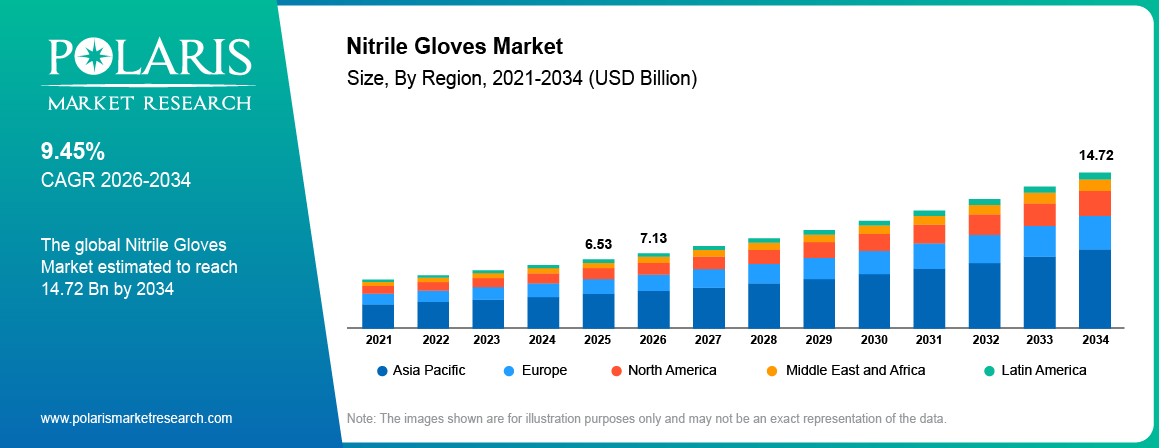
The global nitrile gloves market was valued at around USD 6.53 billion in 2025. The market is projected to register a CAGR of 9.45% from 2026 to 2034. Rising use of nitrile gloves in various industries, such as medical/healthcare, laboratory, pharmaceutical manufacturing, and food processing, drives the market growth. Growing preference for latex-free hand protection is also driving the market expansion.
Market Statistics
Nitrile Gloves Market Key Takeaways
- North America accounted for the largest share of 38.0% of the global market in 2025. The dominance is attributed to the presence of a well-developed healthcare system and high demand for disposable examination gloves. Also, stringent regulations related to workplace safety fuel the market expansion.
- In 2025, the U.S. led the North America market with the largest share of 83.0%. This is fueled by the presence of a huge hospital network, robust outpatient care facilities, diagnostic laboratories, dental care, and emergency service provider.
- The Asia Pacific market is expected to exhibit the CAGR of 10.90% during the forecast period. The growth is attributed to growing healthcare infrastructure and pharmaceutical production, medical research, food processing, electronics manufacturing, and other industries.
- The powdered nitrile gloves segment is expected to record a CAGR of 6.99% during the projected period. The growth is being driven by applications that benefit from faster donning, easier removal, and a reduction in friction during multiple glove changes.
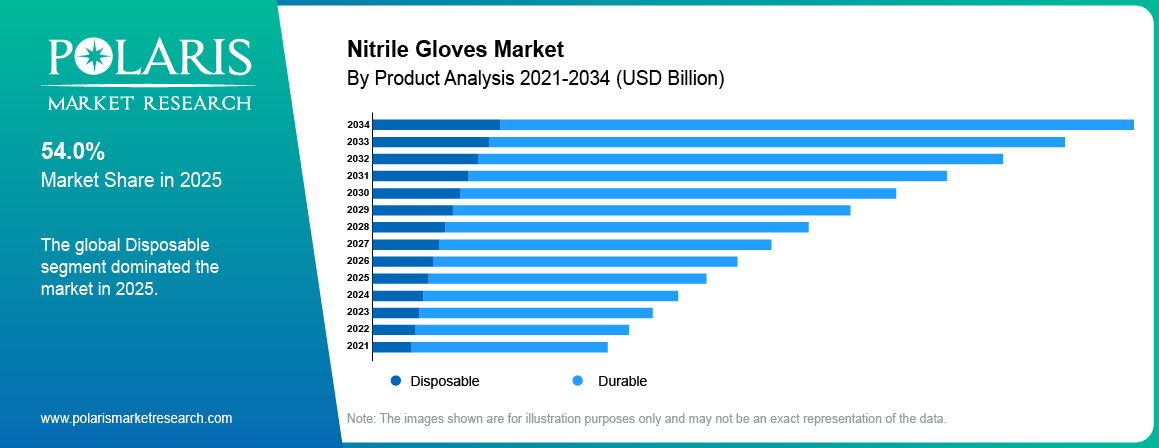
- In 2025, durable nitrile gloves held a 54.0% market share in fields that call for multiple uses, long term usage, and high level of resistance to friction, oil, chemical, and severe handling conditions.
- The non-medical segment is expected to register a CAGR of 10.01% during the forecast period. This is owing to the rising adoption of nitrile gloves in automotive refinishing and repair services, oil and gas, mining, metalworking, machinery, chemicals, and petrochemicals, food processing, pharmaceutical manufacturing, clean rooms, and research centers.
Note: Figures and projections outlined in this report are the result of Polaris Market Research’s proprietary analytical processes, grounded in the latest available datasets and market observation.
Nitrile Gloves in Simple Terms
Nitrile gloves are a type of disposable protective glove. The gloves are made from nitrile butadiene rubber, a synthetic rubber. They offer high puncture resistance, chemical resistance, good flexibility, and an alternative for users allergic to natural rubber.
Moreover, powder-free nitrile gloves are used in the food and dairy industries because of their properties, such as odorless and anti-static nature. These gloves are resistant to solvents, oils, some acids, and biohazards. They are more cut-safe than plastic and have a usable lifespan of 5 years. But conventional nitrile gloves cost more than latex gloves and are not 100% biodegradable.
The nitrile gloves industry is driven by growing applications in medical/healthcare, laboratory, pharmaceutical manufacturing, food processing, automobile service, chemical handling, and clean room industry. The demand is also fueled by the increasing preference for latex-free hand protection. Growing use of disposable PPE by industrial workers and a rising demand for hand gloves with increased durability and good tactile sensitivity fuel the industry growth. Growing adoption of food safety protocols and increased cleanroom utilization boost the market expansion. Also, extended laboratory testing and an expanding footprint in automotive and chemical-processing propel the market development.
How are Nitrile Gloves Made?
Nitrile glove production starts with preparing a nitrile butadiene rubber (NBR) compound with selected additives that influence strength, flexibility, color, and processing properties. Clean ceramic hand-shaped formers are first conditioned with a coagulant solution, making it possible for the nitrile compound to uniformly stick on the surface in the dipping process. The coated formers are then dipped into a nitrile latex solution where the film thickness can be adjusted by the needed glove standard. The gloves are leached, inside and out, to wash away residual chemicals and soluble matter. Then, they are cured (or vulcanized) to build elasticity, strength and puncture resistance. Donning may be enhanced and surface tackiness reduced by use of chlorination or polymer coatings. The completed gloves are then peeled off from the former. The gloves undergo visual inspection, dimensional inspection, air leak testing, and other QC tests. Once approved, they are counted, packaged, and sent for distribution. Production control ensures consistent barrier performance, comfort, and batch-to-batch reliability.
Nitrile Gloves vs Latex Gloves vs Vinyl Gloves
| Attribute | Nitrile Gloves | Latex Gloves | Vinyl Gloves |
| Base material | Nitrile butadiene rubber (synthetic rubber gloves) | Natural rubber latex | PVC (synthetic, non-rubber) |
| Allergy risk | Latex-free, low allergy risk | Higher, natural rubber proteins can trigger allergies | Latex-free, low allergy risk |
| Puncture resistance | High | Moderate to high | Low |
| Chemical resistance | High, resists oils, solvents, many chemicals | Moderate | Low to moderate |
| Tactile sensitivity/fit | Good, close-fitting | Excellent, highly elastic | Looser fit, less elasticity |
| Typical cost | Mid-range | Lower cost | Lowest cost |
| Common use cases | Healthcare, laboratories, automotive, chemical handling | Surgical procedures, general medical exams | Short-duration, low-risk food handling and light-duty tasks |
Source: Polaris Market Research Analysis
Source: Polaris Market Research Analysis
Market Dynamics
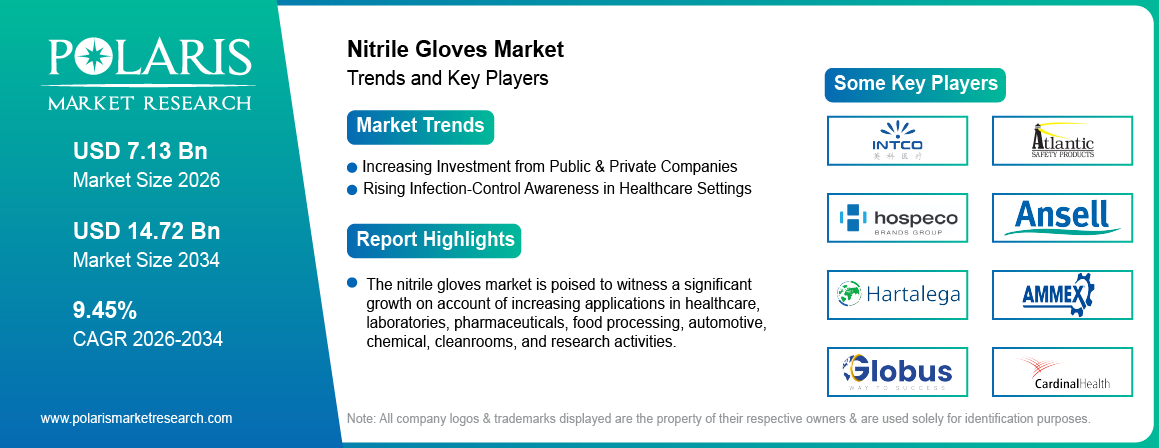
Driver: Increasing Investment from Public & Private Companies
Rising spending by governments and private healthcare providers to strengthen domestic production, supply resilience, and alternative sourcing for medical nitrile gloves and PPE drives the nitrile gloves market. The U.S. Department of Health and Human Services Budget Justification for FY 2026 states active contracts of USD 144.8 million to produce nitrile butadiene rubber, USD 81.3 million to onshore production of nitrile gloves, and USD 136 million for critical NBR chemical feedstock. These investments mitigate dependence on overseas supply and help build a stronger U.S. production platform for exam gloves and other disposable nitrile gloves. On the demand side, CMS forecast private health insurance spending to increase 7.6% in 2025, and hospital spending to grow 6.8%, supporting purchasing activity in hospitals and clinical settings. Overall, public capacity-building and rising private healthcare spending prompt manufacturers to expand capacity, strengthen supply chains, and increase product availability for key end-use sectors globally (Source: hhs.gov, cms.gov).
Driver: Rising Infection-Control Awareness in Healthcare Settings
Increasing awareness of infection control in hospitals and clinics continues to drive demand for medical nitrile gloves, as these facilities promote barrier protection when in contact with patients and during contamination-prone procedures. The U.S. Centers for Disease Control and Prevention (CDC) announced in July 2026 that it funds a network of 65 state and local health departments HAI/AR (Healthcare-associated Infections and Antimicrobial Resistance) programs to detect, respond, and prevent HAI/AR. This established infection-control foundation strengthens compliance to protective measures, and enables glove use within examinations, diagnostics, surgery, dental care, and emergency care. As care providers focus on avoiding cross-contamination of personnel with potentially infectious materials, there is a rising need for latex-free, puncture-resistant disposable nitrile gloves for healthcare (Source: cdc.gov).
Challenge: Fluctuations in Raw Material Prices
Fluctuations in raw material prices adversely impact the nitrile gloves industry. Nitrile butadiene rubber and other chemical inputs are basic cost elements of manufacturing. Volatile prices of synthetic rubber negatively affect production costs, purchasing budgets, company contract pricing, and profit margins, especially for manufacturers of high-volume disposable nitrile gloves. They force producers to renegotiate supply contracts, adjust selling prices or take margin pressure. The volatility in prices also leads manufacturers to diversify suppliers and sign longer-term contracts for the NBR. It helps them increase production efficiency. Producers emphasize sourcing raw materials locally to ensure continuous supply and competitiveness of nitrile gloves in major end-use sectors.
Challenge: Environmental Concerns Over Disposable Glove Waste
Concerns regarding the environmental impact of disposable glove waste are proving to be an emerging concern for the nitrile gloves market. Rising use of disposable gloves in healthcare, laboratories, food processing, cleanrooms, and industrial operations leads to the large amounts of single-use waste. Most traditional disposable nitrile gloves are not recyclable as they are often contaminated with substances after use and are typically sent to landfill or incineration. There is a growing focus on waste reduction, sustainable procurement, and lower environmental impact. It is propelling disposable PPE use across key industries. Healthcare organizations and industrial consumers have also been challenged to enhance their waste management strategies without sacrificing the hygiene and protection of workers. Thus, these considerations may lead to strict disposal protocols and more assessment of alternative materials. This adds to compliance and development costs for manufacturers and potentially challenges the long-term sustainability narrative for traditional nitrile gloves.
Opportunity: Latex-Free & Sustainable Glove Innovation
Latex-free, sustainable glove innovations provide a unique means for manufacturers to diversify their product offerings and address evolving needs from the healthcare, industrial, and environmental sectors. Due to their latex-free nature, nitrile gloves are an excellent choice for those seeking an improved alternative glove material to natural rubber latex. The next degree of development will be in mixing this benefit with biodegradable formulations and more process-efficient, waste-saving packaging solutions. The provided synopsis particularly emphasizes sustainable and biodegradable gloving innovation as developing content and market opportunity in line with recent product-development trends. Products that improve environmental performance while maintaining puncture resistance, chemical protection, tactile sensitivity, and durability will further strengthen penetration in the healthcare, laboratory, pharmaceutical, food service, and industrial markets. The products will also gain traction in sustainability-focused purchasing programs.
Nitrile glove companies are introducing products with lower material content and resource-saving production, along with energy-saving transportation, to improve end-of-life considerations. In December 2025, Top Glove expanded its Green Series range by launching biodegradable diamond textured nitrile glove. The gloves are an eco-friendly solution with superior grip and durability. The firm announced its biodegradable nitrile glove demonstrated a biodegradation rate of 76% in 660 days as per conditions mentioned in the ASTM D5511 test method. Such strategies highlight the growing opportunities for OEMs to expand their portfolios and address procurement strategies oriented toward sustainability (Source: topglove.com).
Source: Polaris Market Research Analysis
Segmentation Analysis
The report provides a comprehensive analysis of the market by type, product, and end use to identify key revenue-generating and high-growth segments.
By Type Insights
Based on type category analysis, the market is bifurcated into powdered and powder-free. The powder-free nitrile gloves segment led the nitrile gloves market share by holding 89.98% in 2025. The leading position is attributed to the rising focus on contamination control and a clean working environment among healthcare providers, laboratories, pharmaceutical manufacturers, food processors, and cleanrooms. Avoiding powder use decreases the chance of residue being imparted to patients, instruments, products, or areas of production sensitive to contamination. Hence, powder-free nitrile gloves can be used in examination, lab, and sterile handling environments. They are also widely used in the medical and industrial sectors because of their latex-free properties, puncture resistance, chemical resistance, and tight fit. Technological advancements in chlorination and polymer-coating processes have improved donning ease without powder. Strong sales of disposable personal protective equipment (PPE) and examination gloves highlight the segment’s dominant position and wide acceptance in regulated environments.
The powdered nitrile gloves segment is expected to record a CAGR of 6.99% during the forecast period. Growth is driven by applications that benefit from faster donning, easier removal, and reduced friction during multiple glove changes. The powder on the inner side absorbs moisture. In certain industrial, laboratory, and general handling conditions, these powdered gloves can improve handling. There is also sustained demand in regions where cost considerations and ease of operations dictate purchases. In an industrial environment, for instance, the workers might like a product that they can don quickly for each of their repetitive tasks, thus creating a demand for these gloves. Yet stricter hygiene standards and the potential for powder-related contamination in medical and cleanroom environments prevent the use of powdered gloves. Therefore, growth remains limited to certain industrial and non-critical applications, where sensitivity to contamination is relatively lower.
By Product Analysis
Based on product category analysis, the market has been segmented into disposable and durable. In 2025, the durable nitrile gloves segment dominated with 54.0% market share. This is due to their growing use in fields that require multiple uses; long-term use; and high resistance to friction, oil, chemicals, and harsh handling. Automotive finishing, machinery, oil and gas, chemical processing, mining, and maintenance applications have long needed more durable hand protection, driving demand for products that last longer rather than being replaced more often. Their longer useful life enhances operational efficiency in the right non-medical settings, while they can also offer sustained protection in extended-use tasks. The added durability also benefits people who use tools, machinery, or chemicals, or manipulate materials in labor-intensive jobs or at home applications, such as gardening or painting. As industrial users are increasingly seeking higher protection, durability, and dexterity without a corresponding increase in replacement costs, demand for durable nitrile gloves is rising.
The disposable nitrile gloves segment is projected to record a CAGR of 10.49% during the forecast period. The growth is mainly attributed to a growing application base in healthcare, laboratories, food processing, pharmaceuticals, automotive service, chemical handling, and research environments. The single-use format allows gloves to be changed between patients, procedures, samples, or tasks. This practice aligns with hygiene protocols and minimizes the risk of cross-contamination. Its users also cite the convenience for applications where fast glove changes are needed, or where PPE procedures (including gloves) are highly standardized. Growing diagnostic activities, food‑safety demands, cleanroom manufacturing, and industrial safety programs also promote the use of these gloves. Disposable gloves are latex-free and provide an unparalleled combination of tactile sensitivity, puncture resistance, and chemical protection. Thus, they are suitable for professional use where hygiene and dependable barrier protection are more critical than the prospect of multiple reuses.
By End Use Assessment
Based on end use category analysis, the market has been segmented on the basis of medical & healthcare and non-medical. The medical & healthcare segment led with a 62.0% share in 2025, due to the consistent glove consumption in patient examination, surgical procedures, dental care, veterinary care, hospitals, laboratories, and emergency medical services. Gloves must be changed frequently in these environments to follow infection-control protocols that protect healthcare staff and minimize cross-contamination between patients and procedures. Growing diagnostic services, developing healthcare facilities, improved occupational safety, and increased focus on hygiene fuel the segment dominance. The widespread use of examination and procedural gloves in routine care also creates steady replacement demand in healthcare settings, thereby driving nitrile glove demand.
The non-medical segment is projected to exhibit the higher CAGR of 10.01% during the forecast period. This is owing to the rising adoption of nitrile gloves in automotive refinishing and repair services, oil and gas, mining, metalworking, machinery, chemicals, and petrochemicals, food processing, pharmaceutical manufacturing, clean rooms, and research centers. These sectors require hand protection from oils, solvents, chemicals, contaminants, and manual-work hazards, while also needing a certain level of dexterity for intricate operations. Demand is also driven in food and pharmaceutical production through hygiene and product contamination controls. Disposable gloves are also used in laboratories and R&D facilities for conducting tests and handling samples. Increased workplace-safety consciousness, wider PPE compliance, and the utility of chemical-resistant nitrile gloves are thus propelling the applications into the diversified non-medical segment.
End Use Segmentation Summary
| Segment Group | Sub-Segments | Representative Use Cases |
| Medical & Healthcare | Examination, Surgical, Dental, Veterinary, Hospital, EMS | Patient exams, surgical procedures, dental treatment, animal handling, emergency response |
| Non-Medical — Industrial | Automotive Finishing, Automotive Aftermarket, Oil & Gas and Mining, Metal & Machinery, Chemical & Petrochemical | Vehicle painting and repair, drilling operations, machining, chemical handling |
| Non-Medical — Food & Pharma | Food & Beverage Processing, Food & Beverage Service, Pharmaceutical, Cleanroom | Food prep and packaging, restaurant service, drug manufacturing, sterile handling |
| Non-Medical — Research | Academic R&D, Industrial R&D, Others | Laboratory testing, product development, general-purpose safety handling |
Source: Polaris Market Research Analysis
Applications of Nitrile Gloves Across Key Industries
Healthcare & Medical Applications
- Examination and Hospital Care: Nitrile gloves for healthcare are commonly used for general observations of patients and the processing of specimens. Medical nitrile gloves are increasingly used in laboratories, medication handling, and general hospital care. Regular changing of gloves is recommended to adhere to hygienic protocols and minimize cross-contamination among patients, healthcare workers, and the environment.
- Dental and Surgical Procedures: Surgical and dental procedures seek reliable barrier protection fashioned from materials that allow for tactile sensitivity and close-fitting performance. Thus, demand for dental gloves is rising with rising number of dental procedures. Surgical gloves enable precise instrument grip and provide puncture and body-fluid protection during the procedure.
- Veterinary Use: Nitrile gloves are the best choice for vets dignostics. Veterinary gloves are used in treating wounds and performing lab work on animals, as well as in all activities that involve exposure to blood and other bodily fluids in veterinary clinics, animal shelter and rescue homes. Professionals with latex sensitivity can also benefit from its latex-free attributes.
- Emergency Medical Services (EMS): EMS workers depend on single use nitrile gloves in emergency response, care for trauma, patient transport, and first-aid functions where quick switching of gloves and dependable barrier protection is a must.
Industrial & Non-Medical Applications
- Automotive/Oil & Gas/Heavy Industry: In automobile painting, vehicle repair, gasoline and oil mining, metal and machine working, nitrile gloves are employed for protection when in contact with oils, greases, fuels, chemicals, paints, or polluted parts. Their strength and flexibility enable them to be used for extended periods of time doing work or maintenance.
- Food & Beverage and Chemical Processing: Food processing and service industries employ single use nitrile gloves for hygienic food handling and preventing product contamination. Chemical and petrochemical industries use chemical-resistant gloves to protect the workers handling material during the process, production, cleaning, and maintenance.
- Pharmaceutical and Equal Environment Operations: Controlled hand coverings for pharmaceutical production and cleanrooms are needed to minimize contamination during manufacturing, packaging, sterile handling, and quality-control processes.
- Life Science: Nitrile gloves are used in academic and industrial R&D laboratories for routine laboratory activities such as preparation of samples, development of products, handling of chemicals, and general data safety. All these diverse applications are driving nitrile glove demand in the industry.
Source: Polaris Market Research Analysis
Regional Analysis
North America Nitrile Gloves Market
North America led the global market share of 38.0% in 2025. The dominance is attributed to the presence of a well-developed healthcare system, high demand for disposable examination gloves, and stringent regulations related to workplace safety. Also, significant penetration in hospitals, laboratories, pharmaceuticals, food processing, automotive services, and chemical handling fuels the regional nitrile gloves market growth. Demand is strengthened by the need to change gloves often during examinations, diagnostic procedures, laboratory testing, emergency care, and any other activity involving contamination risk. The volume of healthcare activities is still very much relevant. According to the U.S. Bureau of Labor Statistics data published in June 2026, the healthcare sector employed about 18.49 million people in May 2026, including nearly 9.23 million in ambulatory healthcare services. It emphasizes the enormous number of professionals who are dependent on that type of routine protection. The ongoing focus on infection prevention, occupational safety, latex-free gloves, chemical resistance, and dependable healthcare supply chain continues to support North America’s dominant market share (Source: bls.gov).
U.S. Nitrile Gloves Market Insight
In 2025, the U.S. led the North America market by holding 83.0% revenue share. This is due to the presence of expanded hospital network, robust outpatient care facilities, diagnostic laboratories, dental care and emergency service providers, and pharmaceutical companies. Rising demand from industrial safety across various sectors also boosts the market expansion. The necessity to change gloves between patients, samples, and contaminated, supersensitive work leads to repeated orders of disposable nitrile gloves in hospitals with high case volumes. Nitrile products have also experienced a benefit due to the general popularity of latex-free gloves and the availability of suitable options for use in chemical-resistant and laboratory applications. Apart from healthcare, the addressable customers are widened by the sizeable automotive, food-processing, chemical, pharmaceutical and research industries. These elements, when combined with well-established health care buyer systems and strict work place protection regimens, will make for significant regional demand contribution from this nation.
Asia Pacific Nitrile Gloves Market
The Asia Pacific market is expected to register a 10.90% CAGR during the forecast period due to growing healthcare infrastructure and pharmaceutical production, medical research, food processing, electronics manufacturing, and other industries. Growing healthcare spending and public investments are raising the availability of and access to facilities in which single-use nitrile gloves are a standard requirement. Growth of hospitals, diagnostic centers, laboratories, pharmaceutical producers, and healthcare professionals results in an escalating recurring need for examination gloves and PPE gloves. Rising awareness of occupational safety and improved hygiene in food, chemical, automotive, electronics, and research sectors is anticipated to the market expansion.
China
In 2025, China held a 46.0% share in the Asia Pacific market. The dominance is attributed to the presence of a large healthcare system, growing medical spending, domestic glove manufacturing, pharmaceutical manufacturing, and vigorous industrial activities. Increasing use in hospitals, primary-care clinics, labs, food-processing operations, electronics production, and chemical companies propels the demand for medical nitrile gloves and chemical-resistant industrial gloves. According to July 2026 China’s National Bureau of Statistics, the per-capita spending on health care and medical services stood at USD 197.86 (RMB 1,330), which accounts for a 1.2% y-o-y growth and 9.0% of overall per-capita consumption spending. Ongoing healthcare expenditure, coupled with infection-control measures and the availability of powder-free, latex-free examination gloves, maintains a stable flow of consumables to be used. The well-established synthetic-rubber and glove manufacturing industry in China further ensures opportunity for domestic supply, scalable production, and export, which is propels its leading position in Asia Pacific (Source: stats.gov.cn).
Europe Nitrile Gloves Market
Europe accounted for 26.0% of the nitrile gloves market in 2025, driven by robust healthcare infrastructure, pharmaceutical production, lab activities, food-processing regulations, and strict requirements for industrial PPE. Hospitals, dental offices, laboratories, cleanrooms, and pharmaceutical companies also drive steady demand for powder-free nitrile gloves because they need to control contamination and prefer latex-free hand protection. Industrial application is also facilitated by automotive production, chemical processing, machinery work, and scientific research needing puncture and chemical resistance. Growing focus on staff safety, healthcare quality, sustainable procurement, and minimized contamination in pharmaceutical and food manufacturing is also driving steady demand for nitrile gloves in the key European countries.
Latin America Nitrile Gloves Market
The Latin America market is expected to record a CAGR of 10.10% during the projected period. This is attributed to the development in healthcare services with better access to medical procedures and enhanced public healthcare infrastructure. Focus on sanitation/ infection control and growing use of disposable PPE in hospitals, laboratories, food processing, and industrial applications also fuel the growth. Brazil dominates in the healthcare-service growth. Increased procedural volumes drive repetitive needs for exam gloves and other disposable protective products in patient care, diagnostics, surgery, and specimen handling. Meanwhile, non-medical applications are expanding through growing pharmaceuticals, food and beverage, automotive, and chemical processing industries. Worker protection and contamination control are also driving nitrile glove use in non-traditional hospital areas.
Middle East & Africa Nitrile Gloves Market
The Middle East and Africa is projected to register a CAGR of 9.79% during the forecast period. This can be attributed to the growing development of healthcare infrastructure, expansion of hospital capacity, medical tourism, investment in pharmaceuticals, and increasing occupational-safety standards. Healthcare delivery systems in the Gulf states are being reinforced. New hospitals, clinics, diagnostic centers, and emergency medical assistance are being made more accessible. This is driving sustained need for disposable nitrile gloves in patient management, investigations, laboratory work, and sepsis-control protocols. Moreover, the region is strong in oil & gas, chemical and petrochemical, food and beverage, and other process & manufacturing industries requiring chemical-resistant gloves to safeguard workers from chemicals, oils, solvents, and other harmful materials.

Source: Polaris Market Research Analysis
Competitive Landscape
The global nitrile gloves market is highly competitive, with the presence of large-scale manufacturers, multi-product healthcare providers, and niche hand protection organizations. These players compete on product quality, manufacturing capacity, distribution reach, application-specific performance, and sustainability measures. The competitive landscape features companies such as AMMEX; Ansell Ltd.; Atlantic Safety Products; Cardinal Health; Globus Group; Hartalega Holdings Berhad; Hospeco Brands Group; INTCO Medical Technology Co., Ltd.; Kossan Rubber Industries Bhd; MAPA Professional; Supermax Corporation Bhd; Sybron; Thermo Fisher Scientific Inc.; Top Glove Corporation Bhd; Unigloves (UK) Limited as the key players. Nitrile gloves market trends in competitive strategies include a growing emphasis on powder-free and latex-free materials, improved chemical and puncture resistance, use of biodegradable materials, and development for use in healthcare, laboratory, cleanroom, food-processing, automotive, and industrial applications. Additionally, nitrile gloves manufacturers are enhancing regional distribution and product offerings to meet the emerging demands of the end user.
List of Nitrile Gloves Key Players
- AMMEX
- Ansell Ltd.
- Atlantic Safety Products
- Cardinal Health
- Globus Group
- Hartalega Holdings Berhad
- Hospeco Brands Group
- INTCO Medical Technology Co., Ltd.
- Kossan Rubber Industries Bhd
- MAPA Professional
- Supermax Corporation Bhd
- Sybron
- Thermo Fisher Scientific Inc
- Top Glove Corporation Bhd
- Unigloves (UK) Limited
Vendor Positioning
| Company | Primary Focus | Notable Recent Activity |
| AMMEX | Disposable gloves for medical, industrial, automotive, foodservice and janitorial applications, including nitrile, latex, vinyl and polyethylene products under AMMEX Professional, Gloveworks and X3. | August 2026: highlighted its Gloveworks Orange RDT industrial nitrile gloves and continued emphasizing supply reliability, with AMMEX reporting first-pass fill rates above 98% across major glove brands. |
| Ansell Limited | Global hand and body protection company serving industrial, healthcare, life sciences and cleanroom applications through examination, surgical, chemical-resistant and industrial gloves. | October 2025: launched the HyFlex Precision Comfort Series with AEROFIT technology, featuring a thinner foam-nitrile coating designed to improve tactility, fit and worker comfort. |
| Atlantic Safety Products | Specialist supplier of disposable nitrile gloves, particularly for automotive, industrial and examination applications, with brands including Black Lightning, Orange Lightning, InTouch and Outrageous Orange. | The current official website identifies Outrageous Orange as a new product launch, expanding its heavy-duty orange nitrile glove portfolio alongside Black Lightning and Orange Lightning. The site does not provide a launch date. |
| Cardinal Health | Healthcare products and distribution company with an extensive PPE portfolio encompassing examination gloves, surgical gloves, masks, gowns and other infection-prevention products. | March 2025: highlighted the launch of FLEXAL Nitrile Biodegradable Exam Gloves in the U.S., developed in response to healthcare customer demand for more sustainable high-use disposable PPE. |
| Globus Group | PPE and hand-protection specialist serving industrial and healthcare markets through brands including Skytec, SHOWA and HAIKA, covering single-use, cut, chemical, impact and general-purpose gloves. | April 2025: SHOWA launched its MFT PRO range through Globus, comprising four general-purpose gloves using microfiber liners designed to improve breathability, moisture management, grip and worker comfort. |
| Hartalega Holdings Berhad | Large-scale specialist manufacturer of nitrile examination and surgical gloves serving healthcare, industrial, food, dental, life-sciences and other professional applications. Its installed glove capacity exceeds 37 billion pieces annually. | Hartalega recently highlighted what it describes as an industry-first disclosure of critically reviewed product carbon-footprint data from its life-cycle assessment covering three key glove products, strengthening its sustainable-manufacturing positioning. |
| Hospeco Brands Group | Broad hygiene, facility-care and protection supplier with disposable nitrile, latex, vinyl and polyethylene gloves, along with chemical-resistant, cut-resistant and work gloves for healthcare, foodservice, janitorial and industrial users. | Its current portfolio continues to expand glove coverage through Safety Zone, Art Noir, CATCH, Dark Light, ProWorks and Virtu-Clean, including medical-exam and controlled-environment products. |
| INTCO Medical Technology Co., Ltd. | Major disposable medical-consumables manufacturer with a core focus on non-latex nitrile and PVC gloves, alongside rehabilitation equipment and other healthcare products. | 2025: reported annual capacity of 103 billion disposable gloves, comprising 70 billion nitrile and 33 billion PVC gloves, while increasing R&D investment and expanding advanced synthetic glove technologies. |
| Kossan Rubber Industries Bhd | Malaysian manufacturer of medical and protective gloves and technical rubber products serving healthcare, industrial and specialized applications. The company entered glove manufacturing in 1988. | 2025: Became the first Malaysian glove company to obtain BPJPH Halal Certification for surgical gloves, strengthening its credentials for markets requiring halal-certified medical products. |
| MAPA Professional | Specialist manufacturer of professional hand-protection solutions spanning chemical protection, cut protection, mechanical handling, thermal protection, disposable gloves and critical-environment applications. | July 2025: Introduced Krytech 574, combining Level C cut protection with a graphene-containing liner, full nitrile coating and Grip & Proof technology for enhanced grip and oil resistance. |
| Supermax Corporation Berhad | Global manufacturer, distributor and marketer of disposable medical rubber gloves, including nitrile and natural-rubber products sold under brands such as SUPERMAX, AURELIA and MAXTER. | Q1 2025: commenced production at its U.S. manufacturing plant, extending its manufacturing footprint beyond Malaysia while continuing to operate glove distribution across more than 165 countries. |
| Sybron UK Ltd. | UK supplier of cleaning, hygiene, catering, disposable and PPE products, serving healthcare, education, hospitality, food manufacturing and facilities-management customers. | Mar 2025: completed a management buyout led by its existing management team, with the company stating that sustainability, Net Zero initiatives and development of eco-friendly product ranges remain strategic priorities. |
| Thermo Fisher Scientific Inc. | Global life-sciences and laboratory supplier offering laboratory and cleanroom PPE, including Fisherbrand, LabServ and other nitrile gloves for laboratories, healthcare, pharmaceutical, industrial and controlled-environment applications. | Its current cleanroom hand-protection offering includes HandPRO nitrile and latex cleanroom gloves, including accelerator-free and sulfur-free nitrile formulations designed for contamination-controlled environments. |
| Top Glove Corporation Bhd | Global glove manufacturer producing examination, surgical, nitrile, natural-rubber and specialty gloves for healthcare, industrial, cleanroom and food applications, with manufacturing operations in Malaysia, Thailand and Vietnam. | FY2025: expanded its next-generation range with LiteGuard Lightweight Latex Examination Gloves, ElastiCore Accelerator-Free Nitrile Examination Gloves, chemotherapy-tested nitrile examination gloves, halogen-free cleanroom gloves and BioGreen biodegradable nitrile gloves. |
| Unigloves (UK) Limited | Hand-protection specialist supplying disposable nitrile and other disposable gloves, safety gloves and associated protective solutions through distribution partners across the UK and parts of Europe. | Aug 2026: Unigloves’ official materials state that the company achieved an EcoVadis Silver sustainability rating, placing it in the top 15%, alongside its continued focus on responsible manufacturing and glove recycling. |
Source: Polaris Market Research Analysis
Industry Developments
- September 2026: Wadi Surgicals announced a partnership with Hubertus Medical Products, based in Andhra Pradesh, India. With this deal, the company plans to launch Enliva Active, a black, food-safe nitrile glove for the Hotels, Restaurants and Catering (HoReCa) sector. (Source: indianpharmapost.com)
- May 2026: BISON Polymers secured €27M in growth financing from a regional banking consortium led by Sparkasse Siegen. With this funding, BISON will expand its production site in Siegen, Germany from two lines to six. The company aims to produce around 1.9 billion nitrile gloves yearly. (Source: dealroom.co)
- February 2026: MAPA Professional introduced its new ADVANCED GRIP technology for UltraNitril 358 and UltraNitril 458. The nitrile chemical-protection gloves incorporate an embedded grip pattern designed to improve handling in dry and greasy conditions while maintaining chemical protection and dexterity. (Source: mapa-pro.com)
- January 2026: Ansell launched TouchNTuff 93-800, a disposable glove with MICROCHEM technology offering at least 15 minutes of acetone resistance, 15 times longer than standard nitrile gloves, for solvent-intensive industrial tasks. (Source: ansell.com)
Future Outlook
The nitrile gloves market is poised to witness a significant growth on account of increasing applications in healthcare, laboratories, pharmaceuticals, food processing, automotive, chemical, cleanrooms, and research activities. Growth in the future will also be driven by increased demand for latex-free, powder-free gloves, enhanced infection-control measures, and expanded use of chemical-resistant hand protection. It is expected that companies will capitalize on using more eco-friendly materials, develop waste-reducing designs, increase grip, enhance puncture resistance, and streamline manufacturing. Further growth will be fueled by increasing healthcare infrastructure development and industrial safety standards, particularly in the developing countries. Procurement and production focused on sustainability and innovative, application-specific uses are expected to be significant competitive differentiators.
Market Segmentation
By Type Outlook (Revenue, USD Billion, 2021–2034)
- Powdered
- Powder-Free
By Product Outlook (Revenue, USD Billion, 2021–2034)
- Disposable
- Durable
By End Use Outlook (Revenue, USD Billion, 2021–2034)
- Medical & Healthcare
- Examination
- Dental
- Veterinary
- Hospital
- EMS
- Surgical
- Others
- Non-Medical
- Automotive Finishing
- Automotive Aftermarket
- O&G and Mining
- F&B Processing
- F&B Service
- Metal & Machinery
- Chemical & Petrochemical
- Pharmaceutical
- Cleanroom
- Academic R&D
- Industrial R&D
- Others
By Regional Outlook (Revenue, USD Billion, 2021–2034)
- North America
- U.S.
- Canada
- Europe
- Germany
- France
- UK
- Italy
- Spain
- Netherlands
- Russia
- Rest of Europe
- Asia Pacific
- China
- Japan
- India
- Malaysia
- South Korea
- Indonesia
- Australia
- Vietnam
- Rest of Asia Pacific
- Middle East & Africa
- Saudi Arabia
- UAE
- Israel
- South Africa
- Rest of Middle East & Africa
- Latin America
- Mexico
- Brazil
- Argentina
- Rest of Latin America
Nitrile Gloves Market Report Scope
| Report Attributes | Details |
| Market Size in 2025 | USD 6.53 Billion |
| Market Size in 2026 | USD 7.13 Billion |
| Revenue Forecast by 2034 | USD 14.72 Billion |
| CAGR | 9.45% from 2026 to 2034 |
| Base Year | 2025 |
| Historical Data | 2021–2024 |
| Forecast Period | 2026–2034 |
| Quantitative Units | Revenue in USD Billion and CAGR from 2026 to 2034 |
| Report Coverage | Revenue Forecast, Competitive Landscape, Growth Factors, and Industry Trends |
| Segments Covered |
|
| Regional Scope |
|
| Competitive Landscape |
|
| Report Format |
|
| Customization | Report customization as per your requirements with respect to countries, regions, and segmentation. |
Source: Polaris Market Research Analysis
Nitrile Gloves Market FAQ's
The nitrile gloves market is expected to exhibit a CAGR of 9.45% during the forecast period. Rising demand from key industries such as healthcare, automotive, and food and beverages will drive the market CAGR during the forecast period.
The nitrile gloves market size is expected to reach USD 14.72 billion by 2034. Rising emphasis on introducing sustainable and biodegradable gloves will fuel the market expansion in the coming years.
The nitrile gloves market is segmented on the basis of type, product, end-use, and region.
The key driving factors in nitrile gloves market are increasing investments from public and private companies and growing infection-control awareness in the healthcare sector.
The nitrile gloves market, by product, is segmented into disposable gloves and durable gloves, catering to both single-use and long-term protection needs.
The key companies in Nitrile Gloves Market are AMMEX; Ansell Ltd.; Atlantic Safety Products; Cardinal Health; Globus Group; Hartalega Holdings Berhad; Hospeco Brands Group; INTCO Medical Technology Co., Ltd.; Kossan Rubber Industries Bhd; MAPA Professional; Supermax Corporation Bhd; Sybron; Thermo Fisher Scientific Inc.; Top Glove Corporation Bhd; Unigloves (UK).
Nitrile gloves are manufactured by dipping cleaned hand-shaped formers into a nitrile butadiene rubber compound, followed by leaching, curing, surface treatment, stripping, and quality testing. The process is designed to provide consistent thickness, flexibility, puncture resistance, and barrier performance.
Powder-free nitrile gloves are widely preferred because they reduce powder residue and contamination risks in healthcare, laboratories, pharmaceutical manufacturing, food processing, and cleanroom environments. Advances in chlorination and polymer coatings also enable easier donning without requiring internal powder.
Yes. Nitrile gloves are widely used in food processing and food-service operations where hygienic handling and contamination control are important. Their durability, close fit, and resistance to oils and various substances make them suitable for food preparation, processing, packaging, and service applications.
Nitrile gloves are used in automotive and chemical applications because they provide resistance to oils, lubricants, solvents, chemicals, and other materials encountered during maintenance and production activities. Their combination of chemical resistance, puncture protection, grip, and dexterity supports automotive finishing, aftermarket repair, chemical processing, petrochemical operations, machinery, and related industrial work.
Yes. Biodegradable nitrile gloves are gaining importance as healthcare and industrial buyers place greater emphasis on reducing disposable PPE waste and improving sustainability performance. Manufacturers are developing alternative formulations and lower-impact products while seeking to retain the protection, flexibility, chemical resistance, and usability expected from conventional nitrile gloves.
Download Sample Report of Nitrile Gloves Market
Please fill out the form to request a customized copy of the research report.


