
Durable Medical Equipment Market Share, Analysis Report, 2026-2034
REPORT DETAILS
What is the Durable Medical Equipment Market Size?
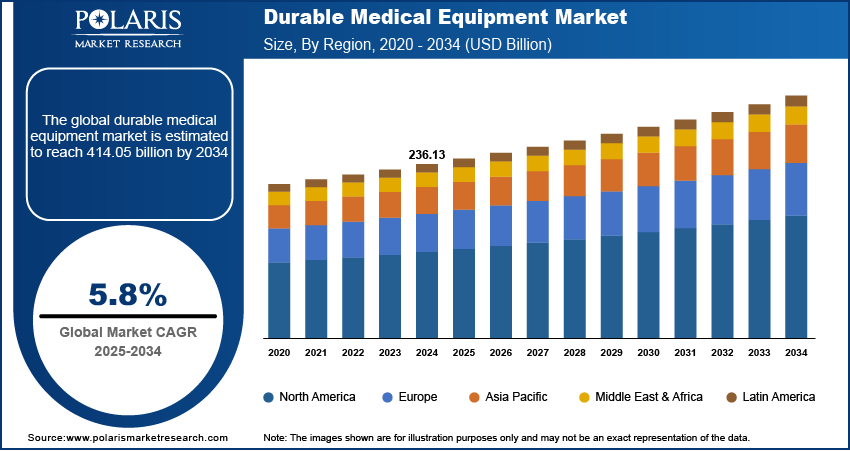
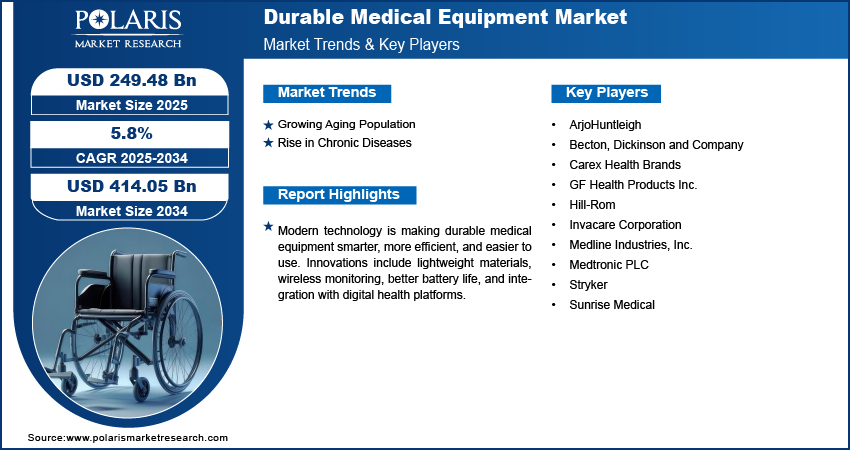
The global durable medical equipment market size was valued at USD 249.48 billion in 2025, growing at a CAGR of 5.8% from 2026 to 2034. The market growth is driven by growing aging population and rising prevalence of chronic diseases.
Market Statistics
Key Takeaways
- In 2024, the monitoring and therapeutic devices segment held the largest market share, as products such as infusion pumps, CPAP machines, and patient monitors are vital for managing both chronic and acute health conditions.
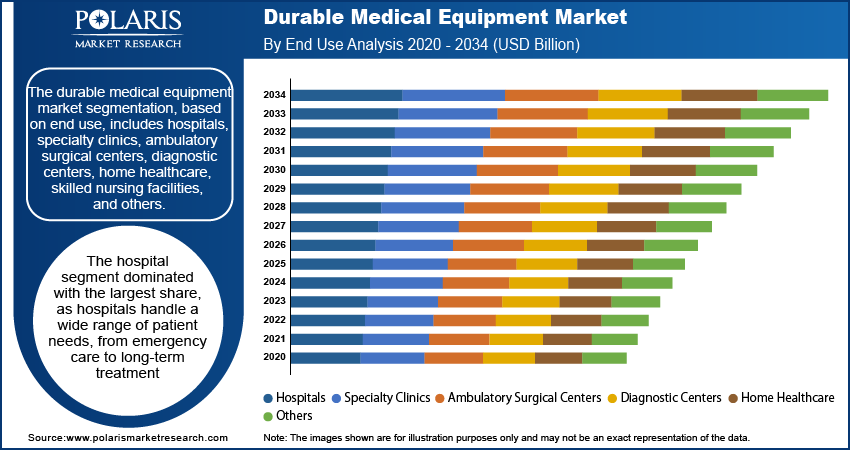
- The ambulatory surgical centers segment is expected to witness strong growth due to increasing demand for affordable and efficient outpatient procedures.
- North America led the market with a 38% revenue share in 2024, supported by a growing aging population and a high incidence of chronic diseases such as diabetes and heart disease.
- The U.S. market is projected to grow at a CAGR of 6.5% during the forecast period, fueled by a robust healthcare system and comprehensive insurance coverage, including Medicare, which facilitates access to durable medical equipment.
- The Asia Pacific industry is anticipated to experience significant growth over the forecast period, driven by advancements in healthcare infrastructure and greater awareness of chronic disease management.
AI Impact on Durable Medical Equipment Market
- AI enhances patient care by enabling smart monitoring devices that provide real-time health data, allowing for quicker and more accurate medical interventions.
- AI-driven analytics improve equipment performance by predicting maintenance needs, reducing downtime, and extending the lifespan of medical devices.
- AI-powered personalization helps tailor durable medical equipment settings to individual patient needs, improving comfort and treatment effectiveness.
- High costs of AI integration and limited technical expertise in the healthcare sector restrain the widespread adoption of AI technologies in the durable medical equipment market.
Durable medical equipment includes long-lasting medical devices that assist patients with daily activities, treatment, or mobility, both in hospitals and at home. Examples include wheelchairs, hospital beds, walkers, oxygen equipment, and blood glucose monitors. These devices are usually prescribed by a doctor. DME, including hospital medical equipment and patient mobility equipment, may be covered by insurance when needed for proper patient care.
Many patients and their relatives opt for treatment at home rather than in hospitals or nursing homes. The reasons behind this trend are mainly related to comfort, low cost of healthcare provision, and increased success rate of recovery. Durable medical equipment in home healthcare, such as portable ventilators, oxygen concentrators, and patient lifts, enables patients to receive healthcare services from the comfort of their own homes. Medical technology innovation, coupled with financial assistance from health insurance and medical professionals, makes home-based medical treatment feasible for patients. Such trends have contributed to increased demand for DME products.
Modern technology is making durable medical equipment smarter, more efficient, and easier to use. Innovations include lightweight materials, wireless monitoring, better battery life, and integration with digital health platforms. These improvements help patients and caregivers monitor health in real-time and make informed decisions quickly. For example, smart wheelchairs with navigation aids or CPAP machines that sync with mobile apps improve both usability and health outcomes. Technology improves the appeal and effectiveness of DME products as it continues to evolve, encouraging wider adoption in hospitals, nursing homes, and private homes alike, thereby fueling the growth.
To Understand More About this Research:Download Sample Report
Smart and Connected Medical Equipment Trends
Innovations are making DME smarter and more intelligent:
- AI-Based Monitoring: Aids in monitoring health parameters of the patients in real-time
- Connectivity: IoT-based devices inform the caregivers about the status of their patients
- Wearable and Smart Mobility: Aids in monitoring vital parameters and mobility of the patients
- Device Customization: AI-based customization of medical devices according to the patient’s needs
What Factors are Driving the Market Growth?
Driver: Growing Aging Population
The number of elderly individuals is increasing globally. According to the European Commission, in Europe alone, 449.3 million people are 65 years or older as of January 2024. Older adults are more likely to experience chronic health conditions, mobility issues, and require long-term medical care. This increases the demand for durable medical equipment such as wheelchairs, hospital beds, and oxygen equipment. The aging population prefers in-home care, and DME supports independent living and improves their quality of life. Additionally, governments and healthcare providers are further investing more in elder care, thereby boosting the growth.
Driver: Rise in Chronic Diseases
Chronic diseases such as diabetes, heart disease, arthritis, and respiratory disorders are becoming more prevalent due to lifestyle factors, aging, and urbanization. According to the Australia Institute of Health and Welfare, as of 2021, 1 in 20 people were diagnosed with diabetes in Australia alone. Managing these conditions requires long-term medical support and equipment such as insulin pumps, CPAP machines, or mobility aids. Hospitals, clinics, and home-care settings rely heavily on durable medical equipment to assist patients in managing symptoms and maintaining functionality. The need for specialized, durable equipment increases as the incidence of chronic illnesses continues to rise, thereby driving the growth.
Restraint: High Equipment Costs and Limited Reimbursement Hinder Adoption
The high price of advanced durable medical equipment remains a notable barrier to wider adoption. In several regions, limited reimbursement coverage increases the financial burden on patients and healthcare providers. As a result, many individuals may delay purchases or opt for basic alternatives. This affordability gap restricts patient access and can slow the adoption of newer, more capable products in cost-sensitive markets.
Opportunity: Technological Advancements Create Smarter, User-Friendly Equipment
Ongoing innovation is making durable medical equipment smarter, more efficient, and easier to use. Improved design and enhanced functionality help patients operate devices with greater comfort and confidence. These advancements open opportunities for manufacturers to differentiate their offerings and meet evolving patient and provider expectations. Companies investing in user-focused product development are well placed to strengthen their competitive position in the market.
Types of Durable Medical Equipment
The DME market entails several products used for mobility, therapy, and home health care purposes, such as:
- Mobility Devices: Wheelchairs, motorized wheelchairs, walkers, crutches, and lift equipment.
- Monitoring and Therapy Devices: Infusion pumps, CPAP, glucometers, and oxygen delivery equipment.
- Bathroom Safety and Medical Furniture: Bath seats, transfer benches, beds, traction units, and specialized beds.
- Home Healthcare Equipment: Portable ventilators, suction machines, and telemetry equipment.
Examples of Durable Medical Equipment
Common DME devices include:
- Electric wheelchairs to enable self-mobility
- Smart medical devices that link to apps for monitoring purposes
- Hospital beds to aid in post-operative recuperation
- Artificial intelligence-based blood glucose monitors and lift aids to help at home
Segmental Insights
Which Segment by Product Dominated the Industry?
The segmentation, based on product, includes personal mobility devices, bathroom safety devices & medical furniture, monitoring & therapeutic devices, and others. In 2024, the monitoring & therapeutic devices segment dominated with the largest share. Therapeutic and monitoring products, such as infusion pumps, CPAP machines, and patient monitors, are essential for managing chronic and acute conditions. The rise in lifestyle-related diseases such as diabetes, sleep apnea, and cardiovascular disorders is driving strong demand for these devices. Patients increasingly rely on at-home monitoring to track their health, which reduces hospital visits and improves long-term care. Moreover, these products are becoming smarter and more user-friendly with digital integration and remote monitoring capabilities. Therapeutic and monitoring DME demand is rising as healthcare shifts toward preventive care and remote patient management, thereby fueling the segment growth.
How Ambulatory Surgical Center Captured Significant Growth?
The segmentation, based on end use, includes hospitals, specialty clinics, ambulatory surgical centers, diagnostic centers, home healthcare, skilled nursing facilities, and others. The ambulatory surgical centers segment is expected to experience significant growth during the forecast period, due to the demand for cost-effective and efficient outpatient procedures. These centers need durable medical equipment such as surgical tables, monitoring systems, and post-operative care tools to deliver high-quality care without overnight stays. Patients prefer ambulatory care services for quicker recovery and lower costs, and this shift is increasing the need for reliable, compact, and portable DME. ASCs are expanding their services as minimally invasive surgeries become more common, driving higher equipment demand. Moreover, supportive insurance policies and faster regulatory approvals for these centers are further fueling the growth in this segment.
What are the Regional Statistics of Durable Medical Equipment Market?
North America Durable Medical Equipment Market Trends
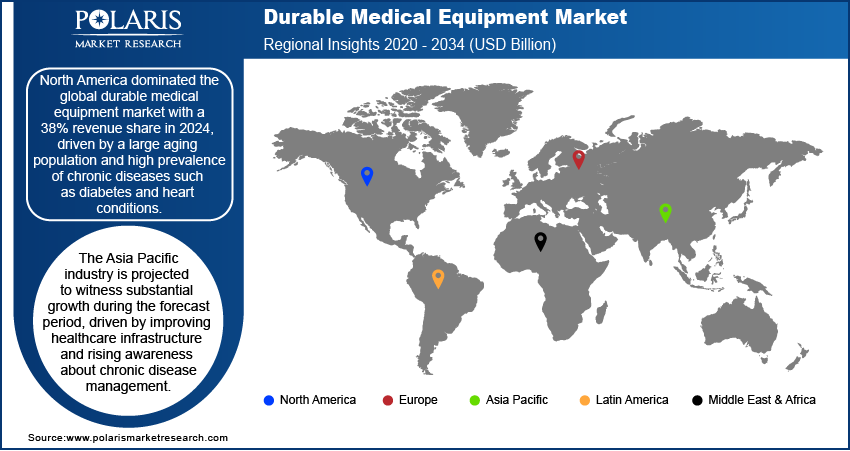
North America dominated the market with a 38% revenue share in 2024, driven by a large aging population and high prevalence of chronic diseases such as diabetes and heart conditions. Advanced healthcare infrastructure and high healthcare spending support the widespread use of DME. Strong insurance coverage and government programs such as Medicare and Medicaid make equipment more affordable for patients. Additionally, continuous technological innovations and increasing home healthcare adoption boost demand. The region’s focus on improving patient outcomes and quality of care in both hospitals and home settings further fuels the growth in North America.
U.S. Durable Medical Equipment Market Insights
The industry in the U.S. is expected to register a CAGR of 6.5% during the forecast period, due to its well-established healthcare system and extensive insurance coverage, including Medicare, which supports durable medical equipment expenses. The increasing number of elderly patients and chronic disease cases drives steady demand for mobility aids, monitoring, and therapeutic devices. Technological advancements and strong healthcare infrastructure improve product availability and quality. The rising trend of home healthcare services and outpatient care further contributes to the growing need for DME. Moreover, government initiatives encouraging preventive care and rehabilitation fuel expansion in the country.
Asia Pacific Durable Medical Equipment Market Analysis
The Asia Pacific industry is projected to witness substantial growth during the forecast period, driven by improving healthcare infrastructure and rising awareness about chronic disease management. The region has a large and growing elderly population, increasing demand for mobility and therapeutic devices. Economic development in countries such as India and Southeast Asia is expanding access to healthcare services, including home care. Additionally, increasing government investments in healthcare and expanding health insurance coverage encourage more people to afford medical equipment. Urbanization and lifestyle changes are further fueling a rise in chronic health issues, which boosts demand in the region.
China Durable Medical Equipment Market Outlook
The China industry is projected to witness substantial growth during the forecast period due to its large elderly population and increasing prevalence of chronic diseases such as COPD, diabetes, and cardiovascular problems. Government initiatives to strengthen healthcare infrastructure and expand health insurance coverage are making durable medical equipment more accessible. Urbanization and rising disposable incomes enable more patients to invest in quality healthcare products. The Chinese government’s focus on improving home healthcare services and rural healthcare access further increases demand. Additionally, domestic manufacturers are innovating and producing cost-effective equipment, making DME more affordable and boosting market growth in the country.
Europe Durable Medical Equipment Market Trends
The industry in Europe is expected to experience significant growth in the future, due to an aging population and high prevalence of chronic diseases such as arthritis, cardiovascular conditions, and respiratory illnesses. Well-established healthcare systems across countries provide strong support for medical equipment use. Government initiatives and reimbursement policies encourage the adoption of advanced and home-based medical devices. Increasing awareness about home healthcare and rehabilitation services is pushing demand for mobility aids and therapeutic products. Technological innovations and rising healthcare expenditure further contribute to growth. Moreover, the rising shift toward outpatient care and preventive treatment propels the need for durable medical equipment across the region.
Germany Durable Medical Equipment Market Analysis
The market in Germany is expected to experience significant growth driven by its rapidly aging population and high chronic disease rates. The country has a strong healthcare infrastructure with universal health coverage that helps patients access expensive medical devices. Germany’s well-developed home healthcare sector and rehabilitation programs increase demand for DME such as mobility aids and monitoring devices. Investments in healthcare technology and government support for elderly care further drive the demand. Furthermore, the preference for outpatient and home care treatments over hospital stays is expanding the market in the country.
Key Players and Competitive Analysis
The industry is characterized by the presence of well-established players competing on innovation, product quality, distribution networks, and pricing strategies. Key companies such as Medtronic PLC, Stryker, Hill-Rom, and Becton, Dickinson and Company leverage their extensive R&D capabilities and global presence to introduce advanced equipment tailored to various care settings. Medline Industries, Inc., GF Health Products Inc., and Carex Health Brands maintain strong positions through broad product portfolios and partnerships with healthcare providers. ArjoHuntleigh, Invacare Corporation, and Sunrise Medical focus on mobility and patient care solutions, often emphasizing ergonomic design and home care compatibility. Strategic initiatives, including mergers, product launches, and geographic expansion, are common as companies aim to capture market share and address growing demand from aging populations and home healthcare trends. Overall, competition remains intense, driven by innovation, regulatory compliance, and the need for cost-effective, patient-centric medical equipment solutions.
Key Players
- ArjoHuntleigh
- Becton, Dickinson and Company
- Carex Health Brands
- GF Health Products Inc.
- Hill-Rom
- Invacare Corporation
- Medline Industries, Inc.
- Medtronic PLC
- Stryker
- Sunrise Medical
Durable Medical Equipment Industry Developments
- January 2026: Lincare noted that Medicare's next DMEPOS competitive bidding round will focus on newer product categories, leaving home oxygen and CPAP services outside its scope. (Source: lincare.com)
- January 2026: Graham-Field introduced the AmeriLux Extended Care Bed. The company stated that the bed is designed to meet the evolving needs of long-term care communities and senior living communities. It is also created to improve the workflow of caregivers. [Source: grahamfield.com/]
- December 2025: Baxter International Inc presented real-world data at the American Society of Health System Pharmacists meeting. It was announced in collaboration with The University of Texas Medical Branch (UTMB Health). The data revealed the positive impact of integrating hospital electronic medical records (EMRs) with smart infusion pumps. [Source: www.baxter.com/]
- August 2025: Sunrise Medical added a Voice Activation feature to its Switch-It CTRL+5 power seating control module. [Source: www.sunrisemedical.com/]
- June 2025: Cardinal Health launched its single-patient use device, the Kendall DL Multi System. The system continuously monitors cardiac activity, blood oxygen, and temperature. The system enhances clinical workflows and reduces infection risks. It also improves diagnostic accuracy across healthcare settings. [Source: www.cardinalhealth.com]
- November 2024: HealthTap launched into the durable medical equipment market through a partnership with Aeroflow Health. The collaboration enabled patients to access DME prescriptions virtually. It strengthens care continuity and expands HealthTap’s reach in delivering AI-supported, high-quality primary care services. [Source: www.Businesswire.com/]
Durable Medical Equipment Market Segmentation
By Product Outlook (Revenue, USD Billion, 2021–2034)
- Personal Mobility Devices
- Wheelchairs
- Scooters
- Walker and Rollators
- Cranes and Crutches
- Door Openers
- Other Devices
- Bathroom Safety Devices & Medical Furniture
- Commodes and Toilets
- Mattress & Bedding Devices
- Monitoring & Therapeutic Devices
- Blood Sugar Monitors
- Continuous Passive Motion (CPM)
- Infusion Pumps Market
- Nebulizers
- Oxygen Equipment
- Continuous Positive Airway Pressure (CPAP)
- Suction Pumps
- Traction Equipment
- Other Equipment
- Insulin Pumps
- Ostomy Bags & Accessories
- Other
- Others
By End Use Outlook (Revenue, USD Billion, 2021–2034)
- Hospitals
- Specialty Clinics
- Ambulatory Surgical Centers
- Diagnostic Centers
- Home Healthcare
- Skilled Nursing Facilities
- Others
By Regional Outlook (Revenue, USD Billion, 2021–2034)
- North America
- U.S.
- Canada
- Mexico
- Europe
- Germany
- France
- UK
- Italy
- Spain
- Netherlands
- Russia
- Rest of Europe
- Asia Pacific
- China
- Japan
- India
- Malaysia
- South Korea
- Indonesia
- Australia
- Vietnam
- Rest of Asia Pacific
- Middle East & Africa
- Saudi Arabia
- UAE
- Israel
- South Africa
- Rest of Middle East & Africa
- Latin America
- Brazil
- Argentina
- Rest of Latin America
Durable Medical Equipment Market Report Scope
| Report Attributes | Details |
| Market Size in 2025 | USD 249.48 Billion |
| Revenue Forecast by 2034 | USD 414.05 Billion |
| CAGR | 5.8% from 2026 to 2034 |
| Base Year | 2025 |
| Historical Data | 2021–2024 |
| Forecast Period | 2026–2034 |
| Quantitative Units | Revenue in USD Billion and CAGR from 2026 to 2034 |
| Report Coverage | Revenue Forecast, Competitive Landscape, Growth Factors, and Industry Trends |
| Segments Covered |
|
| Regional Scope |
|
| Competitive Landscape |
|
| Report Format |
|
| Customization | Report customization as per your requirements with respect to countries, regions, and segmentation. |
Source: Polaris Market Research Analysis
Durable Medical Equipment Market FAQ's
The global market size was valued at USD 249.48 billion in 2025 and is projected to grow to USD 414.05 billion by 2034.
The global market is projected to register a CAGR of 5.8% during the forecast period.
North America dominated the market share in 2025.
A few of the key players in the market are ArjoHuntleigh; Becton, Dickinson and Company; Carex Health Brands; GF Health Products Inc.; Hill-Rom; Invacare Corporation; Medline Industries, Inc.; Medtronic PLC; Stryker; and Sunrise Medical.
The monitoring & therapeutic devices segment dominated the market share in 2025.
The ambulatory surgical center segment is expected to witness the significant growth during the forecast period.
Download Sample Report of Durable Medical Equipment Market
Please fill out the form to request a customized copy of the research report.


