
Arrhythmia Market Share, Size, Trends, Industry Analysis Report, 2025 - 2034
REPORT DETAILS
Arrhythmia Market Summary
The global Arrhythmia market was valued at USD 7.74 billion in 2024 and is expected to grow at a CAGR of 6.6% during the forecast period. The expansion of the industry is being driven by factors such as an expanding worldwide number of cases of lifestyle choices such as smoking, excessive alcohol consumption, and obesity (which renders a person more prone to cardiac arrhythmias) and increasing patient awareness levels.
Market Statistics
Key Takeaways
- Based on the test equipment segment, the Holter monitor segment is expected to be the significant global revenue contributor during the forecast period. This is driven by its widespread use in long-term cardiac monitoring and early arrhythmia detection.
- North America had the largest revenue share in 2024. The market is driven by advanced healthcare infrastructure, and rising adoption of diagnostic technologies.
- Asia Pacific is expected to witness a high CAGR in the global arrhythmia market. This is driven by rising healthcare investments, and growing elderly population.
The global Arrhythmia market was valued at USD 7.74 billion in 2024 and is expected to grow at a CAGR of 6.6% during the forecast period. The expansion of the industry is being driven by factors such as an expanding worldwide number of cases of lifestyle choices such as smoking, excessive alcohol consumption, and obesity (which renders a person more prone to cardiac arrhythmias) and increasing patient awareness levels.
Key Insights
- Based on the test equipment segment, the Holter monitor segment is expected to be the significant global revenue contributor during the forecast period. This is driven by its widespread use in long-term cardiac monitoring and early arrhythmia detection.
- North America had the largest revenue share in 2024. The market is driven by advanced healthcare infrastructure, and rising adoption of diagnostic technologies.
- Asia Pacific is expected to witness a high CAGR in the global arrhythmia market. This is driven by rising healthcare investments, and growing elderly population.
Industry Dynamics
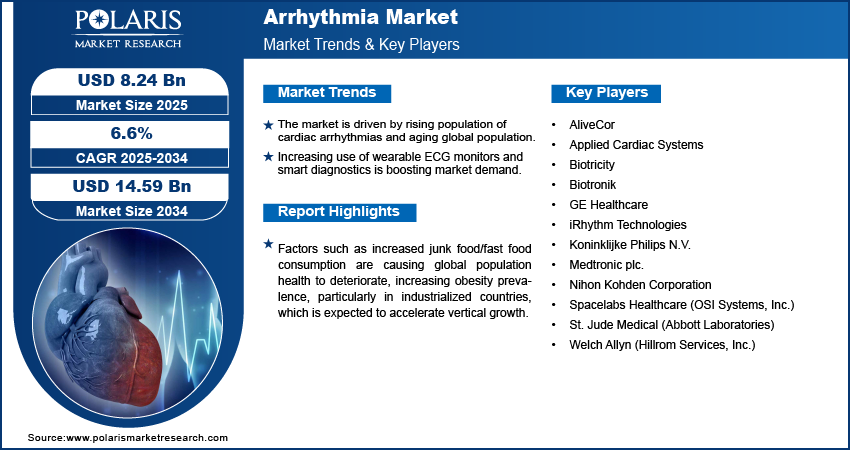
- The market is driven by rising population of cardiac arrhythmias and aging global population.
- Increasing use of wearable ECG monitors and smart diagnostics is boosting market demand.
- The market is growing due to rising awareness and screening for early arrhythmia detection.
- Recent advancements in AI-based diagnostics and minimally invasive treatments are expanding therapeutic options and improving outcomes.
Source: Polaris Market Research Analysis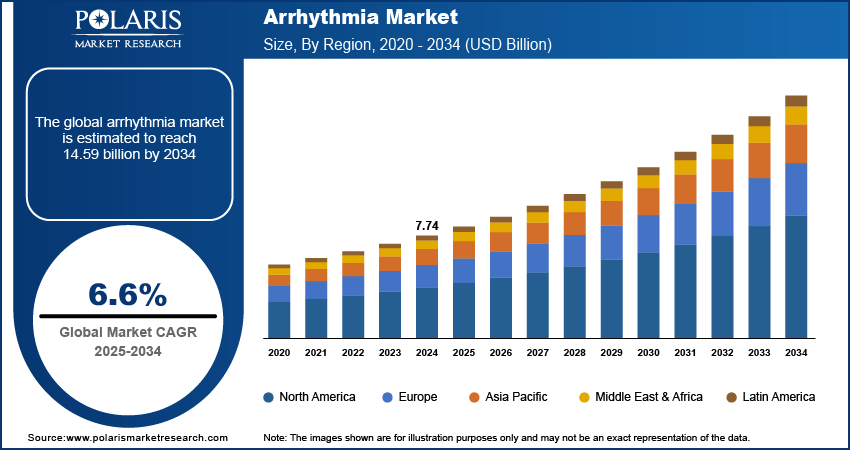
To Understand More About this Research: Download Sample Report
AI Impact on Arrhythmia Market
- AI helps to speed product development by analyzing patient data and predicting treatment outcomes.
- AI helps to optimize clinical operations by forecasting patient needs, and managing hospital resources.
- AI helps to improve diagnostic accuracy by analyzing ECG patterns in real time.
- AI helps to personalize treatment by using patient history and health data to recommend tailored therapies and reduce adverse reactions.
Factors such as increased junk food/fast food consumption are causing global population health to deteriorate, increasing obesity prevalence, particularly in industrialized countries, which is expected to accelerate vertical growth. Further, the high prevalence of these risk factors fuels the prevalence of the disorder. Thus, excessive tobacco smoking increases the risk factors exponentially for the disorder in the region, boosting the market. The rising prevalence of the arrhythmia market in the rest of the Asian region drives the market towards growth.
For instance: As per Singapore Heart Foundation, the total number of deaths due to cardiac disease in Singapore was 6,291 in 2019 and has risen to 6,990 deaths in 2020. Thus, the high mortality rates in the country play an important role in escalating the awareness of the treatment of cardiac arrhythmia, thereby boosting the market growth. Despite the positive considerations, difficulties associated with such devices, as well as an increase in arrhythmia monitoring device recalls, could have an adverse influence on the arrhythmia market share.
Industry Dynamics
Growth Drivers
The surge in cases of cardiac arrhythmias is the factor that is driving the growth during the forecast period. As per the National Institute of Health, Atrial fibrillation affects 37,574 million people globally (0.51 % of the population), and it has increased by 33% in the previous 20 years. In addition, as per the Center For Disease Control and Prevention (CDC), the most frequent type of treated heart arrhythmia is atrial fibrillation, also known as AFib or AF.
When the heart beats too slowly, too quickly, or irregularly, it is called an arrhythmia. AFib is expected to affect 12.1 million people in the US by 2030. AFib was noted on 183,321 death certificates in 2019, with AFib being the underlying cause of death in 26,535 cases. Europeans are more prone than African Americans to suffer from AFib. AFib affects more women than men since the number of cases grows with age, and women live longer than men.
Also, in the US, almost 454,000 hospitalizations with AFib as the primary diagnosis occur each year. Every year, over 158,000 people die as a result of this disease. For more than two decades, the death rate from AFib as a major or contributory cause of death has been rising. Congenital heart abnormalities, coronary artery disease, excessive blood pressure, and other types of cardiovascular disorders are also major causes of abnormal heart rhythms or situations that can lead to the condition.
According to a National Health Service report from September 2021, more than 2 million people in the United Kingdom suffer from heart rhythm issues. Thus, the rising prevalence of cardiac disease and other heart problems is driving the growth of the market.
Source: Polaris Market Research Analysis
Report Segmentation
The market is primarily segmented based on test equipment, site of origin atrial, type, and region.
| By Test Equipment | By Site of Origin Atrial | By Type | By Region |
|
|
|
|
Source: Polaris Market Research Analysis
Know more about this report: Download Sample Report
Insight by Test Equipment
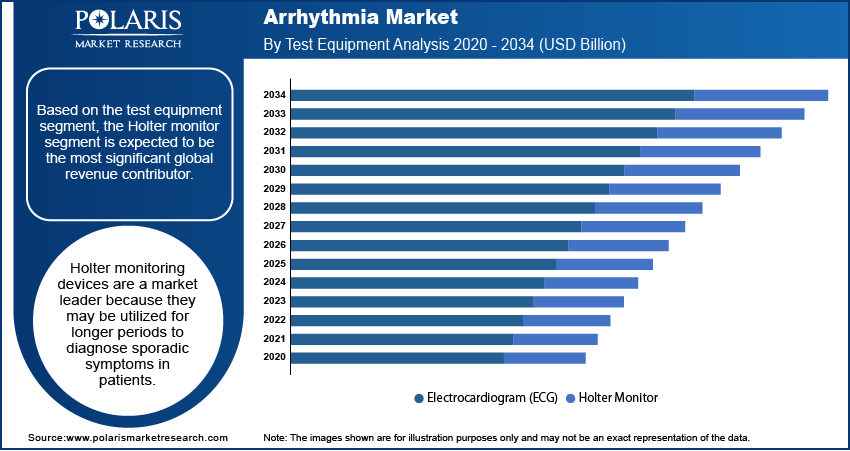
Based on the test equipment segment, the Holter monitor segment is expected to be the most significant global revenue contributor. Holter monitoring devices are a market leader because they may be utilized for longer periods to diagnose sporadic symptoms in patients.
They also provide more easy and faster monitoring to improve patient compliance and treatment outcomes. The increasing number of people suffering from the disorder, as well as many advances in the cardiac monitoring devices market, are driving the segment's growth.
Source: Polaris Market Research Analysis
Geographic Overview
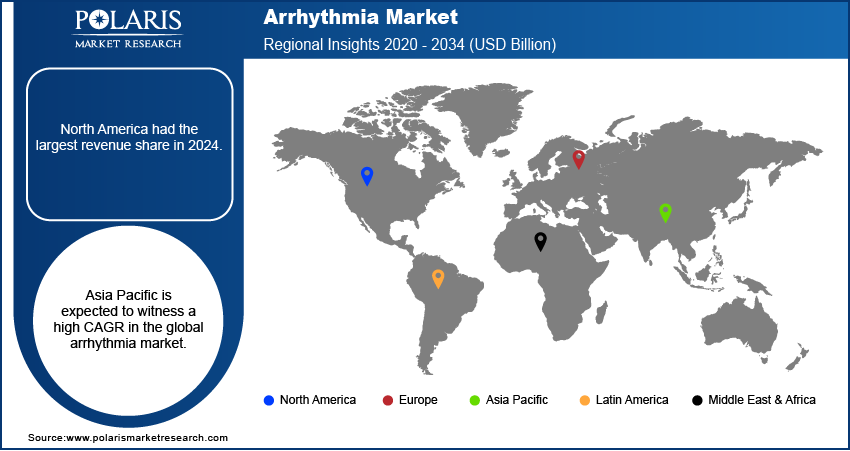
North America had the largest revenue share in 2024. By 2030, the CDC predicts that 12.1 million Americans will suffer from atrial fibrillation (AFib). Furthermore, Mobile Cardiac Outpatient Telemetry (MCOT) is gaining popularity in the US. For example, the US FDA awarded Biotricity's Biotres Cardiac Monitoring Device 510(k) certification for ECG monitoring in January 2022.
The Biotres Cardiac Monitoring Device is a wearable Holter patch that records ECG data in three channels continuously. This has aided the corporation in expanding its cellular device product offering in the US. As a result of these factors, the market is predicted to rise rapidly over the forecast period.
Moreover, Asia Pacific is expected to witness a high CAGR in the global arrhythmia market. Because of the faster growth rate of diagnosis, treatment, and research activities, quality improvements, rising number of collaborations, and healthcare modernization, countries in the Asia-Pacific area, such as China and India, are hotspots for investment potential. To boost revenue, ECG monitoring device manufacturers are focusing on the development of advanced ECG devices, boosting the region's growth.
Source: Polaris Market Research Analysis
Competitive Insight
Some of the major players operating in the global market include:
- Applied Cardiac Systems
- AliveCor
- Biotronik
- Biotricity
- GE Healthcare
- iRhythm Technologies
- Koninklijke Philips N.V.
- Medtronic plc.
- Nihon Kohden Corporation
- St. Jude Medical (Abbott Laboratories)
- Spacelabs Healthcare (OSI Systems Inc.)
- Welch Allyn (Hillrom Services Inc.)
Industry Developments
In May 2025, iRhythm Technologies, Inc. introduced its Zio long-term continuous ECG monitoring system in Japan after receiving approval from the Pharmaceuticals and Medical Devices Agency. The Zio platform enables up to 14 days of uninterrupted cardiac monitoring, surpassing conventional wired Holter devices and patch-based solutions that typically provide shorter monitoring durations.
In May 2024, Vivalink unveiled an integrated technology platform for Mobile Cardiac Telemetry and Holter monitoring that combines remote patient monitoring with advanced arrhythmia detection. The solution simplifies deployment, improves patient management, and helps lower operational costs in ambulatory ECG monitoring services.
Arrhythmia Market Report Scope
| Report Attributes | Details |
| Market size value in 2024 | USD 7.74 Billion |
| Market size value in 2025 | USD 8.24 Billion |
| Revenue forecast in 2034 | USD 14.59 Billion |
| CAGR | 6.6% from 2025 - 2034 |
| Base year | 2024 |
| Historical data | 2020 - 2023 |
| Forecast period | 2025 - 2034 |
| Quantitative units | Revenue in USD Billion and CAGR from 2025 to 2034 |
| Segments covered | By Test Equipment, By Site Of Origin Atrial, By Type, By Region |
| Regional scope | North America, Europe, Asia Pacific, Latin America, Middle East & Africa |
| Key companies | Applied Cardiac Systems, AliveCor, Biotronik, Biotricity, GE Healthcare, iRhythm Technologies, Koninklijke Philips N.V., Medtronic plc., Nihon Kohden Corporation, St. Jude Medical (Abbott Laboratories), Spacelabs Healthcare (OSI Systems, Inc.), and Welch Allyn (Hillrom Services, Inc.) |
Source: Polaris Market Research Analysis
arrhythmia market FAQ's
• The global market size was valued at USD 7.74 billion in 2024 and is projected to grow to USD 14.59 billion by 2034.
• The global market is projected to register a CAGR of 6.6% during the forecast period.
• North America dominated the market in 2024.
• A few of the key players in the market are Applied Cardiac Systems, AliveCor, Biotronik, Biotricity, GE Healthcare, iRhythm Technologies, Koninklijke Philips N.V., Medtronic plc., Nihon Kohden Corporation, St. Jude Medical (Abbott Laboratories), Spacelabs Healthcare (OSI Systems, Inc.), and Welch Allyn (Hillrom Services, Inc.).
• The Holter monitor segment is projected to witness the fastest growth during the forecast period.
Download Sample Report of arrhythmia market
Please fill out the form to request a customized copy of the research report.


