
AI in Drug Discovery Market Size, Share, Trends and Forecast, 2026-2034
REPORT DETAILS
AI in Drug Discovery Market Summary
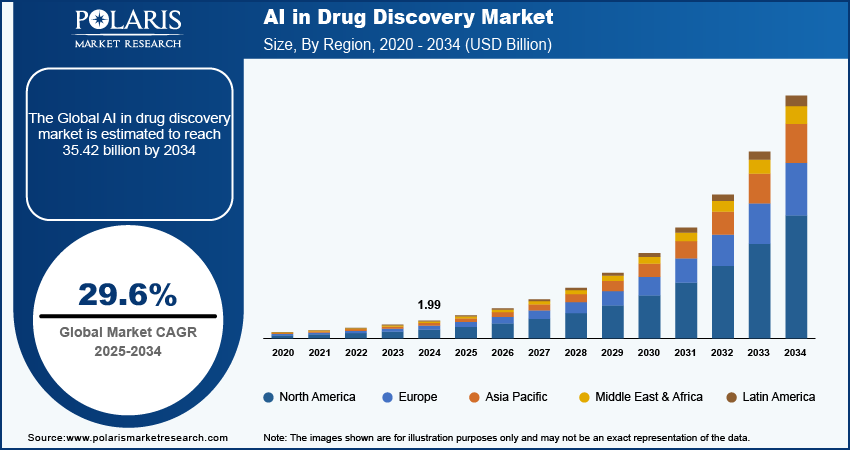
The AI in drug discovery market size was valued at USD 2.29 billion in 2025. The market is projected to grow at a CAGR of 24.78% during 2026–2034. Continuous advancements in artificial intelligence (AI) and increasing collaborations between pharma companies and AI providers are driving market growth. Rising pharmaceutical R&D costs are also shaping the market landscape.
Market Statistics
Key Takeaways
• North America held the largest market share of 38.0% in 2025. The presence of leading pharmaceutical and biotechnology companies contributed to the dominance. Also, the rising burden of chronic diseases drives the regional market growth.
• The U.S. led the North America market with 88.0% share in 2025. The U.S. comprises a world-leading research ecosystem. The country has the presence of top-tier universities, research institutions, and biotech startups. Such infrastructure is contributing to the U.S. market growth.
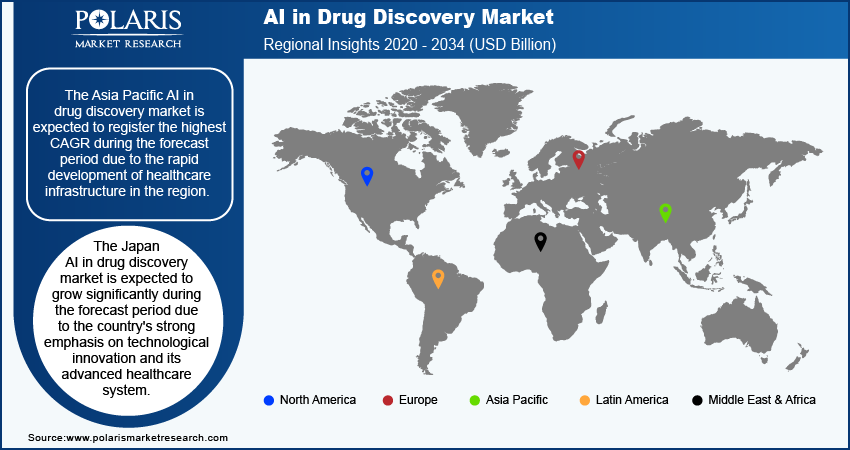
• The Asia Pacific AI in drug discovery market is expected to exhibit the highest CAGR of 27.40% during 2026–2034. This is due to the rapid development of healthcare infrastructure in the region.
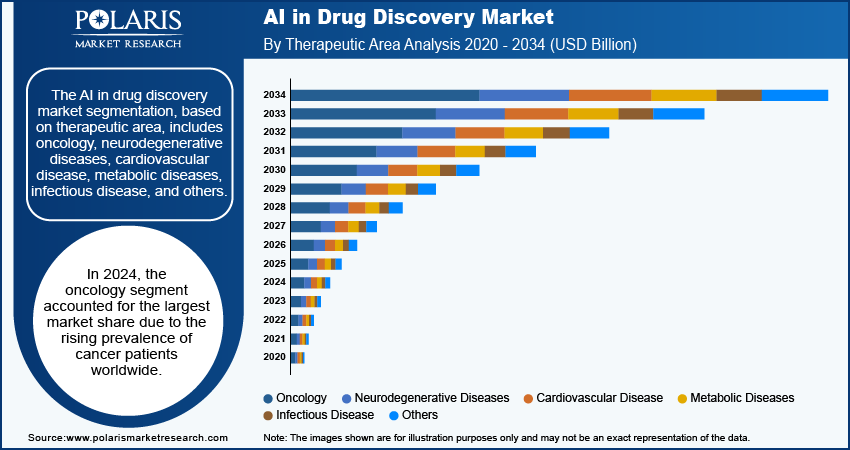
• In 2025, the oncology segment held the largest market share of 29.0%. The dominance is attributed to the increasing prevalence of cancer across the world.
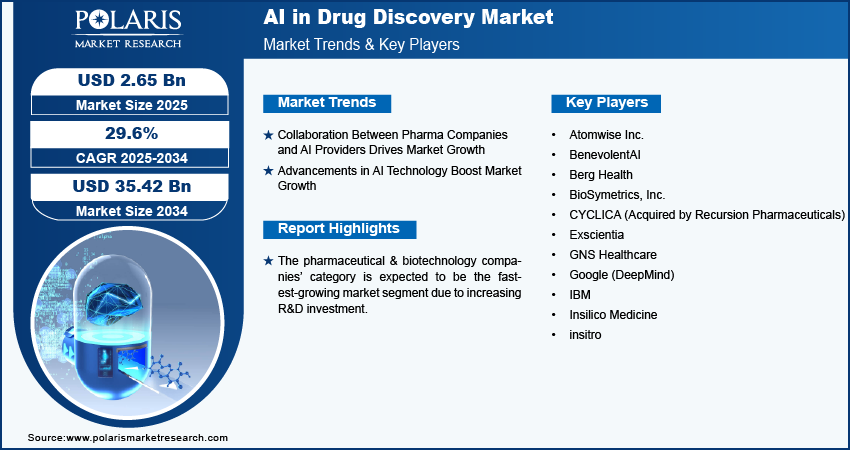
• The pharmaceutical & biotechnology companies segment is expected to register the highest CAGR of 25.60% during the forecast period. This is driven by rising R&D investments and surging emphasis on research and development in novel drug discovery.
Note: Figures and projections outlined in this report are the result of Polaris Market Research’s proprietary analytical processes, grounded in the latest available datasets and market observations.
What Is AI in Drug Discovery? Definition, Workflow, and Benefits
AI in drug discovery refers to the application of artificial intelligence (AI) and machine learning (ML) in identifying and developing drugs. The technology utilizes biological and medical information in identifying targets, screening the candidates for drugs, and predicting the effectiveness and safety of the identified drugs. AI assists scientists in processing information in a much faster way, saving time on trial-and-error testing.
The rising prevalence of chronic diseases like cancer, diabetes, cardiovascular diseases, and neurological disorders drives the market revenue. As per the National Diabetes Statistics Report issued by the Centers for Disease Control and Prevention (CDC) in January 2026, there are more than 40 million people have diabetes in the U.S. The figure constitutes 12% of the country’s population. (source: usdss.cdc.gov). This has led to an increasing demand for innovative and more potent drugs, thus driving demand for AI in drug discovery. Furthermore, the emergence of new diseases and global health crises has highlighted the need for rapid drug discovery and development.
How Does AI Work Across the Drug Discovery Pipeline?
- The AI platform uses databases on biology and chemistry. This aids in the identification of patterns, connections, and other information about diseases through scientific data.
- Machine learning (ML) techniques identify drug targets and molecular patterns. It may assist in the discovery of new medicines.
- The predictive modeling technique tests the safety, effectiveness, and adverse reactions of medicines before laboratory testing.
- The virtual screening technology enables the analysis of millions of chemicals rapidly and the identification of the best candidates.
- The AI platform is employed in enhancing the design of clinical trials and selecting the appropriate participants.
- Scientists undertake laboratory studies, clinical trials, and other tasks for the commercialization of medicines.
Governments and private sectors are heavily investing in AI technologies for healthcare, including drug discovery. These investments are driving research and development efforts, fostering innovation, and encouraging the adoption of AI in drug discovery, significantly boosting market growth. Furthermore, the emergence of new diseases and global health crises, such as the COVID-19 pandemic, has highlighted the need for rapid drug discovery and development. The urgency to address these health challenges has led to increased funding and collaboration with the AI in the drug discovery market.
Traditional Drug Discovery vs. AI-Based Drug Discovery: Key Differences
| Comparison Factor | Traditional Drug Discovery | AI-Based Drug Discovery |
| Discovery Process | Relies on manual research, laboratory experiments, and iterative testing. | AI algorithms automate data analysis, target identification, and molecule discovery. |
| Development Speed | Long drug development cycles. They often take several years. | Significantly accelerates discovery by rapidly analyzing large datasets and predicting outcomes. |
| Drug Candidate Screening | Limited number of compounds can be tested through laboratory methods. | Screens millions of compounds virtually in a fraction of the time. |
| Cost Efficiency | High R&D costs due to extensive experimentation and higher failure rates. | Optimizes candidate selection and minimizes failed experiments. It reduces research costs. |
| Data Analysis | Primarily dependent on human interpretation and conventional statistical methods. | Processes complex genomic, biological, and clinical datasets using ML and predictive analytics. |
| Target Identification | Time-consuming identification of disease targets through laboratory research. | Rapidly identifies potential drug targets using AI-driven pattern recognition and biological modeling. |
| Prediction Accuracy | Greater reliance on trial-and-error approaches during early research stages. | Predicts drug efficacy, toxicity, and molecular interactions before laboratory validation. |
| Personalized Medicine | Limited ability to develop patient-specific therapies. | Supports precision medicine by analyzing patient genomic and clinical data for customized treatments. |
| Overall Efficiency | Slower, resource-intensive, and highly dependent on manual workflows. | Faster, more scalable, and highly efficient through automation and advanced predictive modeling. |
Source: Polaris Market Research Analysis
To Understand More About this Research: Download Sample Report
Generative AI in Drug Discovery: Molecule Design, Optimization and Limitations
AI-powered drug discovery is transforming itself using Generative AI (Gen AI). The technology can create new chemical structures and make predictions about the interaction between drugs and targets. It can come up with potential drugs much faster. Using advanced deep learning techniques, it comes up with drug candidates based on their biological properties. The use of Gen AI reduces the need for experimentations through trial-and-error method. It helps in the process of optimizing leads and assists in the screening of potential candidates. This results in decreased costs and time taken in drug discovery. It can also be helpful in designing and optimizing molecules by creating molecules with particular features and optimizing them. Nevertheless, the use of AI technology may be limited by poor data quality, accuracy of models, biological complexity, and lab testing. The created AI molecules will have to be tested properly to be sure that they are effective, safe, and viable.
AI in Drug Discovery Market Growth Drivers, Opportunities, and 2026 Trends
Driver: Pharma-AI Partnerships Accelerate Target Discovery and Pipeline Development
Pharmaceutical companies are increasingly partnering with AI technology providers to enhance their drug discovery efforts. These collaborations combine the domain expertise of pharma companies with the computational power of AI, leading to more efficient drug development processes and innovative drug candidates. For instance, in June 2026, Sanofi collaborated with AI company Owkin to build next-generation biopharmaceutical AI agents through the K Pro platform from Owkin. These companies will use specialized models to automate and optimize discovery workflows (source: owkin.com).They will leverage data, software, and tuned models to create customized solutions across the drug development lifecycle. As a result, the market share of AI in drug discovery is anticipated to experience substantial growth during the forecast period.
Driver: Rising R&D Costs and Pipeline Attrition Drive AI Adoption
The high costs and increasing complexities involved in conducting research and development for pharmaceuticals have led to the increased use of AI in discovering drugs. Developing a drug involves a lot of testing and research and takes many years with high investments in the process. The technology is employed to cut down such costs. It helps in analyzing data and determining potential drug candidates. In addition, it reduces failure in experimentation within the early stages of research. AI models help in identifying targets and selecting the right leads, hence reducing time taken in development.
Driver: Generative AI, Multimodal Models and Predictive Analytics Expand Discovery Capabilities
The continuous advancements in AI, particularly in natural language processing (NLP), predictive analytics, and quantum computing, are significantly expanding the capabilities of AI in drug discovery. These advancements are facilitating more precise predictions, improved drug-target interactions, and the identification of novel drug candidates. Furthermore, the integration of AI with genomics, proteomics, and other omics technologies is driving demand for personalized medicines. AI algorithms are adept at analyzing complex omics data to identify biomarkers and customize drug treatments based on individual genetic profiles. This personalized approach enhances the efficacy of therapies, thereby fueling the demand for AI in drug discovery solutions.
Opportunities: Growing Adoption of AI in Small and Mid-Sized Biotech Companies
The growing prevalence of AI in drug discovery means that AI suppliers have the potential to serve smaller and medium-sized biotech companies that lack research capacity. This will make it possible for these companies to work with biological data and screen drugs without having large technological teams in house.
As more companies start using AI technologies and collaborating with technology providers, the use of such solutions could increase in smaller companies that develop drugs. It can allow smaller companies to enhance their research potential and compete with large pharmaceutical companies. More collaborations between biotech companies and AI providers could promote the use of such solutions.
AI in Drug Discovery Market Barriers and Adoption Challenges
- High Implementation and Infrastructure Costs: High investment is necessary in hardware, cloud services, software, and manpower for implementing artificial intelligence platforms. These high costs pose problems for small businesses.
- Privacy and Cyber Security Threats: Privacy of patient, genome and clinical trial data is important. There could be cybersecurity threats along with privacy challenges.
- Low-Quality Biological Data: High quality biological data is required by the machine learning model for its optimal functioning. Fragmented or biased biological data can affect the efficiency of the algorithm.
- Regulatory Challenges in AI-Based Drug Development: Regulatory framework for AI-based drug development is yet to evolve.
FDA Regulation and Model Credibility in AI-Assisted Drug Development
The adoption of artificial intelligence in the process of developing drugs presents additional regulatory considerations for pharmaceutical and biotech firms. The FDA evaluates the safety and effectiveness of the products that have been created using AI technology, while the developers have to present proper evidence regarding the applicability of such tools. Since AI is used more and more widely for target identification, molecule screening, and even clinical development, the quality and reliability of data become essential during the review.
Credibility of the models becomes an additional consideration as the outcomes of using AI could be different depending on the training dataset. In case there is bad-quality or biased data, the models could be affected negatively, and the predictions become unreliable. Therefore, developers should validate AI models, document their development process, and measure their performance in order to base their work on AI results. These factors may complicate the drug development process, but they are necessary when developing trust in the AI process.
Data Quality, Reproducibility, Bias and Explainability Challenges
Quality of Data: Large amounts of biological, chemical, and clinical data of high quality are needed by the AI model. Inconsistency in data quality can cause a poor outcome for the model as well as inaccurate predictions. The difference between the format and collection method of the data by various research firms poses another challenge for the use of AI in drug discovery.
Reproducibility: The results obtained from the AI should be consistent and reproducible to be able to apply them in the drug discovery process. Differences in the datasets, models, and testing methods used in the process may cause different results.
Bias: Bias within training data impacts the outcomes generated by the AI model. Poor representation of different kinds of patients, diseases, or biological conditions in a dataset leads to reduced reliability in predictions made by an AI system. It, in turn, impacts the wider application of AI technologies in drug discovery and development.
Explainability: Explainability is one of the main concerns associated with the use of some advanced AI models as they tend to be hard to comprehend. Lack of model explainability may lead to difficulties in understanding the reasons why an AI model picked up on a certain drug candidate or generated a certain prediction.
AI in Drug Discovery Market Segmentation Analysis
AI in Drug Discovery Market by Offering
The software segment led with a 64.8% share in 2025. The dominance of the market segment is driven by increasing use of AI-driven software for target identification, virtual screening, molecular designing, and optimization of drug candidates. The pharmaceutical and biotech companies are increasingly relying on such platforms in order to analyze biological and chemical databases and increase efficiency in the drug discovery process. Higher investments are being made in AI technology, and the need to decrease the cost of drug discovery is also driving the demand for AI software solutions.
AI in Drug Discovery Market by Technology
The machine learning segment accounted for a 71.6% market share in 2025. This is because there is an increase in the application of machine learning algorithms in the analysis of biological, chemical, and clinical information in the process of drug discovery. Machine learning technologies assist in identifying drug targets, screening compounds, drug property prediction, and optimization of drug candidates. Moreover, there is increased demand for drug discovery and the availability of large amounts of data, which support the use of machine learning algorithms.
AI in Drug Discovery Market by Therapeutic Area
The oncology segment accounted for the largest market share of 29.0% in 2025. The leading position of the segment is supported by the high occurrence of cancer diseases and the necessity to create new medicines. There is an increased usage of AI technologies for developing cancer drugs to find the target for therapy, perform screening and data analysis in biology, and create targeted therapy. Development of R&D processes in the area of cancer treatment is expected to further contribute to the segment’s growth.
AI in Drug Discovery Market by Application
The preclinical testing segment is projected to grow at a CAGR of 26.6% during 2026–2034. The segment’s growth is driven by the application of AI in preclinical evaluation of possible drug candidates before they go through clinical trials. Artificial intelligence enables scientists to make assessments of biological and chemical information, evaluate drug safety and efficacy, and choose promising candidates for future experiments. Additionally, the increased demand to minimize costs, time, and risk at the early stage of the research process contributes to AI adoption in preclinical trials.
AI in Drug Discovery Applications and Use Cases
| Application | How AI Helps |
| Cancer Drug Discovery & Precision Oncology | AI identifies drug targets, predicts treatment responses, and supports the development of targeted cancer therapies. |
| Rare Disease Treatment Development | The technology analyzes genetic and clinical data to accelerate the discovery of therapies for rare and underserved diseases. |
| Vaccine Research & Infectious Disease Therapies | AI speeds vaccine development by identifying promising antigens, predicting immune responses, and discovering potential antiviral treatments. |
| Drug Repurposing | AI evaluates existing medicines to identify new therapeutic applications, reducing development time, cost, and clinical risk. |
| Personalized Medicine Development | AI analyzes patient-specific genomic and clinical data to recommend customized treatment strategies and improve therapeutic outcomes. |
| Biomarker Identification & Genomic Analysis | AI detects disease biomarkers and interprets genomic data to enhance diagnosis, patient stratification, and precision drug development. |
Source: Polaris Market Research Analysis
AI in Drug Discovery Market by End User
The pharmaceutical & biotechnology companies segment is projected to grow at 25.60% CAGR.The pharmaceutical & biotechnology companies’ category is expected to be the fastest-growing market segment due to increasing R&D investment. Pharmaceutical and biotechnology companies are significantly increasing their investments in research and development (R&D) to maintain a competitive edge and bring new drugs to market. AI technologies are being increasingly leveraged to optimize and accelerate the drug discovery process, enabling more efficient identification of potential drug candidates. For instance, Pfizer, a pharmaceutical company, has embraced Artificial Intelligence to streamline and accelerate clinical drug development. Thus, the growing need for research and development in novel drug discovery is expected to make the pharmaceutical and biotechnology companies segment the fastest-growing segment in the market during the forecast period.
Small Molecules, Biologics and New Therapeutic Modalities
AI technology is also finding application in the discovery of small molecules, biologics, and innovative therapy modes. The technology assists researchers in analyzing biological and chemical information, discovering potential drugs, and designing and optimizing molecules. The application of AI technology can assist in comparing large numbers of candidates and selecting the ones that require further analysis.
The technology can also assist in the discovery of novel therapies as it helps scientists discover promising drug candidates during the early stage of research. The increasing application of AI technology to different types of therapeutic areas is widening the scope of AI technology and providing opportunities for AI-driven drug discovery platforms.
Emerging Technology Trends in AI in Drug Discovery
| Technology Trend | Impact on Drug Discovery |
| Generative AI for Molecule Creation | Designs novel molecular structures with desired properties, accelerating lead identification and optimization. |
| Digital Twin Technologies in Drug Development | Creates virtual models of biological systems and patients to simulate drug responses and improve development outcomes. |
| AI-Powered Biomarker Discovery | Identifies disease biomarkers from genomic, proteomic, and clinical data to enable precision medicine and targeted therapies. |
| Quantum Computing in Pharmaceutical Research | Enhances molecular simulations and complex chemical calculations, supporting faster drug design and optimization. |
| Federated Learning for Healthcare Data Security | Enables AI model training across multiple institutions without sharing sensitive patient data, improving privacy and regulatory compliance. |
| Automated Robotic Laboratories Integrated with AI | Combines AI with laboratory automation to perform high-throughput experiments, accelerate compound screening, and improve research efficiency. |
Source: Polaris Market Research Analysis
AI in Drug Discovery Market Regional Analysis
By region, the study provides market insights into North America, Europe, Asia Pacific, Latin America, and the Middle East & Africa. North America led with a 38.0% share in 2025. North America, particularly the US, is home to many of the world's leading pharmaceutical and biotechnology companies. These companies have been early adopters of AI technologies to enhance their drug discovery processes, contributing to the market growth. Furthermore, the increasing prevalence of chronic diseases in North America is driving the demand for more efficient and personalized therapies. For instance, according to data from the Centers for Disease Control and Prevention, nearly half of U.S. adults (48.1%, 119.9 million) have high blood pressure (source: cdc.gov). Consequently, the growing burden of chronic diseases necessitates a faster drug development process, which highlights the significant role of AI in drug development, thus contributing to the market growth in North America.
The U.S. led the North America market with a 88.0% share in 2025.The US boasts a world-leading research ecosystem, with top-tier universities, research institutions, and biotech startups collaborating on AI in drug discovery. This ecosystem fosters innovation and rapid advancements, thereby contributing to the market growth in US.
Asia Pacific is projected to account for a 27.40% CAGR during 2026–2034. This is primarily due to the rapid development of healthcare infrastructure in the region. Also, substantial investments in AI technologies by public and private entities is fueling market growth in the region. Furthermore, the increasing prevalence of chronic illnesses and the demand for personalized medicine are compelling pharmaceutical and biotechnology companies in the region to adopt AI-driven drug discovery processes. The sizable and diverse patient pool in countries such as China and India offers valuable data for AI models, significantly strengthening the region's potential for innovation in drug discovery. Additionally, government support and collaborations with global AI and healthcare companies are playing a crucial role in the rapid expansion of the market in the Asia Pacific region.
Japan is projected to grow at a CAGR of 26.8% during 2026–2034. This is owing to its strong emphasis on technological innovation. Japan also has the presence of an advanced healthcare system. Japan's aging population and the associated increase in demand for novel therapies are driving demand for the adoption of AI in drug discovery. Additionally, Japan has a robust pharmaceutical industry that is increasingly investing in AI to accelerate drug development and reduce costs. The government's supportive policies, including funding for AI research and collaborations between academia, industry, and government institutions, further boost the growth of the AI in drug discovery market in Japan.
AI in Drug Discovery Market Trends by Region
| Region | Key Market Trend |
| North America | Market dominance will be supported by advanced biotechnology ecosystems, strong AI investments, leading pharmaceutical companies, and extensive research collaborations. |
| Europe | Strong pharmaceutical R&D capabilities, supportive regulatory initiatives, and increasing adoption of AI across drug discovery and precision medicine. |
| Asia-Pacific | Fastest-growing region due to expanding biotechnology industries, rising healthcare digitalization, government support, and increasing AI adoption in life sciences. |
| China & India | Rapid growth driven by expanding AI healthcare startups, strong pharmaceutical manufacturing capabilities, growing clinical research activities, and investments in biotech innovation. |
| Middle East & Latin America | Emerging markets with increasing investments in healthcare AI, biotechnology research, digital health infrastructure, and collaborations to strengthen pharmaceutical innovation. |
Source: Polaris Market Research Analysis
AI in Drug Discovery Market Competitive Landscape
Leading market players are investing heavily in research and development in order to expand their product lines, which will help the AI in drug discovery market grow even more. Market participants are also undertaking a variety of strategic activities to expand their global footprint, with important market developments including new product launches, contractual agreements, mergers and acquisitions, higher investments, and collaboration with other organizations.
Major players in the AI in drug discovery market include Atomwise Inc.; BenevolentAI; Berg Health (in January 2023, Berg Health acquired by BPGbio Inc.); BioSymetrics, Inc.; CYCLICA (Acquired by Recursion Pharmaceuticals); Exscientia; GNS Healthcare (In January 2023, the company Rebranded as Aitia); Google (DeepMind); IBM; Insilico Medicine; and insitro.
Recursion Pharmaceuticals, Inc. is a biotech company that uses advanced technology to decode biology and industrialize drug discovery. The company is developing multiple drugs in clinical trials, including treatments for cerebral cavernous malformation, neurofibromatosis type 2, familial adenomatous polyposis, Clostridioides difficile infection, and AXIN1 or APC mutant cancers.
Atomwise Inc. is an AI technology company focused on developing AI-powered drug discovery solutions that aim to speed up the process of discovering new potential drug candidates. It uses the AtomNet technology based on deep learning and structure-based virtual screening for drug discovery research. It includes drug target identification and drug repositioning. The technology has been used in drug discovery research, such as potential small-molecule inhibitors for disease-related target identification.
AI Drug Discovery Company Categories and Ecosystem
| Category | Companies |
| AI-first drug discovery and TechBio companies | Recursion, Insilico Medicine, Isomorphic Labs, insitro, BenevolentAI, Atomwise, Owkin, XtalPi, Aitia, and BPGbio |
| Computational chemistry and molecular-design platforms | Schrödinger and related physics-plus-AI providers |
| Biomedical data and analytics specialists | BioSymetrics and other multimodal-data companies |
| Cloud, compute, and foundation technology providers | Microsoft, NVIDIA, Google Cloud, and IBM |
| Pharmaceutical partners and adopters | Sanofi, Eli Lilly, Novartis, GSK, AstraZeneca, Johnson & Johnson, and others |
Leading AI in Drug Discovery Companies
- Aitia (formerly GNS Healthcare)
- Atomwise Inc.
- BenevolentAI
- BioSymetrics, Inc.
- BPGbio, Inc.
- Insilico Medicine
- insitro
- Isomorphic Labs (Alphabet Inc.)
- Owkin, Inc.
- Recursion Pharmaceuticals, Inc.
- Schrödinger, Inc.
- XtalPi Inc.
Recent AI in Drug Discovery Developments, 2026
- July 2026: Insilico Medicine and China Medical System Holdings Limited announced an AI‑empowered drug discovery collaboration. It is targeting a mass-market indication in central nervous system with an innovative mechanism of action (MoA) identified by PandaOmics. (Source: PRNewswire)
- July 2026: GSK announced a collaboration with Relation Therapeutics. The collaboration focuses on building human cellular data sets and training AI models for new target discovery. (source: globenewswire.com)
- March 2026: Eli Lilly extended its AI-driven drug discovery collaboration with Insilico Medicine to a deal worth up to USD 2.75 billion. (source: insilico.com)
- January 2026: Schrödinger announced its partnership with Lilly. The partnership focuses on making the TuneLab platform available through LiveDesign. (source: schrodinger.com)
AI in Drug Discovery Market Outlook, 2026-2034
There will be high growth in the AI drug discovery market in the upcoming years. There has been an increasing number of applications of AI among pharmaceuticals and biotechnology companies for carrying out research and reducing costs in developing drugs. Machine learning, generative AI, and predictive analytics will play important roles in target identification and designing of molecules. Further advances will focus on personalized medicine, automation of the lab using AI, and integration of quantum computing for complex molecular simulations. Collaboration between technological vendors, research institutes, and pharmaceutical firms will be on the rise. Regulatory frameworks become mature and quality healthcare data becomes available. Thus, AI will play an increasingly important role in developing safer, faster, and more effective therapies worldwide.
AI in Drug Discovery Market Segmentation
By Offering Outlook
- Software
- Services
By Technology Outlook
- Machine Learning
- Deep Learning
- Supervised Learning
- Reinforcement Learning
- Unsupervised Learning
- Other Machine Learning Technologies
- Other Technologies
By Therapeutic Area Outlook
- Oncology
- Neurodegenerative Diseases
- Cardiovascular Disease
- Metabolic Diseases
- Infectious Disease
- Others
By Application Outlook
- Drug optimization & repurposing
- Preclinical testing
- Others
By End User Outlook
- Pharmaceutical & Biotechnology Companies
- Contract Research Organizations
- Research Centers
- Academic & Government Institutes
By Regional Outlook
- North America
- US
- Canada
- Europe
- Germany
- France
- UK
- Italy
- Spain
- Netherlands
- Russia
- Rest of Europe
- Asia Pacific
- China
- Japan
- India
- Malaysia
- South Korea
- Indonesia
- Australia
- Vietnam
- Rest of Asia Pacific
- Middle East & Africa
- Saudi Arabia
- UAE
- Israel
- South Africa
- Rest of Middle East & Africa
- Latin America
- Mexico
- Brazil
- Argentina
- Rest of Latin America
AI in Drug Discovery Report Scope
| Report Attributes | Details |
| Market Size Value in 2025 | USD 2.29 billion |
| Market Size Value in 2026 | USD 2.85 billion |
| Revenue Forecast in 2034 | USD 16.77 billion |
| CAGR | 24.78% from 2026 to 2034 |
| Base Year | 2025 |
| Historical Data | 2021–2024 |
| Forecast Period | 2026–2034 |
| Quantitative Units | Revenue in USD billion and CAGR from 2026 to 2034 |
| Report Coverage | Revenue Forecast, Market Competitive Landscape, Growth Factors, and Trends |
| Segments Covered |
|
| Regional Scope |
|
| Competitive Landscape |
|
| Report Format |
|
| Customization | Report customization as per your requirements with respect to countries, regions, and segmentation. |
Source: Polaris Market Research Analysis
Frequently Asked Questions About the AI in Drug Discovery Market
The global AI in drug discovery market size was valued at USD 2.29 billion in 2025 and is projected to grow to USD 16.77 billion by 2034.
The global market is projected to grow at a CAGR of 24.78% during 2026–2034.
North America led with a 38.0% share in 2025
A few of the key players include Aitia (formerly GNS Healthcare); Atomwise Inc.; BenevolentAI; BioSymetrics, Inc.; BPGbio, Inc.; Insilico Medicine; insitro; Isomorphic Labs (Alphabet Inc.); Owkin, Inc.; Recursion Pharmaceuticals, Inc.; Schrödinger, Inc.; and XtalPi Inc.
The oncology segment dominated the market in 2025, accounting for a 29.0% share, driven by the rising prevalence of cancer worldwide.
The pharmaceutical & biotechnology companies segment is expected to register the highest CAGR of 25.60%. This is owing to rising R&D investments by pharma and biotech companies.
Artificial intelligence in drug discovery uses AI and ML technologies for discovering drug targets and designing molecules. The technologies help predict outcomes in the drug discovery process. Thus, AI speeds up drug development.
The technologies analyze biological, chemical, and clinical data. They aim to identify promising drug candidates and optimize the research process. They are used to predict toxicity and improve the efficiency of clinical trials.
Rising costs of pharmaceutical R&D, increasing need for precision medicine, and advances in machine learning technologies, drive the market growth. Also, growing availability of healthcare data and high investments in AI boost the growth.
AI-based drug discovery helps speed up the drug development process and facilitates target identification. It improves predictions and accelerates molecule screening. Personalized treatment development is also among the benefits.
In the future, there will be more implementation of generative AI, quantum computing, laboratory automation, personalized medicine, and clinical trials assisted by AI.
Download Sample Report of AI in Drug Discovery Market
Please fill out the form to request a customized copy of the research report.


